normal EQ vs linear phase EQ
normal EQ vs linear phase EQ
I read a lot about how many things 'should' sound without having the luxury of hearing these things for myself. One thing I've been wondering about recently is how to listen for phasing caused by a conventional EQ (e.g. ReaEQ, which I use in Reaper all the time). Would I hear these problems by themselves without a linear phase EQ for comparison?

Eastwood Records
Re: normal EQ vs linear phase EQ
Good question - applies to quite a few effect discussions, ... Emperors clothes ...  personally I'm of the opinion if I can't hear the difference, its not worth breaking my head (or the $$$).
However putting on my scientific cap - use of a spectral type display - I use Steinberg's Wavelab for detailed analysis, might be more helpful at revealing the effects of phase interference ...
personally I'm of the opinion if I can't hear the difference, its not worth breaking my head (or the $$$).However putting on my scientific cap - use of a spectral type display - I use Steinberg's Wavelab for detailed analysis, might be more helpful at revealing the effects of phase interference ...

Re: normal EQ vs linear phase EQ
For me it's more when you're dealing with multi mic'd sources like drums, and you have a good cogerant phase relationship at tracking, but after applying a lot of eq the sound seems to collapse a bit power-wise.
J
J
-
- Jack Ruston
Frequent Poster -
Posts: 3847 Joined: Wed Dec 21, 2005 12:00 am
Contact:
Re: normal EQ vs linear phase EQ
Hmm, just wanted to re-open this discussion because I'm still not sure I understand how EQs put the signal out of phase. If you EQ a single channel can its phase be affected? Or does this only occur when multiple EQ bands are used? Or is it only made apparent on multi-mic'd instruments where one channel is EQ'd, which sounds 'phasey' against the non-EQ'd channel? Thanks in advance!
Eastwood Records
Re: normal EQ vs linear phase EQ
I'm sure Hugh will add to this, but Ethan Winer explains EQ here
http://www.ethanwiner.com/EQPhase.html
http://www.ethanwiner.com/EQPhase.html
-

- Richie Royale
Frequent Poster - Posts: 4551 Joined: Tue Sep 12, 2006 12:00 am Location: Bristol, England.
Re: normal EQ vs linear phase EQ
Had been wondering if I should get a linear phase EQ for use in parallel processes (to avoid "smearing"?), but have laid off because of 1) some talk about "pre-ringing" (??), 2) descriptions that they are quite CPU intensive.
-

- alexis
Longtime Poster - Posts: 5284 Joined: Fri Jan 10, 2003 12:00 am Location: Hampton Roads, Virginia, USA
Home of the The SLUM Tapes (Shoulda Left Un-Mixed), mangled using Cubase Pro 14; W10 64 bit on Intel i5-4570 3.2GHz,16GB RAM;Steinberg UR28M interface; Juno DS88; UAD2 Solo/Native; Revoice Pro
Re: normal EQ vs linear phase EQ
mjfe2 wrote:Hmm, just wanted to re-open this discussion because I'm still not sure I understand how EQs put the signal out of phase. If you EQ a single channel can its phase be affected?
We are all used to viewing the audio world in terms of the frequency-amplitude response. That's how we draw filter shapes, and measure the 'quality' of mics, speakers and equipment. But there is also a parallel frequency-phase response -- the two go hand in hand. Changes to one always affect the other in the analogue world.
Analogue world filters are built from resistors, capacitors and inductors. The last two are fundamentally resonant energy-storage devices, and consequently signals are delayed slightly as they pass through them -- the amount of delay being dependent on the frequency.
As a result, every filter stage not only affects the amplitude with frequency, but also the delay with frequency. In some design circles engineers will talk of 'group delay', but in the audio world the delays are generally tiny and manifest as relative phase shifts. So every device that has filters -- and they all do, even if only to set the bandwidth limits -- will also have a phase response which varies with frequency.
Here's the phase response of a single channel on the JDK 8MX2 mic preamp/mixer:
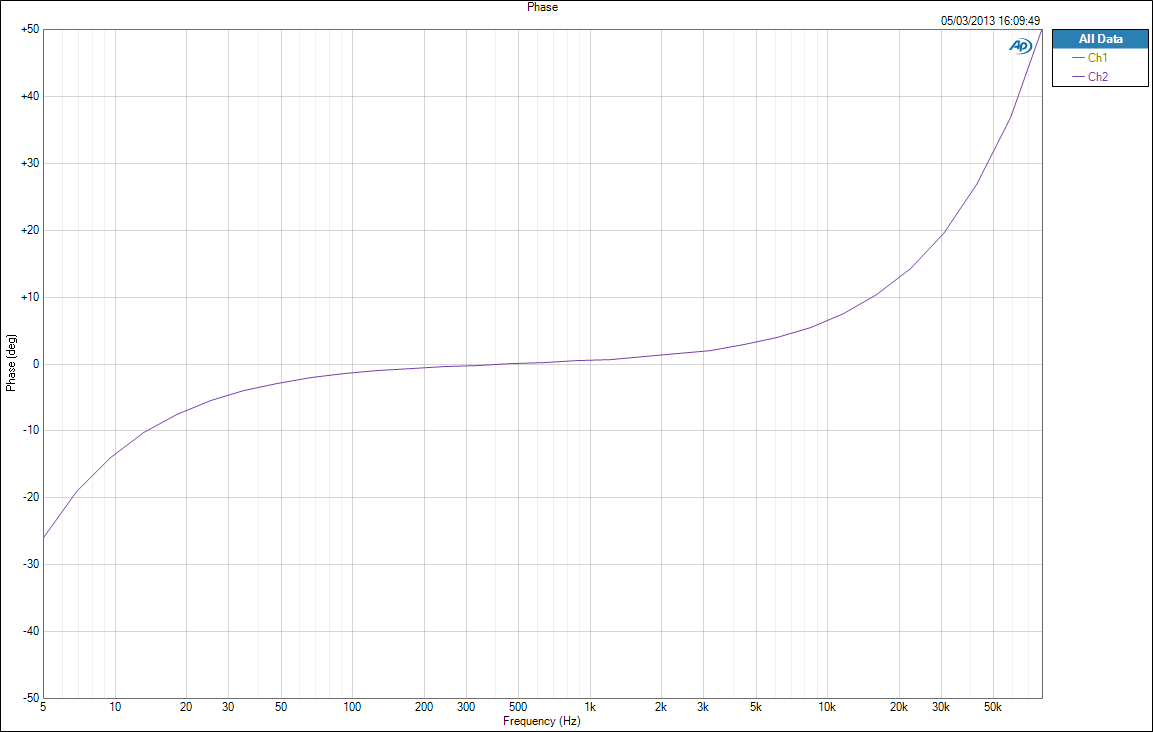
Although our ears are not very sensitive to these typically small relative phase shifts at different frequencies, they do go some way to affecting our perception of different 'flavours' of EQ. More importantly, we have all become completely accustomed to the way analogue EQ alters relative phase with frequency and that's what we expect to hear. These small phase shifts also affect the shape of the amplitude waveform, because the different harmonics are moved in time relative to one another through the action of EQ, as well as changing their amplitudes.
Most digital EQs emulate analogue EQs and so also incorporate similar phase shifts as part of the EQ itself. Linear-phase EQ deliberately doesn't do that... which can be useful in some situations, primarily where you don't want to change the waveform envelope shape.
hugh
-

- Hugh Robjohns
Moderator -
Posts: 43693 Joined: Fri Jul 25, 2003 12:00 am
Location: Worcestershire, UK
Contact:
Technical Editor, Sound On Sound...
(But generally posting my own personal views and not necessarily those of SOS, the company or the magazine!)
In my world, things get less strange when I read the manual...
(But generally posting my own personal views and not necessarily those of SOS, the company or the magazine!)
In my world, things get less strange when I read the manual...
Re: normal EQ vs linear phase EQ
Thanks, as always, Hugh! So is the frequency/phase response the reason why those recent discussions about third-party EQs being no better than bundled DAW EQs are too simplistic? I have to say, it's quite hard to think outside the frequency/amplitude box (especially as it maps so neatly onto how we understand the two dimensions of musical notation!).
Eastwood Records
Re: normal EQ vs linear phase EQ
Hugh Robjohns wrote:We are all used to viewing the audio world in terms of the frequency-amplitude response. That's how we draw filter shapes, and measure the 'quality' of mics, speakers and equipment. But there is also a parallel frequency-phase response -- the two go hand in hand. Changes to one always affect the other in the analogue world.
On another note, how many manufacturers publish stats about the phase response of their equipment? Would this be a useful measurement of quality? I'm always baffled by how many preamps or interfaces, including budget offerings, quote flat frequency responses of 20hz-20khz within a fraction of a decibel. Presumably this is meaingless unless all the frequencies are in phase with each other as well?
Eastwood Records