What's the difference between it and the mic cable?
Is the impedance different?
SOS Pseudo cable
Thanks
SOS Pseudo-balanced Interconnect
SOS Pseudo-balanced Interconnect
-

- Anonymous
Re: SOS Pseudo-balanced Interconnect
No; it's not about impedance and it's very different to a mic cable...
To checkout what pseudo-balanced cables are all about, have a read of THIS.
They're designed to take an unbalanced (signal & ground) jack output and connect to a balanced (signal+, signal- & ground) XLR input and avoiding the dreaded ground-loops.
Physical differences to a mic cable...? Mic has XLR female - this is XLR male; mic has jack input - this is strictly jack output. There are also differences in the pin wiring and there's a resistor inside.
HTH. Mike
To checkout what pseudo-balanced cables are all about, have a read of THIS.
They're designed to take an unbalanced (signal & ground) jack output and connect to a balanced (signal+, signal- & ground) XLR input and avoiding the dreaded ground-loops.
Physical differences to a mic cable...? Mic has XLR female - this is XLR male; mic has jack input - this is strictly jack output. There are also differences in the pin wiring and there's a resistor inside.
HTH. Mike
-
- Mike Stranks
Jedi Poster - Posts: 10589 Joined: Fri Jan 03, 2003 12:00 am
Re: SOS Pseudo-balanced Interconnect
Music Manic wrote:What's the difference between it and the mic cable?
I think Mike has covered it well already, but basically, a mic cable has two signal conductors and an overall screen, each connected directly to their respective XLR pins at each end. It is used to transfer balanced audio at mic or line level.
The pseudo-balanced cable is used to connect an unbalanced source, like a keyboard or unbalanced output equipment, to a balanced destination, with an intellgent wiring configuration that removes the risk of ground loop problems.
Is the impedance different?
Yes and No. The audio signal connection is unchanged, and the only relevant impedance are those of the source and destination. However, the impedance of the screen connection is quite high at audio frequencies to minimise potentially audible ground loop currents but still very low at RF to minimimse interference.
Hugh
-

- Hugh Robjohns
Moderator -
Posts: 43691 Joined: Fri Jul 25, 2003 12:00 am
Location: Worcestershire, UK
Contact:
Technical Editor, Sound On Sound...
(But generally posting my own personal views and not necessarily those of SOS, the company or the magazine!)
In my world, things get less strange when I read the manual...
(But generally posting my own personal views and not necessarily those of SOS, the company or the magazine!)
In my world, things get less strange when I read the manual...
Re: SOS Pseudo-balanced Interconnect
If it conquers a ground loop then yes, it CAN result in lower background noise 
Martin
Martin
-

- Martin Walker
Moderator -
Posts: 22574 Joined: Wed Jan 13, 2010 8:44 am
Location: Cornwall, UK
Contact:
Re: SOS Pseudo-balanced Interconnect
I think it offers further noise reduction than noise caused by ground loops. If my memory is correct-and that's a caveat!-a white paper on the Jensen site suggests substantial noise reduction, which varies with source impedance, when using such cables to connect an unbalanced source to balanced input. It may suggest even further noise improvement using this method when the balanced input employs a transformer. That's with a simple cable arrangement w/o the added components as found in the SOS cable-which may (or not?) be less helpful with ground loops. And perhaps less RF immunity.
Then again, my memory may be incorrect.
Edited later to add:
http://www.jensen-transformers.com/an/an003.pdf
Then again, my memory may be incorrect.
Edited later to add:
http://www.jensen-transformers.com/an/an003.pdf
Re: SOS Pseudo-balanced Interconnect
IIRC the Jensen paper suggests that a really good balanced system, i.e. one that has well matched and large ratio source and sink impedances and one moreover that has a very high (MOhms) common mode input impedance can be very quiet indeed throughout the audio band. It is further mooted that such ultra quiet systems audition better for the lack of "subliminal crud".
That all seems a very reasonable scenario to me?
But such systems are inevitably either transformer balanced, and very good, expensive traffs to boot! Or they use the common mode bootstrapping techniquie that is contained in the THAT corp chip.
Since the SoS lead is not balanced, and excellent tool tho' I am sure it is, such benefits cannot acrue AFAIKS?
Dave.
That all seems a very reasonable scenario to me?
But such systems are inevitably either transformer balanced, and very good, expensive traffs to boot! Or they use the common mode bootstrapping techniquie that is contained in the THAT corp chip.
Since the SoS lead is not balanced, and excellent tool tho' I am sure it is, such benefits cannot acrue AFAIKS?
Dave.
#They did not listen, they are not listening still...Perhaps they never will?#
Re: SOS Pseudo-balanced Interconnect
I'm not aware of this arrangement offering an interface noise advantage. In fact, as the Jensen paper says, there will be a degraded cmrr performance compared to a normal balanced source. However, there will be a significant improvement in ground current noise and that is what this cable is all about.
Hugh
Hugh
-
- Hugh Robjohns
Moderator -
Posts: 43691 Joined: Fri Jul 25, 2003 12:00 am
Location: Worcestershire, UK
Contact:
Technical Editor, Sound On Sound...
(But generally posting my own personal views and not necessarily those of SOS, the company or the magazine!)
In my world, things get less strange when I read the manual...
(But generally posting my own personal views and not necessarily those of SOS, the company or the magazine!)
In my world, things get less strange when I read the manual...
Re: SOS Pseudo-balanced Interconnect
Any noise advantage will be highly dependent on the input stage topology (And in fact some balanced inputs are actually noisier then their unbalanced counterparts, but the stage noise is usually so small in either case that the advantages outweigh the addition noise).
The point of this cable is simply that is is a way to reduce interference from ground loops interacting with gear with unbalanced outputs or poorly thought out balanced inputs. It is an interference reduction measure, not a noise reduction one.
Regards, Dan.
The point of this cable is simply that is is a way to reduce interference from ground loops interacting with gear with unbalanced outputs or poorly thought out balanced inputs. It is an interference reduction measure, not a noise reduction one.
Regards, Dan.
Audiophiles use phono leads because they are unbalanced people!
Re: SOS Pseudo-balanced Interconnect
Ok Time to get the credit card out.
It will come in useful for my guitar preamp and D.I right.
Will an XLR to stereo Phono cable be available on the same basis?
Thanks
It will come in useful for my guitar preamp and D.I right.
Will an XLR to stereo Phono cable be available on the same basis?
Thanks
-
- Guest
Re: SOS Pseudo-balanced Interconnect
Music Manic wrote:It will come in useful for my guitar preamp and D.I right.
If the guitar preamplifier has an unbalanced output and you want to connect it to a balanced line input, then the SOS pseudo-balanced cable will be beneficial in avoiding potential ground loop issues.
DI boxes have balanced mic level outputs by default and this cable is inappropriate in that application.
Witll an XLR to stereo Phono cable be available on the same basis?
No. That is a different problem to solve and far more equipment specific, making a generic cable impossible to make or sell cost-effectively.
Hugh
-
- Hugh Robjohns
Moderator -
Posts: 43691 Joined: Fri Jul 25, 2003 12:00 am
Location: Worcestershire, UK
Contact:
Technical Editor, Sound On Sound...
(But generally posting my own personal views and not necessarily those of SOS, the company or the magazine!)
In my world, things get less strange when I read the manual...
(But generally posting my own personal views and not necessarily those of SOS, the company or the magazine!)
In my world, things get less strange when I read the manual...
Re: SOS Pseudo-balanced Interconnect
I've just brought one and was wondering if it works the other way around. For example,guitar to preamp?
Thanks
Thanks
-
- Guest
Re: SOS Pseudo-balanced Interconnect
Music Manic wrote:I've just brought one and was wondering if it works the other way around. For example,guitar to preamp?
Thanks
Well, you can't have an earth loop with just a guitar but if you were splitting same to an amp?
Dave.
#They did not listen, they are not listening still...Perhaps they never will?#
Re: SOS Pseudo-balanced Interconnect
Music Manic wrote:I've just brought one and was wondering if it works the other way around. For example,guitar to preamp?
No. That's not what it's for, and not suited to that kind of interface.
The normal guitar to guitar preamplifier interface is an unbalanced high impedance system, and there can be no ground loop because the guitar is only grounded via it's output.
You can't feed a guitar into a balanced mic preamp because the impedances are all wrong, and this cable doesn't address that.
The SOS pseudo-balanced cable is specifically and exclusively for connecting low impedance unbalanced instrument and line level equipment to normal balanced line level inputs, where it is desirable to prevent or avoid a ground loop.
Hugh
-
- Hugh Robjohns
Moderator -
Posts: 43691 Joined: Fri Jul 25, 2003 12:00 am
Location: Worcestershire, UK
Contact:
Technical Editor, Sound On Sound...
(But generally posting my own personal views and not necessarily those of SOS, the company or the magazine!)
In my world, things get less strange when I read the manual...
(But generally posting my own personal views and not necessarily those of SOS, the company or the magazine!)
In my world, things get less strange when I read the manual...
Re: SOS Pseudo-balanced Interconnect
Ah! Ok, thanks.
I thought it was designed to get rid of magnetic interference too! Just my imagination running away with me.
I thought it was designed to get rid of magnetic interference too! Just my imagination running away with me.
-
- Guest
Re: SOS Pseudo-balanced Interconnect
Nope. That's achieved by the tightly twisted pair of signal wires, in concert with closely matched source and destination impedances to ground for each wire, and the differential input of a normal balanced interface.
And the star-quad cable configuration does it even better.
Hugh
And the star-quad cable configuration does it even better.
Hugh
-
- Hugh Robjohns
Moderator -
Posts: 43691 Joined: Fri Jul 25, 2003 12:00 am
Location: Worcestershire, UK
Contact:
Technical Editor, Sound On Sound...
(But generally posting my own personal views and not necessarily those of SOS, the company or the magazine!)
In my world, things get less strange when I read the manual...
(But generally posting my own personal views and not necessarily those of SOS, the company or the magazine!)
In my world, things get less strange when I read the manual...
Re: SOS Pseudo-balanced Interconnect
Thanks Hugh!
SOS have got 22 quid out me. AGAIN!!
SOS have got 22 quid out me. AGAIN!!
-
- Guest
Re: SOS Pseudo-balanced Interconnect
Hello all, First time poster here - I've decided it'd be good to get in on the action!
I've recently made up my first pseudo balanced cable but was wondering if anyone could give me some advice on some of the side affects Ive found when using it...
I suspect they're probably part and parcel of using cables in this way but I just wanted to check with some more experienced studio folk if this is the case.
In short the problem I've found is that if I direct monitor the stage piano I've plugged into my sound card using the Pseudo balanced cable whilst the piano is switched off, I get a very loud humming sound in my monitors. When the piano is switched on the hum disappears so it obviously isn't a problem during practical use but I was wondering if this is normal when using P.B. cables?
The cable was made with the cold wire connected to the shield pin at the instrument end and the the shield wire left disconnected but cut back appropriately. I think this follows the instructions I've seen in the SOS article on making them listed here
http://www.soundonsound.com/sos/jul05/a ... 0705_1.htm
I haven't got round to trying reconnecting the shield wire to the shield pin with a resistor in series yet, might this remedy my problem?
My set up is as follows,
mac book pro
emu soundcard with balanced ins and monitor outs running off bus power
m audio pro keys stage piano
the stage piano is wired with the audio running to the emu via the pseudo balanced cable and midi via USB to the macbook
My thinking is that the hum is due to the open shield wire in the pseudo balanced cable going into the sound card, but since this is an integral part of making the cable I thought I might have heard someone mention this side affect earlier?
Using the cable still remedies many other little studio gremlins so this isn't a major issue, but I'm just curious to hear what you've got to say.
Any feedback is greatly appreciated!
Thanks
Ben
I've recently made up my first pseudo balanced cable but was wondering if anyone could give me some advice on some of the side affects Ive found when using it...
I suspect they're probably part and parcel of using cables in this way but I just wanted to check with some more experienced studio folk if this is the case.
In short the problem I've found is that if I direct monitor the stage piano I've plugged into my sound card using the Pseudo balanced cable whilst the piano is switched off, I get a very loud humming sound in my monitors. When the piano is switched on the hum disappears so it obviously isn't a problem during practical use but I was wondering if this is normal when using P.B. cables?
The cable was made with the cold wire connected to the shield pin at the instrument end and the the shield wire left disconnected but cut back appropriately. I think this follows the instructions I've seen in the SOS article on making them listed here
http://www.soundonsound.com/sos/jul05/a ... 0705_1.htm
I haven't got round to trying reconnecting the shield wire to the shield pin with a resistor in series yet, might this remedy my problem?
My set up is as follows,
mac book pro
emu soundcard with balanced ins and monitor outs running off bus power
m audio pro keys stage piano
the stage piano is wired with the audio running to the emu via the pseudo balanced cable and midi via USB to the macbook
My thinking is that the hum is due to the open shield wire in the pseudo balanced cable going into the sound card, but since this is an integral part of making the cable I thought I might have heard someone mention this side affect earlier?
Using the cable still remedies many other little studio gremlins so this isn't a major issue, but I'm just curious to hear what you've got to say.
Any feedback is greatly appreciated!
Thanks
Ben
mac book pro osx mavericks / Mbox 2 mini / m audio BX8a monitos / M Audio pro keys 88 stage piano .
Re: SOS Pseudo-balanced Interconnect
Morning Ben,
The problem is almost certainly in the design of the output stage of the stage piano. When not powered there is effectively no load on the output and thus the following input "sees" a very high impedance and hum intrudes.
I get the same effect with my HP laptop. If I feed the headphone output to a pair of powered speakers either side of my telly I get nice clean sound whilst lappy is running but if I shut it down the speakers hum. It would be a simple matter to make a load box with a couple of 1ks in it if I chose to shift my sorry A!
Similary my ZED 10/2496 combination is marginally quieter with the mixer powered up than off.
Dave.
The problem is almost certainly in the design of the output stage of the stage piano. When not powered there is effectively no load on the output and thus the following input "sees" a very high impedance and hum intrudes.
I get the same effect with my HP laptop. If I feed the headphone output to a pair of powered speakers either side of my telly I get nice clean sound whilst lappy is running but if I shut it down the speakers hum. It would be a simple matter to make a load box with a couple of 1ks in it if I chose to shift my sorry A!
Similary my ZED 10/2496 combination is marginally quieter with the mixer powered up than off.
Dave.
#They did not listen, they are not listening still...Perhaps they never will?#
Re: SOS Pseudo-balanced Interconnect
Hi Dave. Thanks for the reply. I can imagine it being some sort of problem with my keyboard, it was only a fairly cheap one off e bay.
I'm not overly big on my electronics, is there an SOS article or similar on making a load box?
It doesn't cause me an overly big problem, it'd just be nice not to get an aggressive loud hum every time I forget to turn my monitors off before my keyboard.
One edit I've noticed is that the loud hum only occurs when the keyboard is switched off AND the USB from the keyboard to the macbook is disconnected. When the USB is connected and the and keyboard is switched off I just hear a much quieter digital sounding hum. This disappears when it's switched on though as you'd expect with the Pseudo cable its run through.
Thanks
Ben
I'm not overly big on my electronics, is there an SOS article or similar on making a load box?
It doesn't cause me an overly big problem, it'd just be nice not to get an aggressive loud hum every time I forget to turn my monitors off before my keyboard.
One edit I've noticed is that the loud hum only occurs when the keyboard is switched off AND the USB from the keyboard to the macbook is disconnected. When the USB is connected and the and keyboard is switched off I just hear a much quieter digital sounding hum. This disappears when it's switched on though as you'd expect with the Pseudo cable its run through.
Thanks
Ben
mac book pro osx mavericks / Mbox 2 mini / m audio BX8a monitos / M Audio pro keys 88 stage piano .
Re: SOS Pseudo-balanced Interconnect
You can make a load pretty simply and cheaply with two jack sockets wired pin to pin and a 10kOhm resistors connected hot to shield.
Insert that in the line and see if it solved the problem. If so, buy a wee ally box from Maplin and do a proper job.
(I know I mentioned ONE k resistors but that was for a headphone output. The cheap chips in a cheap synth will not like so low a load.)
Dave.
Insert that in the line and see if it solved the problem. If so, buy a wee ally box from Maplin and do a proper job.
(I know I mentioned ONE k resistors but that was for a headphone output. The cheap chips in a cheap synth will not like so low a load.)
Dave.
#They did not listen, they are not listening still...Perhaps they never will?#
Re: SOS Pseudo-balanced Interconnect
Like this? 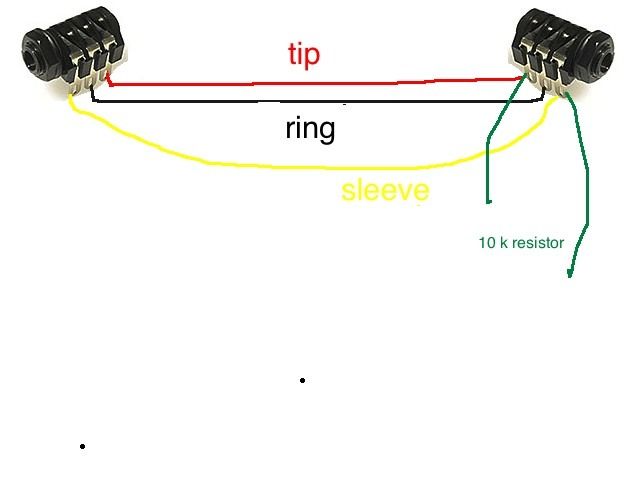
You'll have to pardon the simplicity of the drawing, lol.
If so would I still be inserting my pseudo balanced cable out of it into my soundcard?
thanks
Ben
You'll have to pardon the simplicity of the drawing, lol.
If so would I still be inserting my pseudo balanced cable out of it into my soundcard?
thanks
Ben
mac book pro osx mavericks / Mbox 2 mini / m audio BX8a monitos / M Audio pro keys 88 stage piano .
Re: SOS Pseudo-balanced Interconnect
Even simpler Ben.
I am assuming the output of the piano is an a TS jack? So just mono jacks pin for pin +10k.
Dave.
I am assuming the output of the piano is an a TS jack? So just mono jacks pin for pin +10k.
Dave.
#They did not listen, they are not listening still...Perhaps they never will?#
Re: SOS Pseudo-balanced Interconnect
Hi Ben,
I think I may have an alternative theory as to what's happening here...
Would I be right in thinking that the keyboard is a 'Class II' or double insulated device? The label next to the power socket will have that 'box within a box' symbol and the mains lead -- if removable -- will have two pins/sockets rather than three. or, more likely, you havea an external class II wall wart supply and a two-pole DC lead to the piano?
I think there are two issues here. One is the lack of (active) loading when the keyboard is turned off, as Dave has suggested already. But that is only accounting for the very modest background hum you notice when the keyboard is off but the USB is still connected.
The reason the hum suddenly becomes so much louder when you disconnect the USB lead is, I think, because that also removes the screening ground, and so the entire keyboard then acts as an aerial, instead of being an integral part of the macbook's ground plane.
The obvious solution is not to disconnect the USB until after you've turned off the speakers...
However, the alternative is to fit a ground lead to tie the keyboard ground permanently to a proper earth -- which would stop it acting as an aerial. Quite how you would achieve that depends on what electrical skills and facilities are available....
As a quick and dirty test, try getting a length of wire and wrap one end around the metal body of the output plug on the keyboard. The other end needs to go to a known good earth, which could be anything from one of the wall mounting screws of a mains socket, to the metal enclosure of any Class 1 grounded electrical device (which is plugged into a wall socket).
I think with that wire in place you'll find that the big hum no longer happens when you disconnect the USB. You might even find that the little hum gets littler as well!
This solution introduces another ground point in the system which potentially sets up a ground loop... but you'll have no problem with that because you're already using our fabulous pseudo-balanced cables!
hugh
I think I may have an alternative theory as to what's happening here...
BenConvey wrote:I've noticed ... that the loud hum only occurs when the keyboard is switched off AND the USB from the keyboard to the macbook is disconnected. When the USB is connected and the and keyboard is switched off I just hear a much quieter digital sounding hum. This disappears when it's switched on though as you'd expect with the Pseudo cable its run through.
Would I be right in thinking that the keyboard is a 'Class II' or double insulated device? The label next to the power socket will have that 'box within a box' symbol and the mains lead -- if removable -- will have two pins/sockets rather than three. or, more likely, you havea an external class II wall wart supply and a two-pole DC lead to the piano?
I think there are two issues here. One is the lack of (active) loading when the keyboard is turned off, as Dave has suggested already. But that is only accounting for the very modest background hum you notice when the keyboard is off but the USB is still connected.
The reason the hum suddenly becomes so much louder when you disconnect the USB lead is, I think, because that also removes the screening ground, and so the entire keyboard then acts as an aerial, instead of being an integral part of the macbook's ground plane.
The obvious solution is not to disconnect the USB until after you've turned off the speakers...
However, the alternative is to fit a ground lead to tie the keyboard ground permanently to a proper earth -- which would stop it acting as an aerial. Quite how you would achieve that depends on what electrical skills and facilities are available....
As a quick and dirty test, try getting a length of wire and wrap one end around the metal body of the output plug on the keyboard. The other end needs to go to a known good earth, which could be anything from one of the wall mounting screws of a mains socket, to the metal enclosure of any Class 1 grounded electrical device (which is plugged into a wall socket).
I think with that wire in place you'll find that the big hum no longer happens when you disconnect the USB. You might even find that the little hum gets littler as well!
This solution introduces another ground point in the system which potentially sets up a ground loop... but you'll have no problem with that because you're already using our fabulous pseudo-balanced cables!
hugh
-
- Hugh Robjohns
Moderator -
Posts: 43691 Joined: Fri Jul 25, 2003 12:00 am
Location: Worcestershire, UK
Contact:
Technical Editor, Sound On Sound...
(But generally posting my own personal views and not necessarily those of SOS, the company or the magazine!)
In my world, things get less strange when I read the manual...
(But generally posting my own personal views and not necessarily those of SOS, the company or the magazine!)
In my world, things get less strange when I read the manual...