I looked up a spoken word dynamic mic shoot out thanks to Bob Bickerton who was advising me on mics on another thread, and the question was asked as to why all the mics under review for radio and podcasting were dynamics - answer:
"Dynamic microphones tend to be less sensitive than condensers, so they “hear” mostly what’s in front of the mic rather than whatever is going on in the next room. For recordings made in non-optimal spaces — like, say, 99% of podcasts — this is a huge benefit."
I'm sure this was getting discussed on here not too long ago, and maybe it's just an odd use of language that is perfectly legit, but I've often wondered about this, and the related question of why condensers might be more susceptible to feedback on stage. It's demonstrably true as a rule of thumb in my experience, but I have come to believe as I learned how to do live sound that it is to do with polar patterns, a comparative sensitivity to mechanical noise, sometimes exaggerated top end and the fact that you can't eat them and sing into them at the same time the way you can with dynamics.
And yet the paragraph above seems to be like something I have heard before which is people talking about condensers and dynamics as though somehow the zone within which a dynamic will pick you up is smaller than that of a condenser - or to put it another way, that the mic can tell how far away from it the sound source is, and that the sensitivity of a dynamic mic drops off more quickly as you move away - hence the line above about "they “hear” mostly what’s in front of the mic rather than whatever is going on in the next room". The thing is, thinking about it this way often actually pans out in real life, particularly live, but surely all that's going on with "the next room" is that you're much closer to the dynamic's capsule than you would be with an LDC, and also that it maybe has a tighter polar pattern in vocal frequency range (or something...)
Thoughts?
Condensers, dynamics, sensitivity and gain.
Condensers, dynamics, sensitivity and gain.
-

- molecular
Frequent Poster -
Posts: 1318 Joined: Sat Dec 13, 2003 12:00 am
Location: Skye / Stroud / Seyðisfjorður
Contact:
Anto mo Ninja, Watashi mo Ninja http://www.hectormacinnes.com
Re: Condensers, dynamics, sensitivity and gain.
You're right. Mics cant "reach out" and grab more distant sounds. They can only respond to the pressure waves that appear at their diaphragms. (There's a good response to this in the Shure company's educational notes on mics).
Even a shotgun mic cant "reach out" to the more distant sounds. It can only more effectively reject unwanted sounds from certain directions.
It's true that a less sensitive mic will mean quieter sounds (whether they are far away or close is immaterial) will be the first to be lost in system noise. But adding system noise to mask unwanted room noise, by say choosing a low sensitivity mic (and/or a noisy preamp!), is not usually ideal. For it will also mask quiet sounds close to the mic, not least the quiet vocalist! Far better to get the wanted voice level well above the unwanted room sounds in the first place.
Even a shotgun mic cant "reach out" to the more distant sounds. It can only more effectively reject unwanted sounds from certain directions.
It's true that a less sensitive mic will mean quieter sounds (whether they are far away or close is immaterial) will be the first to be lost in system noise. But adding system noise to mask unwanted room noise, by say choosing a low sensitivity mic (and/or a noisy preamp!), is not usually ideal. For it will also mask quiet sounds close to the mic, not least the quiet vocalist! Far better to get the wanted voice level well above the unwanted room sounds in the first place.
-
- Tim Gillett
Frequent Poster - Posts: 2707 Joined: Wed Jan 30, 2013 12:00 am Location: Perth, Western Australia
Re: Condensers, dynamics, sensitivity and gain.
I'm probably way off the mark but I think it's because condenser diaphragms are made of a thin foil and dynamics made of a much more dense material.
Imaging blowing at a bit of kitchen foil from a meter away and then blowing at a bit of card from the same distance with the same power. The foil will flap about more than the card.
So to put that into the next room context- Sound waves coming from the next room will still have the power to move the foil whereas it will be too weak to move the dynamic mic diaphragm.
No doubt one of the experts will come along shortly and disprove my theory but at least then you should get a good answer!
Chris
Imaging blowing at a bit of kitchen foil from a meter away and then blowing at a bit of card from the same distance with the same power. The foil will flap about more than the card.
So to put that into the next room context- Sound waves coming from the next room will still have the power to move the foil whereas it will be too weak to move the dynamic mic diaphragm.
No doubt one of the experts will come along shortly and disprove my theory but at least then you should get a good answer!
Chris
-
- gingertimmins
Regular - Posts: 498 Joined: Wed Dec 05, 2007 12:00 am
Re: Condensers, dynamics, sensitivity and gain.
molecular wrote:"Dynamic microphones tend to be less sensitive than condensers, so they “hear” mostly what’s in front of the mic rather than whatever is going on in the next room.
Sensitivity is determined by a number of factors. For example, there's the basic electrical sensitivity -- the ability to convert the diaphragm's mechanical movement into a varying electrical voltage, and there's the willingness of the diaphragm to move in response to changing air pressure.
Electromagnetic (dynamic) mics are generally low on both, while electostatic (capacitor) mics are usually relatively high on both.
For dynamics, the electrical sensitivity is determined by the number of wire turns in the voicecoil and the strength of the magnet, and getting more of both makes the mic bigger and causes other problems. And the diaphragm is relatively massive (heavy) because of the copper wire coils glued on the back. This means it isn't very interested in moving for weak or high frequency sounds.
In contrast the electrostatic diaphragm has nothing else attached and so moves in response to quiet and high frquency sounds very easily. More sensitivity/headroom is achieved with more polarising voltage, which is also relatively easy to achieve.
H
-

- Hugh Robjohns
Moderator -
Posts: 43684 Joined: Fri Jul 25, 2003 12:00 am
Location: Worcestershire, UK
Contact:
Technical Editor, Sound On Sound...
(But generally posting my own personal views and not necessarily those of SOS, the company or the magazine!)
In my world, things get less strange when I read the manual...
(But generally posting my own personal views and not necessarily those of SOS, the company or the magazine!)
In my world, things get less strange when I read the manual...
Re: Condensers, dynamics, sensitivity and gain.
I think we tackled this one in our 'audio myths' article a while back. If two mics have the same frequency response and polar pattern, they will pick up the same ratio of close to distant sound. It simply isn't possible for a microphone to discriminate between near and far sounds.
The reason that dynamic mics often give a drier sound in practice is simply because they are mostly designed to be used close to the performer.
The reason that dynamic mics often give a drier sound in practice is simply because they are mostly designed to be used close to the performer.
-
- Sam Inglis
Moderator - Posts: 3228 Joined: Fri Dec 15, 2000 12:00 am
Re: Condensers, dynamics, sensitivity and gain.
Sam Inglis wrote:If two mics have the same frequency response and polar pattern, they will pick up the same ratio of close to distant sound.
Absolutely. Basic physics, innit!
 But dynamic mics usually have a noticeably curtailed HF response compared to capacitor mics (for the reasons highlighted above), and since their diaphragm's have more inertia they are inherently less sensitive to low level sounds.
 It simply isn't possible for a microphone to discriminate between near and far sounds.
I'm not sure that's strictly true. Any diaphragm needs a certain minimum pressure difference to cause it to move. That minimum is considerably higher for a dynamic mic than a capacitor mic. And for a given SPL from a source, the resulting air pressure decreases with increasing distance. So a dynamic mic is likely to cease to generate any useful output at a shorter distance from the source than a capacitor mic... All other aspects being equal
The reason that dynamic mics often give a drier sound in practice is simply because they are mostly designed to be used close to the performer.
Also very true. They are generally designed to sound balanced when placed close to the source, and so for sources at greater distances the absent proximity effect means that the mic is inherently less sensitive to mid and low frequency signals... which are the ones carrying most audio energy anyway.
H
-
- Hugh Robjohns
Moderator -
Posts: 43684 Joined: Fri Jul 25, 2003 12:00 am
Location: Worcestershire, UK
Contact:
Technical Editor, Sound On Sound...
(But generally posting my own personal views and not necessarily those of SOS, the company or the magazine!)
In my world, things get less strange when I read the manual...
(But generally posting my own personal views and not necessarily those of SOS, the company or the magazine!)
In my world, things get less strange when I read the manual...
Re: Condensers, dynamics, sensitivity and gain.
Hugh Robjohns wrote:Any diaphragm needs a certain minimum pressure difference to cause it to move. That minimum is considerably higher for a dynamic mic than a capacitor mic. And for a given SPL from a source, the resulting air pressure decreases with increasing distance. So a dynamic mic is likely to cease to generate any useful output at a shorter distance from the source than a capacitor mic... All other aspects being equal
That's interesting - so in some ways the inertia of a dynamic mic's capsule almost acts as a very low threshold expander/gate on the room sound...?
But presumably we're talking about a VERY low threshold here... would it be high enough to make any noticeable difference to domestic/stage room reflections or any practical problems such as someone talking on the phone in an adjacent room...?
-
- molecular
Frequent Poster -
Posts: 1318 Joined: Sat Dec 13, 2003 12:00 am
Location: Skye / Stroud / Seyðisfjorður
Contact:
Anto mo Ninja, Watashi mo Ninja http://www.hectormacinnes.com
Re: Condensers, dynamics, sensitivity and gain.
It's mostly been said, but at a practical level it's simply because dynamic mics (of the kind being discussed) are designed to be worked very close relative to condensers so distant sounds are simply attenuated relative to the close source.
Bob
Bob
-

- Bob Bickerton
Longtime Poster -
Posts: 5634 Joined: Fri Dec 20, 2002 12:00 am
Location: Nelson, New Zealand
Contact:
Re: Condensers, dynamics, sensitivity and gain.
molecular wrote:Hugh Robjohns wrote:Any diaphragm needs a certain minimum pressure difference to cause it to move. That minimum is considerably higher for a dynamic mic than a capacitor mic. And for a given SPL from a source, the resulting air pressure decreases with increasing distance. So a dynamic mic is likely to cease to generate any useful output at a shorter distance from the source than a capacitor mic... All other aspects being equal
That's interesting - so in some ways the inertia of a dynamic mic's capsule almost acts as a very low threshold expander/gate on the room sound...?
But presumably we're talking about a VERY low threshold here... would it be high enough to make any noticeable difference to domestic/stage room reflections or any practical problems such as someone talking on the phone in an adjacent room...?
Personally I have my doubts whether a dynamic will act as an expander on quiet sounds. The practical limitation on a dynamic reproducing quiet sounds seems to be preamp noise. The preamp noise will of course mask quiet sounds (whether near or far from the mic) but it's a different effect from a downwards expander. Still in practice the masking effect will have a similar result in that quiet sounds below a certain threshold will become less audible, almost as if they were downwards expanded.
-
- Tim Gillett
Frequent Poster - Posts: 2707 Joined: Wed Jan 30, 2013 12:00 am Location: Perth, Western Australia
Re: Condensers, dynamics, sensitivity and gain.
Bob Bickerton wrote:It's mostly been said, but at a practical level it's simply because dynamic mics (of the kind being discussed) are designed to be worked very close relative to condensers so distant sounds are simply attenuated relative to the close source.
Yeah, well this is basically what I'd always thought, although Hugh's point is very interesting... but as has also been suggested it's sort of neither here nor there if that threshold of the dynamic capsule "kicking in" is so low as to be below the noise level of a good preamp...
I suppose as I said in the original post, it's maybe just a particular use of language, but it's interesting that it remains so common to talk about dynamics as though they meaningfully reject noises beyond a certain distance away, even among people who I know have a lot more experience than I do. It is one of those instances where the practical implications of a theory coincide with reality even if the theory is actually incorrect in some ways... I'm sure there is a term for that.
-
- molecular
Frequent Poster -
Posts: 1318 Joined: Sat Dec 13, 2003 12:00 am
Location: Skye / Stroud / Seyðisfjorður
Contact:
Anto mo Ninja, Watashi mo Ninja http://www.hectormacinnes.com
Re: Condensers, dynamics, sensitivity and gain.
Picking up the 'room', compared to the source, is a ratio thing: How close to the capsule the sound source is compared to the far sound. The mic's pickup pattern will alter this ratio.
Sensitivity (output) of a mic is how much welly the mic gives out, combined with the gain of the mic pre, so too little output and the mic pre can be working too hard and will produce noise, and pick up more electrical interference. And with too much output, and you may well overload a bad (or old design) mic pre with a modern dynamic, or a sensitive condenser.
Mic-wise, more sensitive is not "better", and less is not "worse". They are just specifications that need to be taken into account with the task at hand and the equipment to hand.
Sensitivity (output) of a mic is how much welly the mic gives out, combined with the gain of the mic pre, so too little output and the mic pre can be working too hard and will produce noise, and pick up more electrical interference. And with too much output, and you may well overload a bad (or old design) mic pre with a modern dynamic, or a sensitive condenser.
Mic-wise, more sensitive is not "better", and less is not "worse". They are just specifications that need to be taken into account with the task at hand and the equipment to hand.
-

- Guy Johnson
Frequent Poster -
Posts: 1336 Joined: Fri May 02, 2003 12:00 am
Location: North Pembrokeshire
Contact:
This is my few words.
Re: Condensers, dynamics, sensitivity and gain.
Guy Johnson wrote:Picking up the 'room', compared to the source, is a ratio thing: How close to the capsule the sound source is compared to the far sound. The mic's pickup pattern will alter this ratio.
Absolutely... but I wonder if there's something else going on here to confuse the issue? When people talk about capacitor mics on stage, they are generally talking about large-diaphragm capacitor mics, not SDCs.
And in fact there are plenty of SDC capacitor mics used on stage without any problems -- the Neumann KMS 105, or the Shure SM87A, are just two popular and well known examples.
So what's the difference between these capacitor stage mics and general purpose LDC capacitor mics? The number of diaphragms involved!
Few people seem to know and understand the difference between single-diaphragm cardioid capsules -- which pervade the vast majority of dynamic and hand-held stage capacitor mics -- and dual-diaphragm or Braunmuhl-Weber capsules which pervade most LDC capacitor mics. (The dual-diaphragm capsule is an essential component of switched-pattern mics, of course).
The science is a little complex but in essence, when switched to cardioid mode, although the rear diaphragm on a B-W capsule becomes electrically inactive it still acts as the first element of the rear path acoustic network, providing additional compliance at LF. This additional compliance obviously isn't present in a single-diaphragm capsule.
The rear diaphragm's compliance acts to reduce the amount of LF reaching the rear of the active front diaphragm -- especially for distant sources -- and the effect is to change (often quite dramatically) the strength of the proximity effect (as well as the capsule's susceptibility to popping). This is the primary reason why virtually every LDC vocal mic uses a B-W capsule, even if it is a fixed cardioid pattern mic -- simply because it works better, with less variable bass performance, with close vocalists!
However, the polar response also behaves differently with both frequency and source distance, as this diagram shows:
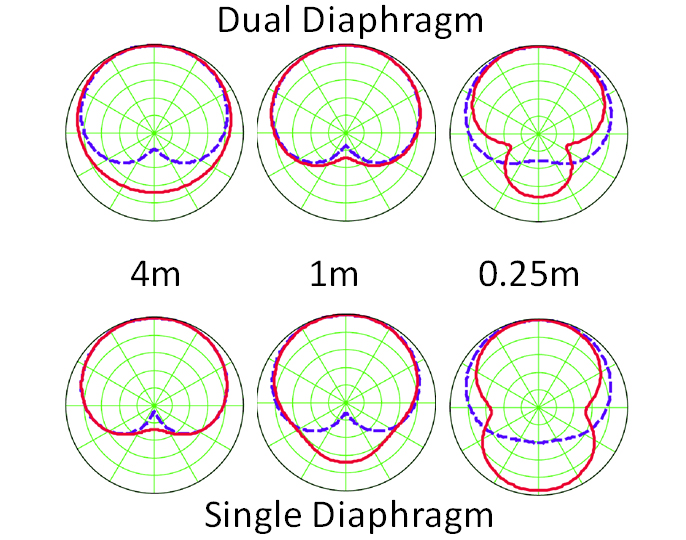
So, what happens if you swap out a (single-diaphragm) dynamic mic for a (dual-diaphragm B-W) capacitor mic?
For starters, the B-W capacitor mic has much less proximity effect than the single-diaphragm dynamic mic, and so the manufacturer will not have equalised it so strongly to be flat with close sources. This means that the lower end of the frequency spectrum of more distant sources will also be captured at a far greater level than the dynamic mic would have done. So the LF spill and room tone will inherently appear to be much greater with the LDC for a given source distance.
In addition, whereas a single-diaphragm mic retains a good cardioid polar response across all frequencies for distant sources, the dual-diaphragm B-W capsule becomes significantly more omnidirectional at LF -- again making it much more prone to picking up unwanted LF spill and room sound than the neat cardioid LF response of the single-diaphragm mic.
Since the LF end of the spectrum carries way more energy than the mid and HF ends, it's not really surprising that the instant impression of swapping out a dynamic mic for a LDC (B-W) capacitor mic is that the latter picks up a lot more room/spill...
Just a thought that might help to further explain what's going on in this complex situation...
If the opportunity arises I'll try to rig up some comparisons of single-diaphragm dynamic and capacitor mics, with a dual-diaphragm capacitor mic, to compare and contrast the spill pickup to illustrate this more clearly.
H
-
- Hugh Robjohns
Moderator -
Posts: 43684 Joined: Fri Jul 25, 2003 12:00 am
Location: Worcestershire, UK
Contact:
Technical Editor, Sound On Sound...
(But generally posting my own personal views and not necessarily those of SOS, the company or the magazine!)
In my world, things get less strange when I read the manual...
(But generally posting my own personal views and not necessarily those of SOS, the company or the magazine!)
In my world, things get less strange when I read the manual...
Re: Condensers, dynamics, sensitivity and gain.
This "room pickup" myth regarding capacitor microphones is very widespread and in many cases it is difficult to have a rational conversation about it on some forums!
My take on the matter is that people tend to set gains on AIs and mixers to where they THINK they should be and are then surprised when an LDC picks up the clock in the next room.
I have pointed out more than once (usually to no avail) That a typical dynamic will have a sensitivity of 2mV/Pa or less whereas even a modest LDC will be around 20mV/Pa. If we take the max gain of many mid priced AIs as 60dB then just plugging in a big cap mic is in effect having an 80dB mic pre! I don't have an 80dB pre to hand but I bet my SM57 would pickup just as much as my Sontronics STC-2 does into my KA6 if I did!
Incidentally, when I got back into audio and recording some 9 years ago, I was staggered how much the sensitivity of microphones had increased in the 20yrs or so I had spent in the wilderness! It took me a month or two to realize that the mic mnfctrs now used about 90dBSPL as the reference level! In my day it was 70dB (might have been 75dB?)
Dave.
My take on the matter is that people tend to set gains on AIs and mixers to where they THINK they should be and are then surprised when an LDC picks up the clock in the next room.
I have pointed out more than once (usually to no avail) That a typical dynamic will have a sensitivity of 2mV/Pa or less whereas even a modest LDC will be around 20mV/Pa. If we take the max gain of many mid priced AIs as 60dB then just plugging in a big cap mic is in effect having an 80dB mic pre! I don't have an 80dB pre to hand but I bet my SM57 would pickup just as much as my Sontronics STC-2 does into my KA6 if I did!
Incidentally, when I got back into audio and recording some 9 years ago, I was staggered how much the sensitivity of microphones had increased in the 20yrs or so I had spent in the wilderness! It took me a month or two to realize that the mic mnfctrs now used about 90dBSPL as the reference level! In my day it was 70dB (might have been 75dB?)
Dave.
#They did not listen, they are not listening still...Perhaps they never will?#
Re: Condensers, dynamics, sensitivity and gain.
ef37a wrote:It took me a month or two to realize that the mic mnfctrs now used about 90dBSPL as the reference level! In my day it was 70dB (might have been 75dB?)
I can't remember when the international standard reference for sound pressure became 1 Pascal (1 Pa or 1N/m2) which is 94dB SPL, but it was a very long time ago. Presumably in the mid 60s when the SI system was widely adopted.
Back in the dark ages (when I was still a twinkle in my father's eye), most mic manufacturers used to specify mic sensitivity relative to a lower CGS reference of 1 microbar or 1 dyne per square cm -- both being the equivalent of a sound pressure level of 74dB SPL. (1Pa is equivalent to 10ubar or 10dyne/cm2).
But that doesn't actually mean typical mic sensitivity has changed at all, it just gave lower numbers because it had a lower reference level.
20mV/Pa for a modern capacitor mic is the same as 2mV/ubar or 2mV/dyne/cm2.
H
-
- Hugh Robjohns
Moderator -
Posts: 43684 Joined: Fri Jul 25, 2003 12:00 am
Location: Worcestershire, UK
Contact:
Technical Editor, Sound On Sound...
(But generally posting my own personal views and not necessarily those of SOS, the company or the magazine!)
In my world, things get less strange when I read the manual...
(But generally posting my own personal views and not necessarily those of SOS, the company or the magazine!)
In my world, things get less strange when I read the manual...
Re: Condensers, dynamics, sensitivity and gain.
Hugh Robjohns wrote:ef37a wrote:It took me a month or two to realize that the mic mnfctrs now used about 90dBSPL as the reference level! In my day it was 70dB (might have been 75dB?)
I can't remember when the international standard reference for sound pressure became 1 Pascal (1 Pa or 1N/m2) which is 94dB SPL, but it was a very long time ago. Presumably in the mid 60s when the SI system was widely adopted.
Back in the dark ages (when I was still a twinkle in my father's eye), most mic manufacturers used to specify mic sensitivity relative to a lower CGS reference of 1 microbar or 1 dyne per square cm -- both being the equivalent of a sound pressure level of 74dB SPL. (1Pa is equivalent to 10ubar or 10dyne/cm2).
But that doesn't actually mean typical mic sensitivity has changed at all, it just gave lower numbers because it had a lower reference level.
20mV/Pa for a modern capacitor mic is the same as 2mV/ubar or 2mV/dyne/cm2.
H
Them's the very chaps Hugh! Dynes! I was 16 in 1960 and just learning about such things in the hallowed (then!) pages of Hi Fi News (Rex Baldock) and later Tape Recorder. The "World" might have gone SI in the 60's but audio manufacturers didn't with their specifications! THE go to reporters mic was the Grampian DP4, often the DP4H because few recorders had low Z, High gain inputs (What Hugh? Nagra 4? Heck, I was 17 and an apprentice radio tech!)
And I am sorry. I did not make it plain folks. Mics have NOT suddenly become 20dB more sensitive. I was reading the speccs wrongly!
Dave.
#They did not listen, they are not listening still...Perhaps they never will?#
Re: Condensers, dynamics, sensitivity and gain.
That post about single and dual diaphragm LDCs was educational to me, didn't know that.. though it tallies with what I think of as the LDC 'sound' and how different cardioid condensers work using the single mic scenario.
Most Happy!
Most Happy!
-
- Guy Johnson
Frequent Poster -
Posts: 1336 Joined: Fri May 02, 2003 12:00 am
Location: North Pembrokeshire
Contact:
This is my few words.
Re: Condensers, dynamics, sensitivity and gain.
Yes, I also enjoyed Hugh's eloquent post on SDC versus LDC.
Always great to learn new stuff - well done.
Hopefully your information vaults are not utterly expired and you have many more pearls of wisdom to share!
Bob
Always great to learn new stuff - well done.
Hopefully your information vaults are not utterly expired and you have many more pearls of wisdom to share!
Bob
-
- Bob Bickerton
Longtime Poster -
Posts: 5634 Joined: Fri Dec 20, 2002 12:00 am
Location: Nelson, New Zealand
Contact:
Re: Condensers, dynamics, sensitivity and gain.
There might be a few other gems tucked away, and there's lays more to learn. But it is odd that no one seems to mention the technical and practical implications of single and dual diaphragm capsules. I feel a feature article coming on...
H
H
-
- Hugh Robjohns
Moderator -
Posts: 43684 Joined: Fri Jul 25, 2003 12:00 am
Location: Worcestershire, UK
Contact:
Technical Editor, Sound On Sound...
(But generally posting my own personal views and not necessarily those of SOS, the company or the magazine!)
In my world, things get less strange when I read the manual...
(But generally posting my own personal views and not necessarily those of SOS, the company or the magazine!)
In my world, things get less strange when I read the manual...
Re: Condensers, dynamics, sensitivity and gain.
Hugh Robjohns wrote:There might be a few other gems tucked away, and there's lays more to learn. But it is odd that no one seems to mention the technical and practical implications of single and dual diaphragm capsules. I feel a feature article coming on...
That gets my vote! It'd be a good thing to read more about. Out of interest, Hugh, where does that diagram come from? Is it one you put together?
-

- Mike Senior
Frequent Poster -
Posts: 1086 Joined: Fri Aug 08, 2003 12:00 am
Location: Cambridge, UK
Contact:
Re: Condensers, dynamics, sensitivity and gain.
Mike Senior wrote:Out of interest, Hugh, where does that diagram come from? Is it one you put together?
I think I derived it from an AES paper produced by some Shure engineers. I'll see if I can dig it out for you. -- Check your PMs.
H
-
- Hugh Robjohns
Moderator -
Posts: 43684 Joined: Fri Jul 25, 2003 12:00 am
Location: Worcestershire, UK
Contact:
Technical Editor, Sound On Sound...
(But generally posting my own personal views and not necessarily those of SOS, the company or the magazine!)
In my world, things get less strange when I read the manual...
(But generally posting my own personal views and not necessarily those of SOS, the company or the magazine!)
In my world, things get less strange when I read the manual...
Re: Condensers, dynamics, sensitivity and gain.
Fantastic -- thanks a lot Hugh!
-
- Mike Senior
Frequent Poster -
Posts: 1086 Joined: Fri Aug 08, 2003 12:00 am
Location: Cambridge, UK
Contact:
Re: Condensers, dynamics, sensitivity and gain.
Preamp noise can't be ignored either, and if I want to record very quiet sounds, I always use a mic that is powered externally. At least with my H4n, powering the mic with the device's own phantom power supply increases the noise to noticeable levels for quiet sounds even with very quiet mics.
Re: Condensers, dynamics, sensitivity and gain.
Elephone wrote:At least with my H4n, powering the mic with the device's own phantom power supply increases the noise to noticeable levels for quiet sounds even with very quiet mics.
That's rather disturbing. One of the key benefits of phantom power -- and the main reason it superseded AB powering -- is that any power supply noise is presented as common mode to the audio signal, and thus inherently inaudible. To behave as you describe suggests something amiss in the design of the H4n's power arrangements and/or preamp.
H
-
- Hugh Robjohns
Moderator -
Posts: 43684 Joined: Fri Jul 25, 2003 12:00 am
Location: Worcestershire, UK
Contact:
Technical Editor, Sound On Sound...
(But generally posting my own personal views and not necessarily those of SOS, the company or the magazine!)
In my world, things get less strange when I read the manual...
(But generally posting my own personal views and not necessarily those of SOS, the company or the magazine!)
In my world, things get less strange when I read the manual...