I'm an opera singer, classical pianist and composer. I'm just getting into DAWs, VSTs, and basic recording techniques. Since it's virtually impossible for a soprano to have a career in strictly opera, I'm interested in branching out.
So my goals are to record and promote my own compositions, but also to market my voice to other composers who may want a soprano soloist for legit opera sound, and also a quasi-operatic sound that might be found in heavy metal for example.
The challenges I have are to eliminate reverb/early reflections as much as possible, while having room for the sound to go somewhere.
I own a Rode Nt1a which needs to be repaired (or replaced if it costs too much to fix), so not totally married to that, but if I can get started with this and focus on room treatment and recording techniques, that would be better.
The space I have is my living room in an open-concept space, about 14 x 28. It's an odd shape and I can post a picture later to help. 10' ceilings, wood floors, and a few windows. I know, sounds terrible.
My main question is what is the best way to get an accurate recording of operatic singing? My voice is pretty big (spinto) and I've worked really hard at my singing, so I don't really want to compromise my sound, although I understand for heavy metal quasi-operatic singing won't be full like opera.
Any advice is appreciated!
Recording operatic singing
Re: Recording operatic singing
Morodiene wrote: The challenges I have are to eliminate reverb/early reflections as much as possible, while having room for the sound to go somewhere.
I can see that if you are planning to make your own vocal recordings available to fit into other people's tracks, then you don't want to have a very prominent reverb on them, but at the same time, it might not be necessary or desirable to shoot for a completely 'dead' sound, and you might also find it more difficult to sing well in such an environment.
Personally, I would much rather record vocals in the middle of a well-treated, large live space or control room than in a vocal booth. A controlled amount of fairly natural, neutral ambience is unlikely to be a problem in practice, whereas the boxy and unnatural sound of a badly constructed vocal booth is very hard to deal with at the mix.
Morodiene wrote:
The space I have is my living room in an open-concept space, about 14 x 28. It's an odd shape and I can post a picture later to help. 10' ceilings, wood floors, and a few windows. I know, sounds terrible.
Hard to tell without seeing photos, but that doesn't sound too bad to me. I suspect your best option is to find the best-sounding spot within that space, and then hang up duvets or other dampening material at times when you need to record with a deader sound.
Morodiene wrote: My main question is what is the best way to get an accurate recording of operatic singing? My voice is pretty big (spinto) and I've worked really hard at my singing, so I don't really want to compromise my sound, although I understand for heavy metal quasi-operatic singing won't be full like opera.
It will depend on the musical context. If you want it actually to sound like an opera, then you'd really need to mic at some distance in a space that sounds like an opera hall. For metal styles, you'd need to be miked much closer (though many people err on the side of too close in my view).
-
- Sam Inglis
Moderator - Posts: 3228 Joined: Fri Dec 15, 2000 12:00 am
Re: Recording operatic singing
Sam Inglis wrote: I can see that if you are planning to make your own vocal recordings available to fit into other people's tracks, then you don't want to have a very prominent reverb on them, but at the same time, it might not be necessary or desirable to shoot for a completely 'dead' sound, and you might also find it more difficult to sing well in such an environment.
Personally, I would much rather record vocals in the middle of a well-treated, large live space or control room than in a vocal booth. A controlled amount of fairly natural, neutral ambience is unlikely to be a problem in practice, whereas the boxy and unnatural sound of a badly constructed vocal booth is very hard to deal with at the mix.
Good to hear! I found just that: singing in a totally dead room in a recording studio felt awful, and there was nowhere for the sound to go.
Hard to tell without seeing photos, but that doesn't sound too bad to me. I suspect your best option is to find the best-sounding spot within that space, and then hang up duvets or other dampening material at times when you need to record with a deader sound.
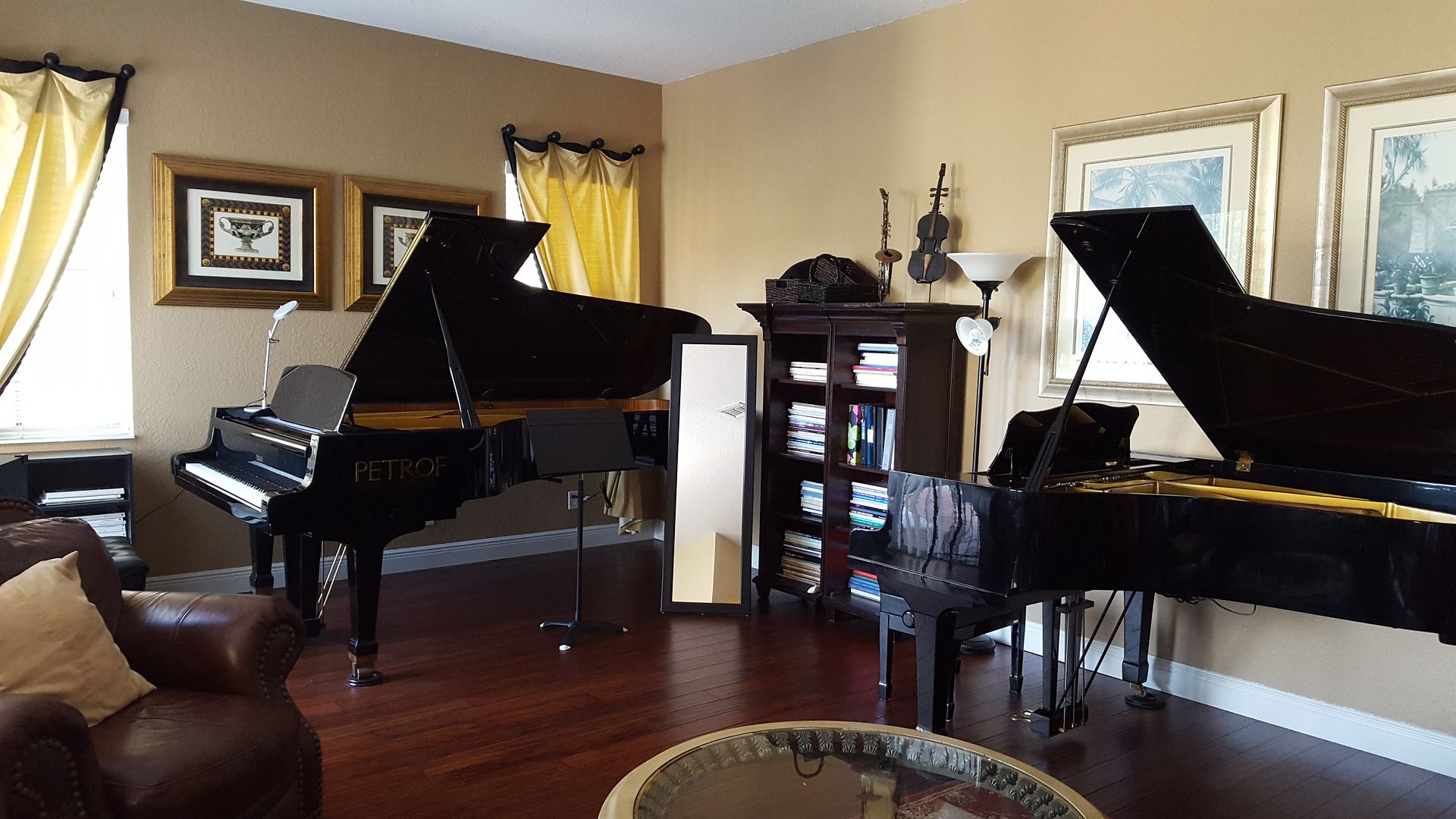
Below is a pic of part of the room. To the left of the Petros there are sliding glass doors. To the right of the Yamaha is all open to a hallway, fpyer, and kithen. In back of the camera is a hexagonal? room.
It will depend on the musical context. If you want it actually to sound like an opera, then you'd really need to mic at some distance in a space that sounds like an opera hall. For metal styles, you'd need to be miked much closer (though many people err on the side of too close in my view).
Yes, this is exactly what I was wondering. "Dry" opera really doesn't work because so much does depend upon the acoustics of the room. I could record at my church which is a large space, but it's not a terribly live space due to carpeting everywhere (it's more like a stage).
Professional opera singer and classical pianist
Re: Recording operatic singing
I've recorded opera singers and there are choices.
In a good acoustic the mic's can be further back. But you may need to record using close mic's. In this case some artificial reverb, or perhaps using stereo widening may be give the voice more space and bloom.
In a large hall recording opera with full orchestra, the singers are not too far from the mic's. (About 3-4 feet). But for solo work or with piano it might need closer miking. However, for voice alone a little more distance may be better. It's a question of trial and error.
I also think you might get a better and more spacious sound using two mic's (i.e. record in stereo), with a Blumlein pair, or coincident pair, or even a spaced pair. (You might also find omni mic's get the best sound).
In a good acoustic the mic's can be further back. But you may need to record using close mic's. In this case some artificial reverb, or perhaps using stereo widening may be give the voice more space and bloom.
In a large hall recording opera with full orchestra, the singers are not too far from the mic's. (About 3-4 feet). But for solo work or with piano it might need closer miking. However, for voice alone a little more distance may be better. It's a question of trial and error.
I also think you might get a better and more spacious sound using two mic's (i.e. record in stereo), with a Blumlein pair, or coincident pair, or even a spaced pair. (You might also find omni mic's get the best sound).
Re: Recording operatic singing
Ariosto wrote:I've recorded opera singers and there are choices.
In a good acoustic the mic's can be further back. But you may need to record using close mic's. In this case some artificial reverb, or perhaps using stereo widening may be give the voice more space and bloom.
In a large hall recording opera with full orchestra, the singers are not too far from the mic's. (About 3-4 feet). But for solo work or with piano it might need closer miking. However, for voice alone a little more distance may be better. It's a question of trial and error.
I also think you might get a better and more spacious sound using two mic's (i.e. record in stereo), with a Blumlein pair, or coincident pair, or even a spaced pair. (You might also find omni mic's get the best sound).
Interesting! Would two NT1As work? Or if I need omnis, what would u recommend? I may be able to convince hubby to spend $200 per mic, or would only one omni be needed?
Professional opera singer and classical pianist
Re: Recording operatic singing
There's a thread here discussing budget mic options, including a couple of Omnis in that range. http://www.soundonsound.com/forum/showf ... =1#1181608
If you can go a bit more then there are the NT55s which seem to be quite highly recommended. web page
[Edited to try and get a url working.]
If you can go a bit more then there are the NT55s which seem to be quite highly recommended. web page
[Edited to try and get a url working.]
-

- Drew Stephenson
Apprentice Guru -
Posts: 29715 Joined: Sun Jul 05, 2015 12:00 am
Location: York
Contact:
(The forumuser formerly known as Blinddrew)
Ignore the post count, I have no idea what I'm doing...
https://drewstephenson.bandcamp.com/
Ignore the post count, I have no idea what I'm doing...
https://drewstephenson.bandcamp.com/
Re: Recording operatic singing
Morodiene wrote: Interesting! Would two NT1As work? Or if I need omnis, what would u recommend? I may be able to convince hubby to spend
Interesting! Would two NT1As work? Or if I need omnis, what would u recommend? I may be able to convince hubby to spend 00 per mic, or would only one omni be needed? 00 per mic, or would only one omni be needed?
I'm not familiar with the NT1A's but for £439 you can get a matched pair of Rode NT55's at KRM Audio. They seem to be the cheapest in the UK as far as I know.
Others may have other recommendations but bear in mind that operatic voices are very different to voices in the pop world etc. You will not want to sing with the lips touching the mic, but rather with some space or distance to sing into. Getting the best sound is very experimental. Using one mic is a possibility but if you want to perform lieder with piano, a stereo pair in the traditional position with you in the curve of the grand piano (with lid on middle height) and the mic's about 4-6 feet away might work best. Also consider ribbon mic's but the good ones are expensive starting at about £1,400 a pair.
Re: Recording operatic singing
Ariosto wrote:Morodiene wrote: Interesting! Would two NT1As work? Or if I need omnis, what would u recommend? I may be able to convince hubby to spendMorodiene wrote: Interesting! Would two NT1As work? Or if I need omnis, what would u recommend? I may be able to convince hubby to spend 00 per mic, or would only one omni be needed?
I'm not familiar with the NT1A's but for £439 you can get a matched pair of Rode NT55's at KRM Audio. They seem to be the cheapest in the UK as far as I know.
Others may have other recommendations but bear in mind that operatic voices are very different to voices in the pop world etc. You will not want to sing with the lips touching the mic, but rather with some space or distance to sing into. Getting the best sound is very experimental. Using one mic is a possibility but if you want to perform lieder with piano, a stereo pair in the traditional position with you in the curve of the grand piano (with lid on middle height) and the mic's about 4-6 feet away might work best. Also consider ribbon mic's but the good ones are expensive starting at about £1,400 a pair. 00 per mic, or would only one omni be needed?
I'm not familiar with the NT1A's but for £439 you can get a matched pair of Rode NT55's at KRM Audio. They seem to be the cheapest in the UK as far as I know.
Others may have other recommendations but bear in mind that operatic voices are very different to voices in the pop world etc. You will not want to sing with the lips touching the mic, but rather with some space or distance to sing into. Getting the best sound is very experimental. Using one mic is a possibility but if you want to perform lieder with piano, a stereo pair in the traditional position with you in the curve of the grand piano (with lid on middle height) and the mic's about 4-6 feet away might work best. Also consider ribbon mic's but the good ones are expensive starting at about £1,400 a pair.
Yes, I've found that recording too close yields some very unwanted results. For now I'll just be recording to go with tracks and not deal with piano as well - which is a whole new can of worms!
You're the 2nd person whose mentioned ribbon mics for opera, but ya, I'm not in a position to justify the money. Do you have any brand in mind that I can put on my short list?
Professional opera singer and classical pianist
Re: Recording operatic singing
Morodiene wrote: You're the 2nd person whose mentioned ribbon mics for opera, but ya, I'm not in a position to justify the money. Do you have any brand in mind that I can put on my short list?
Depending on where you are you might be able to hire some?
-
- Drew Stephenson
Apprentice Guru -
Posts: 29715 Joined: Sun Jul 05, 2015 12:00 am
Location: York
Contact:
(The forumuser formerly known as Blinddrew)
Ignore the post count, I have no idea what I'm doing...
https://drewstephenson.bandcamp.com/
Ignore the post count, I have no idea what I'm doing...
https://drewstephenson.bandcamp.com/
Re: Recording operatic singing
blinddrew wrote:Morodiene wrote: You're the 2nd person whose mentioned ribbon mics for opera, but ya, I'm not in a position to justify the money. Do you have any brand in mind that I can put on my short list?
Depending on where you are you might be able to hire some?
That's a good way to see if I like something before buying it, and could certainly hold me over until I'm financially ready to buy. Thanks!
Professional opera singer and classical pianist
Re: Recording operatic singing
Probably not that applicable to your situation as you don't have a comparable space, but here's an SOS article on recording Pavarotti that you might find interesting.

Reliably fallible.
Re: Recording operatic singing
ignoring anything else,
i'd say the ceiling is too low in the room pictured to be able to get a really properly good result….. opera has a vast dynamic range, and really needs a good bit of space, both to get the mic's far enough back and up, and also plainly for the acoustic effect of the early reflections, something at least double that height really…… vaulted ceiling territory rather than flat would be nice….. …….
churches are typically too reverberant though….
there's a reason most opera recordings are "live performance" in an opera hall…… because that's where it sounds best …..
i'd say the ceiling is too low in the room pictured to be able to get a really properly good result….. opera has a vast dynamic range, and really needs a good bit of space, both to get the mic's far enough back and up, and also plainly for the acoustic effect of the early reflections, something at least double that height really…… vaulted ceiling territory rather than flat would be nice….. …….
churches are typically too reverberant though….
there's a reason most opera recordings are "live performance" in an opera hall…… because that's where it sounds best …..
-

- Studio Support Gnome
Frequent Poster - Posts: 3025 Joined: Tue Jul 22, 2003 12:00 am Location: UK
Mostly Retired from Audio.... If I already know you I'll help, if not.... Ask Hugh Robjohns, unless that is you're in need of 80's shred guitar... that, I'm still interested in having fun with...
Re: Recording operatic singing
Studio Support Gnome wrote:ignoring anything else,
i'd say the ceiling is too low in the room pictured to be able to get a really properly good result….. opera has a vast dynamic range, and really needs a good bit of space, both to get the mic's far enough back and up, and also plainly for the acoustic effect of the early reflections, something at least double that height really…… vaulted ceiling territory rather than flat would be nice….. …….
churches are typically too reverberant though….
there's a reason most opera recordings are "live performance" in an opera hall…… because that's where it sounds best …..
hmm, that's interesting to note. My church is not very reverberant at all. It's a modern setting with a stage and comfy theater-like seating, and carpeting throughout, but seats about 600. So perhaps this would be best suited for opera. Do you think I'd still need a panel or two to absorb some of the sound? One behind the mic and another behind me? Or is it one of those things where you go and experiment with positioning?
Professional opera singer and classical pianist
Re: Recording operatic singing
The way I approach this (and this is just my own personal experience for what it is worth) is to use two duvets and a ribbon mic in my small studio space (14ft x 14ft with 8ft ceiling) . One duvet behind the singer and one behind the microphone. The null plane of the microphone aligning with the space between the duvets. And the space between the duvets at a glancing angle to the walls of the room. This way the singer can hear himself "normally" via the reflections off the ceiling and floor but the same reflections are significantly reduced by the ribbon mic's null. This results in a relatively dry sound which can then be enhanced using ITB reverb. I like to use convolution reverb (namely Space Designer in Logic Pro X) and stereo delays.
I think you will find that the control you get with ITB reverb will be very helpful, especially for a beginner. You can control the amount of reverb and even the "distance" of the voice using the pre delay setting. Location recording is pretty much burned in which means if it isn't great there is no fixing it.
Not to mention the convenience of being able to record at home, especially if you are experimenting/learning. It is quite discouraging, and I know this from experience, to invest in all the time setting up equipment and recording at a special location only to realise when you get back home that something is wrong.
Just my point of view...not to be taken too seriously!
I think you will find that the control you get with ITB reverb will be very helpful, especially for a beginner. You can control the amount of reverb and even the "distance" of the voice using the pre delay setting. Location recording is pretty much burned in which means if it isn't great there is no fixing it.
Not to mention the convenience of being able to record at home, especially if you are experimenting/learning. It is quite discouraging, and I know this from experience, to invest in all the time setting up equipment and recording at a special location only to realise when you get back home that something is wrong.
Just my point of view...not to be taken too seriously!
If in doubt use a duvet!
Re: Recording operatic singing
As Studio Support Gnome points out, the ceiling is your issue. I have a similar medium sized space which I use for recording local bands, but I am constantly fighting the reflections from the ceiling.
These can be managed to a certain extent, but not without either making some compromises as to the reflections you may be capturing or changing the aesthetics of the room using acoustic treatment... and you certainly have a very pretty front room.
Overall, however, a high ceiling is the preferred option.
Churches on the other hand often already own GOBOs, (movable sound absorbing screens), of varying quality, but you might have to work quite hard to minimise the reflections from such a significant space.
The best thing is to get on and make some test recordings in each space. Listen to what you get, make some adjustments and then go again. You should come to some conclusions very quickly about what, if anything, is workable.
If you decide you can work with a local space and are planning to do this regularly, then some investment in GOBOs (or even permanent acoustic treatment if you decide to work at home) may be advisable.
I would advise you not to get too excited, too early. I have achieved some surprising results using close miking and GOBOs with a quite low ceiling, but the nature of the recordings you want to make are unlikely to be best served by this approach.
Studio Support Gnome has a wealth of knowledge on the subject of acoustic treatment.
Regards,
Reg
These can be managed to a certain extent, but not without either making some compromises as to the reflections you may be capturing or changing the aesthetics of the room using acoustic treatment... and you certainly have a very pretty front room.
Overall, however, a high ceiling is the preferred option.
Churches on the other hand often already own GOBOs, (movable sound absorbing screens), of varying quality, but you might have to work quite hard to minimise the reflections from such a significant space.
The best thing is to get on and make some test recordings in each space. Listen to what you get, make some adjustments and then go again. You should come to some conclusions very quickly about what, if anything, is workable.
If you decide you can work with a local space and are planning to do this regularly, then some investment in GOBOs (or even permanent acoustic treatment if you decide to work at home) may be advisable.
I would advise you not to get too excited, too early. I have achieved some surprising results using close miking and GOBOs with a quite low ceiling, but the nature of the recordings you want to make are unlikely to be best served by this approach.
Studio Support Gnome has a wealth of knowledge on the subject of acoustic treatment.
Regards,
Reg
-

- RegressiveRock
Frequent Poster - Posts: 1495 Joined: Wed Sep 01, 2004 12:00 am Location: Buntingford, Herts
Smoking Goats
https://www.facebook.com/SmokingGoats
https://www.facebook.com/SmokingGoats
Re: Recording operatic singing
Morodiene wrote:
hmm, that's interesting to note. My church is not very reverberant at all. It's a modern setting with a stage and comfy theater-like seating, and carpeting throughout, but seats about 600. So perhaps this would be best suited for opera. Do you think I'd still need a panel or two to absorb some of the sound? One behind the mic and another behind me? Or is it one of those things where you go and experiment with positioning?
sounds like that space MIGHT work …… note that i did say Typically…… meaning bare stone everywhere with bare wooden pews …..
i'd experiment…… noting , that close mic technique does NOT do justice to typical operatic performance….
M/S at some distance might be a good way to give you some choice over room contribution.
-
- Studio Support Gnome
Frequent Poster - Posts: 3025 Joined: Tue Jul 22, 2003 12:00 am Location: UK
Mostly Retired from Audio.... If I already know you I'll help, if not.... Ask Hugh Robjohns, unless that is you're in need of 80's shred guitar... that, I'm still interested in having fun with...
Re: Recording operatic singing
Morodiene wrote: My main question is what is the best way to get an accurate recording of operatic singing?
Getting an accurate recording of any voice is the same regardless of genre. It's the voice, not the genre you are recording. Operatic singing can have big dynamics but even at close range a good mic should handle it if set up correctly.
You can use a close or a distant mic and still be accurate. But if forced to record in a space with bad reverb or background noise, close is obviously better. Even a suitable headworn mic, set up well, could do it. Removing already recorded bad room reverb is not so easy, but you can always add good artificial reverb later.
-
- Tim Gillett
Frequent Poster - Posts: 2707 Joined: Wed Jan 30, 2013 12:00 am Location: Perth, Western Australia