Hi everyone,
I am a classical pianist and want to make some studio quality home recording (mostly advanced classical music plus some jazz).
I recently bought an almost new Steinway D grand piano that was previously used briefly in a concert hall and played by renowned soloists, so a top instrument with warm, rich and delicate tone. The room is not perfect but this will not pose a problem since I intend to close-mike the piano above the strings.
I intend to buy 2 microphones in the 1000-2000 USD price range EACH . Any suggestions (LDC, SDC, tube condenser, even ribbon?)
Further, I already have a Focusrite Clarett 4 USB audio interface. I presume this is not a match for the instrument/microphones. My dilemma is simply this: should I buy a separate 2 channel mic-preamp + A/D converter (I would still need a USB connection to PC - could I use my Focusrite Clarett for that?) or an all-in-one-box solution (a really top-notch USB interface)?
On this site I read about Antelope Pure2 A/D converter. Is this a viable alternative?
What kind of a price range am I looking at for the preamp+converter to match the mikes and to make real difference in recorded sound (and which models do you suggest)?
Help greatly appreciated!
Studio quality piano recording
Studio quality piano recording
-
- mikrokozmos
- Posts: 3 Joined: Sat Jan 19, 2019 7:58 pm
Re: Studio quality piano recording
mikrokozmos wrote: Further, I already have a Focusrite Clarett 4 USB audio interface. I presume this is not a match for the instrument/microphones.
I'm not an expert at piano recording compared to some of the others here but I think that you will find that your audio interface is fine. You will probably have to spend a great deal of money to improve on the sound and any improvement will be small. You'll do far better to spend as much as possible on microphones and room treatment (even though you intend to close mic, treating the room appropriately will give you more options).
-

- James Perrett
Moderator -
Posts: 16988 Joined: Mon Sep 10, 2001 12:00 am
Location: The wilds of Hampshire
Contact:
JRP Music - Audio Mastering and Restoration. JRP Music Facebook Page
Re: Studio quality piano recording
I'm no expert (I'm sure John Willett will be along in a bit, he is an expert on piano recordings), but I suspect that with a Clarett and a couple of decent mics, you'd be best spending the rest of your time/money making your room as good as you can possibly make it. Even when close miking I'd expect that to have far more impact on the sound quality than going up another level of pre-amp.
Others may disagree, in which case listen to them.
EDIT - James beat me to it!
Oh, and welcome to the forum.
Others may disagree, in which case listen to them.
EDIT - James beat me to it!
Oh, and welcome to the forum.
Last edited by Drew Stephenson on Sat Jan 19, 2019 9:36 pm, edited 1 time in total.
-

- Drew Stephenson
Apprentice Guru -
Posts: 29715 Joined: Sun Jul 05, 2015 12:00 am
Location: York
Contact:
(The forumuser formerly known as Blinddrew)
Ignore the post count, I have no idea what I'm doing...
https://drewstephenson.bandcamp.com/
Ignore the post count, I have no idea what I'm doing...
https://drewstephenson.bandcamp.com/
Re: Studio quality piano recording
Another +1 for room treatment (and another welcome). Treating the room to achieve the best acoustic sound makes a huge difference to the recordings made in it. It can be done using materials that will fit in with almost any decor and for a surprisingly modest cost.
You have a large (by most standards) budget and a superb instrument to record, saving a few hundred £/$/€ on room treatment would definitely be a bad idea. Get the room right and those expensive mics can give their best and you have more options than very close miking (which doesn't always produce the best sound).
You have a large (by most standards) budget and a superb instrument to record, saving a few hundred £/$/€ on room treatment would definitely be a bad idea. Get the room right and those expensive mics can give their best and you have more options than very close miking (which doesn't always produce the best sound).
-

- Sam Spoons
Forum Aficionado - Posts: 22904 Joined: Thu Jan 23, 2003 12:00 am Location: Manchester UK
Still mourning the loss of my 'Jedi Poster" status
People often mistake me for a grown-up because of my age.
People often mistake me for a grown-up because of my age.
Re: Studio quality piano recording
I specialise in piano recording (as has been said) and have recorded a Steinway D many times.
My first choice nowadays is the Gefell M 221 omni.
I don't know the US price, but I think this should just about get inside your limit. Make sure you specify a matched pair when you order and Gefell will pair-match with no extra cost.
There are several dealers in the USA.
I also like the Sennheiser MKH 20 and 8020 and have also used the Neumann KM 131-D (there is also the KM 131-A version, but I have not used that). I have done several recordings with the MKH 20.
Others to consider are the Josephson C617set (uses the same nickel diaphragm measurement capsule as the Gefell M 221) and some people also like the Schoeps omnis.
Though my personal favourites are the M 221 and MKH 20.
For positioning - get someone to play the piano and you move around the room listening carrefully at various positions and distances - where it sounds best to your ears is a good starting position for placing the microphones.
I hope this helps.
My first choice nowadays is the Gefell M 221 omni.
I don't know the US price, but I think this should just about get inside your limit. Make sure you specify a matched pair when you order and Gefell will pair-match with no extra cost.
There are several dealers in the USA.
I also like the Sennheiser MKH 20 and 8020 and have also used the Neumann KM 131-D (there is also the KM 131-A version, but I have not used that). I have done several recordings with the MKH 20.
Others to consider are the Josephson C617set (uses the same nickel diaphragm measurement capsule as the Gefell M 221) and some people also like the Schoeps omnis.
Though my personal favourites are the M 221 and MKH 20.
For positioning - get someone to play the piano and you move around the room listening carrefully at various positions and distances - where it sounds best to your ears is a good starting position for placing the microphones.
I hope this helps.
-

- John Willett
Longtime Poster -
Posts: 7297 Joined: Tue Mar 07, 2000 12:00 am
Location: Oxfordshire UK
Contact:
John
Sound-Link ProAudio
Circle Sound Services
Sound-Link are UK Distributors for: Microtech Gefell, ME-Geithain, AETA, HUM, Håkan, Meyer Turtle
Sound-Link ProAudio
Circle Sound Services
Sound-Link are UK Distributors for: Microtech Gefell, ME-Geithain, AETA, HUM, Håkan, Meyer Turtle
Re: Studio quality piano recording
Sam Spoons wrote: You have a large (by most standards) budget and a superb instrument to record, saving a few hundred £/$/€ on room treatment would definitely be a bad idea. Get the room right and those expensive mics can give their best and you have more options than very close miking (which doesn't always produce the best sound).
You will have to be *very* careful with room treatment as a piano room is a performance spase,m rather than a recording studio, and you need to get the right balance.
You really need a professional acoustics expert to design the room treatment required, and doing this properly won't be cheap.
-
- John Willett
Longtime Poster -
Posts: 7297 Joined: Tue Mar 07, 2000 12:00 am
Location: Oxfordshire UK
Contact:
John
Sound-Link ProAudio
Circle Sound Services
Sound-Link are UK Distributors for: Microtech Gefell, ME-Geithain, AETA, HUM, Håkan, Meyer Turtle
Sound-Link ProAudio
Circle Sound Services
Sound-Link are UK Distributors for: Microtech Gefell, ME-Geithain, AETA, HUM, Håkan, Meyer Turtle
Re: Studio quality piano recording
Clearly you should listen to JW rather than me, he has far more experience and knowledge.
-
- Sam Spoons
Forum Aficionado - Posts: 22904 Joined: Thu Jan 23, 2003 12:00 am Location: Manchester UK
Still mourning the loss of my 'Jedi Poster" status
People often mistake me for a grown-up because of my age.
People often mistake me for a grown-up because of my age.
Re: Studio quality piano recording
This has been largely covered. A good matched pair of SDC Omni directional mics would be standard approach. I’ve successfully used MKH8020 and also KM183 (vertical orientation).
The interface will be the least of your problems and as has been noted improving your room acoustics will be of paramount importance. If you’re at all serious ( and given you’ve just bought Steinway D - you probably are) then a professionally designed acoustic space will be critical. You simply won’t fix problems with the room by close miking or trying to treat the room yourself.
Bob
The interface will be the least of your problems and as has been noted improving your room acoustics will be of paramount importance. If you’re at all serious ( and given you’ve just bought Steinway D - you probably are) then a professionally designed acoustic space will be critical. You simply won’t fix problems with the room by close miking or trying to treat the room yourself.
Bob
-

- Bob Bickerton
Longtime Poster -
Posts: 5637 Joined: Fri Dec 20, 2002 12:00 am
Location: Nelson, New Zealand
Contact:
Re: Studio quality piano recording
All the OP said was "the room is not perfect". Do we really know how good or bad is the room acoustic?
-
- Tim Gillett
Frequent Poster - Posts: 2707 Joined: Wed Jan 30, 2013 12:00 am Location: Perth, Western Australia
Re: Studio quality piano recording
But he’s proposing compromised mic positioning because of a sub-standard room acoustic.
Just for the record, spaced omnidirectional microphones in a good acoustic are a preferred method for classical piano. Lots of good articles on the SOS website. Positioning would generally be ‘in the room’ - i.e. not too close.
Bob
Just for the record, spaced omnidirectional microphones in a good acoustic are a preferred method for classical piano. Lots of good articles on the SOS website. Positioning would generally be ‘in the room’ - i.e. not too close.
Bob
-
- Bob Bickerton
Longtime Poster -
Posts: 5637 Joined: Fri Dec 20, 2002 12:00 am
Location: Nelson, New Zealand
Contact:
Re: Studio quality piano recording
I would certainly agree with Bob, John W and the others who have stated that you should sort out the room acoustics. For classical piano, recording close to the strings is not usually a technique used, but it is however, often used for jazz, especially if you have added instruments such as a jazz quartet/quintet etc. Usually the closest the mics are for classical piano is just outside the lid, but some prefer a little more distance, and of course this all depends on room size and the acoustic especially with regard to reverberation.
The Steinway D is a very reverberant instrument, full of overtones, as you as a pianist will be very aware of. To capture this instrument accurately the room acoustics and their treatment are vital. If you no doubt work with other instrumentalists as well, you will need the acoustics to be tamed so that a good balance and mix with the piano can be obtained, even if this is just with one instrument like a violin or cello.
The Steinway D is a very reverberant instrument, full of overtones, as you as a pianist will be very aware of. To capture this instrument accurately the room acoustics and their treatment are vital. If you no doubt work with other instrumentalists as well, you will need the acoustics to be tamed so that a good balance and mix with the piano can be obtained, even if this is just with one instrument like a violin or cello.
Re: Studio quality piano recording
Thanks guys! Lots to think about, everything you said makes perfect sense. I shall focus first on getting decent mikes, then start experimenting with the positioning and room treatment.
-
- mikrokozmos
- Posts: 3 Joined: Sat Jan 19, 2019 7:58 pm
Re: Studio quality piano recording
Hi mikrokozmos,
I was wondering what are the approximate dimensions of the room you are planning to record in. These could have a large bearing on such things as the placement of the piano within the room, mic choice and placement, and room treatment.
Tim
I was wondering what are the approximate dimensions of the room you are planning to record in. These could have a large bearing on such things as the placement of the piano within the room, mic choice and placement, and room treatment.
Tim
-
- Tim Gillett
Frequent Poster - Posts: 2707 Joined: Wed Jan 30, 2013 12:00 am Location: Perth, Western Australia
Re: Studio quality piano recording
There's no point in an 'in the room' recording if the room sounds bad. And, although you MAY be able to tame what's bad about the room, adding 'good' room sound is quite another matter.
Practically, you may have to close-mike and fake the 'room'. Purist techniques are only applicable when the source is faultless.
What mics have you got already? I suggest a lot of experimenting with mic positioning before you spend big money.
Practically, you may have to close-mike and fake the 'room'. Purist techniques are only applicable when the source is faultless.
What mics have you got already? I suggest a lot of experimenting with mic positioning before you spend big money.
-
- Exalted Wombat
Longtime Poster - Posts: 5846 Joined: Sat Feb 06, 2010 12:00 am Location: London UK
You don't have to write songs. The world doesn't want you to write songs. It would probably prefer it if you didn't. So write songs if you want to. Otherwise, please don't bore us with beefing about it. Go fishing instead.
Re: Studio quality piano recording
warm, rich and delicate tone
So I assume you have a New York, rather than Hamburg crafted instrument.
I have played Model Ds, from an early age, in all types of settings, and they can overwhelm a small space, but it depends on what you are playing. For example, the Chopin Polonaise in F-sharp minor, Op. 44, is going to tax an acoustically poor space, whereas a Bach Partita will probably be fine.
What I would suggest is that you initially hire a recording engineer, e.g. John Willett or someone in the States who specialises in piano recordings, and see how they get on.
Some final thoughts, which I know are obvious, is that recording yourself alters your performance, at least initially, unless you are used to being recorded regularly. Also, are you happy with the pitch your instrument has been tuned to by your piano technician and is everything in tune? Playing big works will knock your piano out of tune, so factor in visits by your technician.
Last edited by Nazard on Sun Jan 20, 2019 7:06 pm, edited 1 time in total.
Re: Studio quality piano recording
I will say, that I once recorded a double CD of Chopin Nocturnes on a Steinway D that was in a room in a domestic setting.
If you want to hear it, it is still available on Amazon HERE.
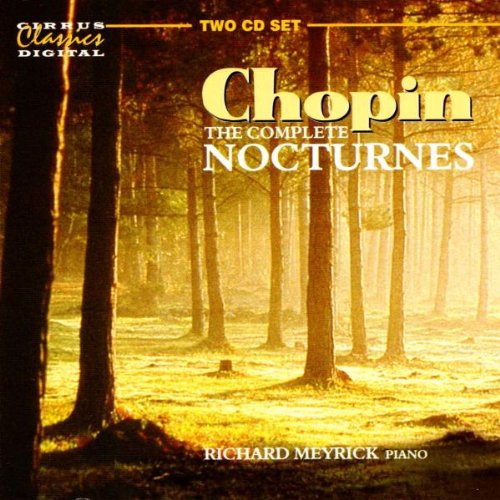
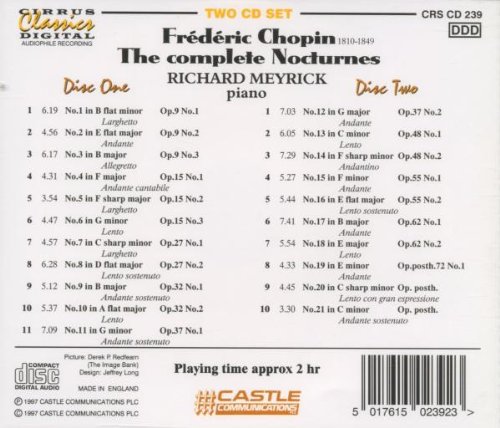
I have posted this, not for self-promotion, but what you can acheive in a not optimal recording environment.
The microphones were quality omnis and about 2-metres from the piano - but were in a completely different position from what I would normally use because this was the best place in the acoustic.
If you want to hear it, it is still available on Amazon HERE.
I have posted this, not for self-promotion, but what you can acheive in a not optimal recording environment.
The microphones were quality omnis and about 2-metres from the piano - but were in a completely different position from what I would normally use because this was the best place in the acoustic.
-
- John Willett
Longtime Poster -
Posts: 7297 Joined: Tue Mar 07, 2000 12:00 am
Location: Oxfordshire UK
Contact:
John
Sound-Link ProAudio
Circle Sound Services
Sound-Link are UK Distributors for: Microtech Gefell, ME-Geithain, AETA, HUM, Håkan, Meyer Turtle
Sound-Link ProAudio
Circle Sound Services
Sound-Link are UK Distributors for: Microtech Gefell, ME-Geithain, AETA, HUM, Håkan, Meyer Turtle
Re: Studio quality piano recording
I just ordered the last one in stock John!
I'm looking forward and very curious to hear this Chopin Nocturnes recording to see what can be achieved in non-ideal acoustic space. I'm in the market for a couple of spaced omni's myself for recording classical piano (Yamaha C7) which is in my living room with all sorts of problems for standing waves and resonances. Acoustic treatment is out of the question without being on receiving end of divorce papers:) For now (and far from ideal), I have piano positioned where the best balanced sound is from where I sit at the piano stool because this allows me to control my playing and the nuances better in my performance. I have a couple of cardioid DPAs' just outside the lid. It's clean, but little acoustic space or ambience for the piano to breath, so I artificially add a nice reverb using my MixPre. Results are actually not bad but obviously its never gonna be like the Carnegie Hall!
I'm looking forward and very curious to hear this Chopin Nocturnes recording to see what can be achieved in non-ideal acoustic space. I'm in the market for a couple of spaced omni's myself for recording classical piano (Yamaha C7) which is in my living room with all sorts of problems for standing waves and resonances. Acoustic treatment is out of the question without being on receiving end of divorce papers:) For now (and far from ideal), I have piano positioned where the best balanced sound is from where I sit at the piano stool because this allows me to control my playing and the nuances better in my performance. I have a couple of cardioid DPAs' just outside the lid. It's clean, but little acoustic space or ambience for the piano to breath, so I artificially add a nice reverb using my MixPre. Results are actually not bad but obviously its never gonna be like the Carnegie Hall!
Last edited by Paul Isaacs on Mon Jan 21, 2019 5:04 pm, edited 1 time in total.
-
- Paul Isaacs
Poster - Posts: 25 Joined: Fri May 05, 2017 4:30 pm
Paul Isaacs
Sound Devices LLC
Sound Devices LLC
Re: Studio quality piano recording
Hi everyone,
I'm certainly not as experienced as many on this forum, but I wanted to add two thoughts to this discussion.
First the room... we all hear slightly differently, based on anatomy, but also based on positioning in a room. I understand the idea of room treatments, but part of the uniqueness and originality of a performance is the room in which the performance takes place. Now obviously if you're getting muddied sound from reflective surfaces, it'd help to work on the room, but a studio piano will never sound like a piano in a symphony hall and vice versa. The room, in short, has character that adds to the music being played. Consider also that when much of this classical music was composed and played initially, they didn't have a lot of the fancy room treatments that we have today. While I'm certainly not condemning forward audio progress and better sound, there is something to be said about the natural sound in a room. Now, I understand acoustically bad rooms and venues- heck, I've run sound for a rock band playing inside a mall, as one example. But, I think there is some room to differentiate between a clean room and the character that a space can add to an instrument. I hope this makes sense... basically, I wouldn't want to completely remove a piano from its environment by making the room too perfect. Additionally and unfortunately, sound is often very subjective and what may sound great to one engineer may have slight (or major) problems to another. (I think it'd be interesting to get a massive chunk of acoustic foam and just hack out enough space for a piano and bench and play in there...)
Second, the mics: you could certainly run two matched mics on two channels, as is fairly standard practice. I submit, however, that those two mics may catch most -but not all- of a performance. I'd recommend placement of additional microphones with different acoustic properties. Why? For one, these additional mics won't negatively affect your primary mic pair, but in post, they can be used to fine tune the sound as each of the additional mics will hear slightly different sound than your primaries. Second, you can mic specific components of the performance as needed- mic the dampers to mix in that subtle damper sound, or place mics to specifically highlight bright highs or rumbling lows based on the music being played, or even catch the fingertips striking the keys. Additionally, you can expand the 3D nature of sound in a space to create a more "live" or real sound. (I realize there is a point of diminishing returns and placing mics ad absurdum wouldn't gain much, but I'm just talking about an additional 1-3 mics.)
Is there a reason not to add more mics? ("It's just not done," is certainly a reasonable answer!) Maybe it'd just be redundant. I know it'd cost more (it's just money, right?) but good mics can be rented for projects as well, so it's an option.
Just a few thoughts, but if these ideas are inane, I certainly submit to more experienced minds.
I'm certainly not as experienced as many on this forum, but I wanted to add two thoughts to this discussion.
First the room... we all hear slightly differently, based on anatomy, but also based on positioning in a room. I understand the idea of room treatments, but part of the uniqueness and originality of a performance is the room in which the performance takes place. Now obviously if you're getting muddied sound from reflective surfaces, it'd help to work on the room, but a studio piano will never sound like a piano in a symphony hall and vice versa. The room, in short, has character that adds to the music being played. Consider also that when much of this classical music was composed and played initially, they didn't have a lot of the fancy room treatments that we have today. While I'm certainly not condemning forward audio progress and better sound, there is something to be said about the natural sound in a room. Now, I understand acoustically bad rooms and venues- heck, I've run sound for a rock band playing inside a mall, as one example. But, I think there is some room to differentiate between a clean room and the character that a space can add to an instrument. I hope this makes sense... basically, I wouldn't want to completely remove a piano from its environment by making the room too perfect. Additionally and unfortunately, sound is often very subjective and what may sound great to one engineer may have slight (or major) problems to another. (I think it'd be interesting to get a massive chunk of acoustic foam and just hack out enough space for a piano and bench and play in there...)
Second, the mics: you could certainly run two matched mics on two channels, as is fairly standard practice. I submit, however, that those two mics may catch most -but not all- of a performance. I'd recommend placement of additional microphones with different acoustic properties. Why? For one, these additional mics won't negatively affect your primary mic pair, but in post, they can be used to fine tune the sound as each of the additional mics will hear slightly different sound than your primaries. Second, you can mic specific components of the performance as needed- mic the dampers to mix in that subtle damper sound, or place mics to specifically highlight bright highs or rumbling lows based on the music being played, or even catch the fingertips striking the keys. Additionally, you can expand the 3D nature of sound in a space to create a more "live" or real sound. (I realize there is a point of diminishing returns and placing mics ad absurdum wouldn't gain much, but I'm just talking about an additional 1-3 mics.)
Is there a reason not to add more mics? ("It's just not done," is certainly a reasonable answer!) Maybe it'd just be redundant. I know it'd cost more (it's just money, right?) but good mics can be rented for projects as well, so it's an option.
Just a few thoughts, but if these ideas are inane, I certainly submit to more experienced minds.
Last edited by John19523 on Mon Jan 21, 2019 9:45 pm, edited 1 time in total.
Re: Studio quality piano recording
Paul Isaacs wrote:I just ordered the last one in stock John!
I'm looking forward and very curious to hear this Chopin Nocturnes recording to see what can be achieved in non-ideal acoustic space. I'm in the market for a couple of spaced omni's myself for recording classical piano (Yamaha C7) which is in my living room with all sorts of problems for standing waves and resonances. Acoustic treatment is out of the question without being on receiving end of divorce papers:) For now (and far from ideal), I have piano positioned where the best balanced sound is from where I sit at the piano stool because this allows me to control my playing and the nuances better in my performance. I have a couple of cardioid DPAs' just outside the lid. It's clean, but little acoustic space or ambience for the piano to breath, so I artificially add a nice reverb using my MixPre. Results are actually not bad but obviously its never gonna be like the Carnegie Hall!
Cheers Paul, I hope you like it.
It was recorded quite a few years ago now on an extremely low budget from the record company.
It was recorded over a couple of days in the "music room" of a large house (obviously, since they could afford a Steinway D) - it was a modern house, not an old one, so the ceiling heights were lower than an old house.
I tried several positions in the room with both MS and spaced (20cm) omnis. The omnis definitely sounded best and the final position was behiond the pianist - behind his right shoulder and a little to the right.
Oh - the room was totally untreated and just a room in a house with a piano in it; though we did move the piano from it's normal position to get a better sound in the room.
The pianist was very happy with the result, as were also the record company.
Last edited by John Willett on Mon Jan 21, 2019 9:37 pm, edited 1 time in total.
-
- John Willett
Longtime Poster -
Posts: 7297 Joined: Tue Mar 07, 2000 12:00 am
Location: Oxfordshire UK
Contact:
John
Sound-Link ProAudio
Circle Sound Services
Sound-Link are UK Distributors for: Microtech Gefell, ME-Geithain, AETA, HUM, Håkan, Meyer Turtle
Sound-Link ProAudio
Circle Sound Services
Sound-Link are UK Distributors for: Microtech Gefell, ME-Geithain, AETA, HUM, Håkan, Meyer Turtle
Re: Studio quality piano recording
Exalted Wombat wrote:There's no point in an 'in the room' recording if the room sounds bad. And, although you MAY be able to tame what's bad about the room, adding 'good' room sound is quite another matter.
Practically, you may have to close-mike and fake the 'room'. Purist techniques are only applicable when the source is faultless.
Well said, EW.
-
- Tim Gillett
Frequent Poster - Posts: 2707 Joined: Wed Jan 30, 2013 12:00 am Location: Perth, Western Australia
Re: Studio quality piano recording
If you *have* to record a grand piano in a domestic room - first move the piano to the room position where it sounds best in the room (which is likely to be different from where it would normally sit).
When you are happy with the piano position, get someone else to play the piano and you move around the room to find the place where the piano sounds best to your ears. Mark this point as it is likely to be the best place to put the microphones.
Although recording in a domestic room is hardly ever ideal, this will minimise any nasties and get the best possible recording in the room.
This is what I did when I recorded the Chopin Nocturne CD with Richard Meyrick for Cirrus Digital Classics.
When you are happy with the piano position, get someone else to play the piano and you move around the room to find the place where the piano sounds best to your ears. Mark this point as it is likely to be the best place to put the microphones.
Although recording in a domestic room is hardly ever ideal, this will minimise any nasties and get the best possible recording in the room.
This is what I did when I recorded the Chopin Nocturne CD with Richard Meyrick for Cirrus Digital Classics.
-
- John Willett
Longtime Poster -
Posts: 7297 Joined: Tue Mar 07, 2000 12:00 am
Location: Oxfordshire UK
Contact:
John
Sound-Link ProAudio
Circle Sound Services
Sound-Link are UK Distributors for: Microtech Gefell, ME-Geithain, AETA, HUM, Håkan, Meyer Turtle
Sound-Link ProAudio
Circle Sound Services
Sound-Link are UK Distributors for: Microtech Gefell, ME-Geithain, AETA, HUM, Håkan, Meyer Turtle
Re: Studio quality piano recording
Thank you all for very insightfull thoughts!
I will try to add some reflections of mine:
1) Room acoustics: the rectangular room is 4m X 12m, the piano stands 1m apart from one short side of the room (parallel to it), projecting the sound to the big remaining rectangle. The ceiling is standard 2,6m. The long sides are partly covered with bookshelves, there is wooden floor.
So, being just a musician, I cannot tell what the acoustics of the room is (actually I even don't know how good acoustics is defined at all), but I presume it is not up to any studio standard.
As one of the commenters put it vividly, I won't be able to treat the room in any way (for similar reasons as his), that's why I wanted to downplay the probable shortcomings of reverb/reflections/ambience by placing the mics under the lid or close to the piano.
2) Can the instrument (it is a Hamburg model) overwhelm the room? I actually did play both pieces mentioned by one of the commenters - Chopin fis-moll Polonaise and Bach Partita Nr1 - and the Polonaise was better with semi-closed lid as it is a very aggressive piece.
I also experimented with a friend playing Schubert's last B-Dur Sonate and Beethoven's Arietta from op 111, and, surprisingly, using 2 budget condensers AKG C3000 placed 30cm before the rim and 60cm apart (and 30cm above the rim), it sounded amazingly close to studio sound heard on CDs (and I've heard hundreds of those so here I can trust my ears). However, placing the mics just 1 meter away from the piano (and a bit higher), the sound was muddied/inarticulate and there was a lot of reverb, so the positioning is absolutely critical!
3) Omni vs cardioid: obviously, based on most comments, omnis are the preferred option, since the soundboard of the piano is so vast. However, since I fear that the ambient sound will probably be imperfect, I decided to go with Schoeps MK21 open cardioid (any counter-arguments?). (Unfortunately, in Europe (Slovenia) it is difficult to get Gefell/Josephson and I feel Schoeps is superior to Sennheiser).
I also found a comment on using more mics a very appealing proposal - maybe to place an additional different character mic (eg ribbon or tube LDC) at the tail of the instrument or somewhere in the room and to try to mix it with Schoeps pair to add some flair.
4) Chopin Nocturnes: I will try to get this CD to see what a professional could extract from ordinary conditions (private home). I think that Nocturnes are perfect for exploring the sound as they contain a universum of dynamics/articulation/tonal variations.
Regards!
I will try to add some reflections of mine:
1) Room acoustics: the rectangular room is 4m X 12m, the piano stands 1m apart from one short side of the room (parallel to it), projecting the sound to the big remaining rectangle. The ceiling is standard 2,6m. The long sides are partly covered with bookshelves, there is wooden floor.
So, being just a musician, I cannot tell what the acoustics of the room is (actually I even don't know how good acoustics is defined at all), but I presume it is not up to any studio standard.
As one of the commenters put it vividly, I won't be able to treat the room in any way (for similar reasons as his), that's why I wanted to downplay the probable shortcomings of reverb/reflections/ambience by placing the mics under the lid or close to the piano.
2) Can the instrument (it is a Hamburg model) overwhelm the room? I actually did play both pieces mentioned by one of the commenters - Chopin fis-moll Polonaise and Bach Partita Nr1 - and the Polonaise was better with semi-closed lid as it is a very aggressive piece.
I also experimented with a friend playing Schubert's last B-Dur Sonate and Beethoven's Arietta from op 111, and, surprisingly, using 2 budget condensers AKG C3000 placed 30cm before the rim and 60cm apart (and 30cm above the rim), it sounded amazingly close to studio sound heard on CDs (and I've heard hundreds of those so here I can trust my ears). However, placing the mics just 1 meter away from the piano (and a bit higher), the sound was muddied/inarticulate and there was a lot of reverb, so the positioning is absolutely critical!
3) Omni vs cardioid: obviously, based on most comments, omnis are the preferred option, since the soundboard of the piano is so vast. However, since I fear that the ambient sound will probably be imperfect, I decided to go with Schoeps MK21 open cardioid (any counter-arguments?). (Unfortunately, in Europe (Slovenia) it is difficult to get Gefell/Josephson and I feel Schoeps is superior to Sennheiser).
I also found a comment on using more mics a very appealing proposal - maybe to place an additional different character mic (eg ribbon or tube LDC) at the tail of the instrument or somewhere in the room and to try to mix it with Schoeps pair to add some flair.
4) Chopin Nocturnes: I will try to get this CD to see what a professional could extract from ordinary conditions (private home). I think that Nocturnes are perfect for exploring the sound as they contain a universum of dynamics/articulation/tonal variations.
Regards!
-
- mikrokozmos
- Posts: 3 Joined: Sat Jan 19, 2019 7:58 pm
Re: Studio quality piano recording
It is a decently large domestic room and, I guess is in your house so that marital (other relationships are available) disharmony is at the root of your inability to install room treatment? However there are approaches that may help, and be aesthetically acceptable in some domestic environments, in the form of heavy drapes hung a short distance from one or both of the end walls (or a temporary solution of a couple of duvets) which combined with moving the piano further from the end of the room may well give better results allowing more distant miking?
-
- Sam Spoons
Forum Aficionado - Posts: 22904 Joined: Thu Jan 23, 2003 12:00 am Location: Manchester UK
Still mourning the loss of my 'Jedi Poster" status
People often mistake me for a grown-up because of my age.
People often mistake me for a grown-up because of my age.
Re: Studio quality piano recording
mikrokozmos wrote: I decided to go with Schoeps MK21 open cardioid (any counter-arguments?). (Unfortunately, in Europe (Slovenia) it is difficult to get Gefell/Josephson and I feel Schoeps is superior to Sennheiser).
Schoeps is good and it comes down to personal choice.
Personally I would not say that Schoeps is superior to Sennheiser and I have used Sennheiser in the past.
If you take: DPA, Gefell, Neumann, Schoeps,and Sennheiser I would say that they arte all pretty equal in quality.
But they are all different in design and concept.
DPA - quality electret based on a B&K measurement capsule (original series).
Gefell - AF condenser based on a nickel diaphragm measurement capsule where the diaphragm is actually "grown in place" on the housing. (M 221 and new M 102)
Neumann - AF condenser with a Mylar diaphragm.
Schoeps - AF condenser with a Mylar diaphragm
Sennheiser - RF condenser with a Mylar diaphragm - completely different technique from an AF condenser with far lower levels of distortion and lower self-noise. (MKH symmetrical series).
-
- John Willett
Longtime Poster -
Posts: 7297 Joined: Tue Mar 07, 2000 12:00 am
Location: Oxfordshire UK
Contact:
John
Sound-Link ProAudio
Circle Sound Services
Sound-Link are UK Distributors for: Microtech Gefell, ME-Geithain, AETA, HUM, Håkan, Meyer Turtle
Sound-Link ProAudio
Circle Sound Services
Sound-Link are UK Distributors for: Microtech Gefell, ME-Geithain, AETA, HUM, Håkan, Meyer Turtle
Re: Studio quality piano recording
mikrokozmos wrote: I also experimented with a friend playing Schubert's last B-Dur Sonate and Beethoven's Arietta from op 111, and, surprisingly, using 2 budget condensers AKG C3000 placed 30cm before the rim and 60cm apart (and 30cm above the rim), it sounded amazingly close to studio sound heard on CDs (and I've heard hundreds of those so here I can trust my ears). However, placing the mics just 1 meter away from the piano (and a bit higher), the sound was muddied/inarticulate and there was a lot of reverb, so the positioning is absolutely critical!
3) Omni vs cardioid: obviously, based on most comments, omnis are the preferred option, since the soundboard of the piano is so vast. However, since I fear that the ambient sound will probably be imperfect, I decided to go with Schoeps MK21 open cardioid (any counter-arguments?). (Unfortunately, in Europe (Slovenia) it is difficult to get Gefell/Josephson and I feel Schoeps is superior to Sennheiser).
I have been experimenting with mic positions and alternative setups in an untreated room approx 18 feet by 12 feet with a ceiling height of about 12+ feet, recording a model "O" Steinway grand which has just recently been re-built by Steinway.
I have good results from having the mic's at the rim curve of the piano (with lid up of course) and I had one take in mono using the AKG C414 XLS set to omni, and another good take using DPA 2006C (Omni) mic's in stereo.
I then moved the mic's out to approx 2.5 feet into the room with mic's looking at the piano (before the DPA were pointing at the ceiling). OK sound but not nearly as good.
I then moved the DPA mic's back to about 6 feet and pointing more at the piano's bridge area. Really bad sound. Early reflections and possibly some comb filtering and/or phase problems. The mics were on separate stands and 40cm (16 inches) apart.
I will further experiment (when I can get the pianist back) and try close miking under the lid over the strings and particularly nearer the piano bridge on the bass side.
But what I have found helpful with this instrument is some EQ - raising the lower frequencies by about 8 dB and slight 2dB increase around the mid/top frequencies.
So you might have to also use some tweaking of the frequencies using EQ, but then maybe not with a Model D.
Last edited by Ariosto on Sat Jan 26, 2019 1:48 pm, edited 1 time in total.