Hi,
I just recently got a peterson strobe tuner, and have reintonated my guitar. I did this by adjusting the bridge saddles based on the 5th and 17th frets.
The results were amazing the guitar has never sounded so sweet from the 4th fret to the 22nd.
If I intonate based on the nut and the 12th fret the results are so so all over the neck.
So clearly the nut is causing the problems... Upto 5 cents on the open D and G strings.
So I was thinking of making one of these:
http://mimf.com/nutcomp/
Since I can't but a left handed Earvana. Any thoughts?
Cheers
Steve
Intonation: Nut compensation
Forum rules
For all tech discussions relating to Guitars, Basses, Amps, Pedals & Guitar Accessories.
For all tech discussions relating to Guitars, Basses, Amps, Pedals & Guitar Accessories.

Re: Intonation: Nut compensation
Hi Steve. Nut compensation theory and techniques like those presented by Stephen Delft, Buzz Feiten and others have gained a lot of attention in later years. Although interesting in many ways, and despite the fact that I know people who swear by their compensated nuts, I have yet to find one theory that convinces me.
Firstly, different compensation technique developers recommend slightly different measures and have slightly different ways of calculating these measures, which indicates there is a certain amount of arbitrariness involved.
Secondly, since the compensation is basically taking place at the nut, it can only deal with fretting related to open strings; as soon as you leave open string territory, e.g. when using a capo or barré chord, the compensation is in pratice overridden. Fretting with a barré is the equivalent of moving the nut, which means that you should move the compensation as well. This in turn means that to make a difference to the overall tuning, every single fret should be compensated - a technique that has been tried by numerous luthiers over the years, but has never caught on.
As a former guitar tech I find nut-related intonation problems mainly have to do with the nut slots being to shallow. They should be deep enough to make the string height over the first fret equal to the string height over the second fret when you hold down the string against the first fret. I'd say most factory-setup guitars have too shallow slots, probably because filing them down to the optimal height is a precision work that requires time, and time is money. And if you file down too far, you either have to replace the nut or fill the slot with some superglue and start over again, which again takes too much time. Better leave a safety margin, then.
A nut slot that is ever so slightly too high, forces the finger to press the string harder near the nut than higher up the neck to reach the fret. The extra force brings extra tension to the string, which sharpens the pitch. Of course, fretting a string anywhere on the fingerboard causes string tension, but if the string-to-fret height is consistent from the nut upwards (slightly increasing on the way up), this tension is effectively compensated for "globally" by intonating the saddle(s). In fact, the optimal solution is the old (not so fasionable today) "zero-fret" construction, which uses a fret - similar in size/height to all other frets - at the nut position and just uses the nut to guide the strings and give them the correct spacing.
Another thing to consider is the nature of the tempered tuning which has been used in western music since the 17th century, and which more or less makes all intervals on instruments with fixed notes (like guitars, pianos etc) slightly out of tune. This, of course, is nothing you can compensate away from, but in combination with a nut that is a bit too high, this often means that when e.g. getting an open position C major in perfect tune, the G# in the open position E major is way too sharp. If your nut slots are optimal in height, your overall intonation correct, and you still get these sharp notes you should ask yourself if maybe you are using excessive force when fretting. Letting go slightly on the pressure could be all that is needed to solve the problem.
Just my thoughts and experience.
Firstly, different compensation technique developers recommend slightly different measures and have slightly different ways of calculating these measures, which indicates there is a certain amount of arbitrariness involved.
Secondly, since the compensation is basically taking place at the nut, it can only deal with fretting related to open strings; as soon as you leave open string territory, e.g. when using a capo or barré chord, the compensation is in pratice overridden. Fretting with a barré is the equivalent of moving the nut, which means that you should move the compensation as well. This in turn means that to make a difference to the overall tuning, every single fret should be compensated - a technique that has been tried by numerous luthiers over the years, but has never caught on.
As a former guitar tech I find nut-related intonation problems mainly have to do with the nut slots being to shallow. They should be deep enough to make the string height over the first fret equal to the string height over the second fret when you hold down the string against the first fret. I'd say most factory-setup guitars have too shallow slots, probably because filing them down to the optimal height is a precision work that requires time, and time is money. And if you file down too far, you either have to replace the nut or fill the slot with some superglue and start over again, which again takes too much time. Better leave a safety margin, then.
A nut slot that is ever so slightly too high, forces the finger to press the string harder near the nut than higher up the neck to reach the fret. The extra force brings extra tension to the string, which sharpens the pitch. Of course, fretting a string anywhere on the fingerboard causes string tension, but if the string-to-fret height is consistent from the nut upwards (slightly increasing on the way up), this tension is effectively compensated for "globally" by intonating the saddle(s). In fact, the optimal solution is the old (not so fasionable today) "zero-fret" construction, which uses a fret - similar in size/height to all other frets - at the nut position and just uses the nut to guide the strings and give them the correct spacing.
Another thing to consider is the nature of the tempered tuning which has been used in western music since the 17th century, and which more or less makes all intervals on instruments with fixed notes (like guitars, pianos etc) slightly out of tune. This, of course, is nothing you can compensate away from, but in combination with a nut that is a bit too high, this often means that when e.g. getting an open position C major in perfect tune, the G# in the open position E major is way too sharp. If your nut slots are optimal in height, your overall intonation correct, and you still get these sharp notes you should ask yourself if maybe you are using excessive force when fretting. Letting go slightly on the pressure could be all that is needed to solve the problem.
Just my thoughts and experience.

Mats G
Re: Intonation: Nut compensation
Hi,
Well I've gone and super glued some extra delrin strips to the D G and B strings on my MIA strat. I will cut a new nut completely with these compensations once I am certain that they are spot on after a few more string changes....
I have to safe the results are better than I could have imagined. All open string chords sound MUCH better, it is a very pleasing experience just to sit and strum the guitar randomly and listen. I am very happy. I can play chords all over the neck with open strings and they sound wonderfull.
I have set up my guitar with a very slight give in the neck, and with a high enough string at the nut to play slide. I needed a great deal of compensation on the open G string. Before which the open G string was 6 cents flat ( the D was 5 cents adn the B 4 cents flat. Now it is within a half a cent (the error of the strobe tuner) as are all the open string and frets all the way up the fingerboard...
I agree with you that no one theory suits all. I can almost gaurantee to you that with my string gauge (13-17-20-36-46-56) and my higher than normall action the Earvana nut would not provide as good a solution as I now have. I don't need any compensation on the low E A and high E strings. I believe this must be because of the high tension of these strings for the guages I use is counter acting the effects of the high action, high nut slot height. My testing has proven to me at least that you have to compensate the nut for the actual guitar, guitar, player, string gauge, and action. Anything else is a compromise.
This guitar is now the sweetest sounding I have ever heard.
The only downside is that the nut looks a bit messy. Although this will improve when I get around to cutting a custom one piece version.
Cheers
Steve
Well I've gone and super glued some extra delrin strips to the D G and B strings on my MIA strat. I will cut a new nut completely with these compensations once I am certain that they are spot on after a few more string changes....
I have to safe the results are better than I could have imagined. All open string chords sound MUCH better, it is a very pleasing experience just to sit and strum the guitar randomly and listen. I am very happy. I can play chords all over the neck with open strings and they sound wonderfull.
I have set up my guitar with a very slight give in the neck, and with a high enough string at the nut to play slide. I needed a great deal of compensation on the open G string. Before which the open G string was 6 cents flat ( the D was 5 cents adn the B 4 cents flat. Now it is within a half a cent (the error of the strobe tuner) as are all the open string and frets all the way up the fingerboard...
I agree with you that no one theory suits all. I can almost gaurantee to you that with my string gauge (13-17-20-36-46-56) and my higher than normall action the Earvana nut would not provide as good a solution as I now have. I don't need any compensation on the low E A and high E strings. I believe this must be because of the high tension of these strings for the guages I use is counter acting the effects of the high action, high nut slot height. My testing has proven to me at least that you have to compensate the nut for the actual guitar, guitar, player, string gauge, and action. Anything else is a compromise.
This guitar is now the sweetest sounding I have ever heard.
The only downside is that the nut looks a bit messy. Although this will improve when I get around to cutting a custom one piece version.
Cheers
Steve
Re: Intonation: Nut compensation
Just a quick comment. Mat G is right to explain that most intonation problems are due to poorly cut nut slots. So your starting point has to be a professional set-up. As Mat implied, there is no such thing as a perfect set-up, just the best compromise for the individual guitarist, and a decent guitar tech will set-up the guitar to meet your needs, not some abstract ideal. And, for our sins, we love an instrument that highlights the diffences between harmonic tuning and equal temperament tuning. In plain english that means that the G string can be as much as 12% sharp compared to a harmonic G, and all other notes on the G string are equally sharp. We get used to that and we all tune our G strings slightly diffently, to find the best compromise for how we play. But some guitars have subtle errors in their fretting, and if those errors mean a guitar plays slightly sharp, the G string will be intolerable when fretted (the same applies to all the strings, whether the guitar tends towards sharp or flat, but the G string is the one that highlights the problem most). In those cases a compensated nut can pay great rewards

There is a profound African saying, "A white man who cannot dance is a victimless crime, whereas a white man with a djembe drum ..."
Re: Intonation: Nut compensation
The whole issue of nut compensation is nonsense and I have yet to hear a sound technical explanation of it that holds water. The Feiten System in particular is a farrago of misapprehension about equal temperament and harmony, with a number of fundamental errors of logic and science.
As Mats G rightly says, I think most problems with intonation at the nut are owing to incorrect cutting of the nut slots. Most manufacturers leave these too high and few players bother to have a proper set up done.
As most guitars these days are CNC machined I don't think that errors in fret placement contribute significantly to this problem (except for Gibson, some of whose guitars use a fret placement factor that is closer to the rule of 18 than 2root12) but there is a perceptual factor which may contribute to the myth of "first fret sharpness".
If one plays a perfectly tuned equal temperament first position e chord you will observe that the note at the first fret on the G string sounds sharp; this is because in equal temperament the major third between the A flat on the third string and the E on the fourth is slightly stretched, by approximately 13 cents. By comparison the minor third between the A flat on the third string and the B on the second string is compressed by about 15 cents. The combination of the two, to someone who is not fully cognizant of the compromises inherent in the equal temperament system (and that's most guitarists i'm afraid ) leads to the misapprehension that it is a misalignment of the first fret that is responsible and so the wild goose chase for a solution starts.
If you think about it, any rationale that is applied to the nut must also be applicable to every fret as well. Nut compensation can contribute nothing globally because if you put a capo on the first fret you immediately eliminate its effect and restore the uniform constant ratio geometric progression you started with ...
I don't think that Zenguitar's point about fret inaccuracy is without merit though as i have seen plenty of, um, handmade guitars with questionable fret locations, but more of an issue for me is that of badly dressed "flat-top" frets where the string sounds from the back edge of the fret instead of the crown of the bead. I don't think this is something that nut compensation could or needs to solve; a simpler solution is to just get the job done properly.
As Mats G rightly says, I think most problems with intonation at the nut are owing to incorrect cutting of the nut slots. Most manufacturers leave these too high and few players bother to have a proper set up done.
As most guitars these days are CNC machined I don't think that errors in fret placement contribute significantly to this problem (except for Gibson, some of whose guitars use a fret placement factor that is closer to the rule of 18 than 2root12) but there is a perceptual factor which may contribute to the myth of "first fret sharpness".
If one plays a perfectly tuned equal temperament first position e chord you will observe that the note at the first fret on the G string sounds sharp; this is because in equal temperament the major third between the A flat on the third string and the E on the fourth is slightly stretched, by approximately 13 cents. By comparison the minor third between the A flat on the third string and the B on the second string is compressed by about 15 cents. The combination of the two, to someone who is not fully cognizant of the compromises inherent in the equal temperament system (and that's most guitarists i'm afraid
) leads to the misapprehension that it is a misalignment of the first fret that is responsible and so the wild goose chase for a solution starts.If you think about it, any rationale that is applied to the nut must also be applicable to every fret as well. Nut compensation can contribute nothing globally because if you put a capo on the first fret you immediately eliminate its effect and restore the uniform constant ratio geometric progression you started with ...
I don't think that Zenguitar's point about fret inaccuracy is without merit though as i have seen plenty of, um, handmade guitars with questionable fret locations, but more of an issue for me is that of badly dressed "flat-top" frets where the string sounds from the back edge of the fret instead of the crown of the bead. I don't think this is something that nut compensation could or needs to solve; a simpler solution is to just get the job done properly.
-

- octavedoctor
Regular -
Posts: 115 Joined: Sun Sep 07, 2008 12:00 am
Location: Bridgend, Cardiff and Bristol
Contact:
Re: Intonation: Nut compensation
Stvy wrote:I have set up my guitar with a very slight give in the neck, and with a high enough string at the nut to play slide.
This will be the cause of the intonation error that causes you to seek this solution. Excessive arc relief plays havoc with intonation but if that is what you need to do to pay slide then it's a legitimate compromise. The Stephen Delft compensation can only make open chords in the first three positions sound better and only certain chords at that; more unfamiliar chords will sound worse, inevitably as the changes in intervals required for the chords that sound more in tune will be entirely wrong for chords of a different shape, however there is a definite placebo effect apparent in users of these systems who will swear that their guitars sound better even though, to an objective observer, they don't.
Myself, I feel that a better solution is to educate guitarists so that they can accept equal temperament the way keyboard players accept it. The problem is that keyboard players don't have to tune their own instruments and usually have a more sound musical education than guitarists, so they understand the compromises necessary in a way that guitarists don't.
-
- octavedoctor
Regular -
Posts: 115 Joined: Sun Sep 07, 2008 12:00 am
Location: Bridgend, Cardiff and Bristol
Contact:
Re: Intonation: Nut compensation
Hi Octave Doctor, and welcome.
You've made some very constructive posts over the last few days, and it is always good to have someone with your experience on board. So please, feel free to keep on posting.
You are right, it is increasingly rare to find guitars with the frets in the wrong position. And yes, in most cases the problem has far more to do with the profile of the fret than the location. But even with CNC, tools get worn which can result in the front edge of the nut being slightly further away from the bridge. Making the actual scale length fractionally longer. A lot depends where the factory Quality Control puts the reject threshold as to how many actually get through.
However, to some extent, that is irrelevant. A decent tech could and should be capable of spotting where the problem lies. The essence of this thread is not about that, but about the benefits, or otherwise, of sweetened tuning systems like Buzz Feiten or Earvana.
My approach is quite simple. The modern guitar is a compromise. The location of the frets is based around Equal Temperament which averages out all the harmonically derived scales to deliver an average tuning. However, that averaging out works better for some strings than others, leaving some notes more out of tune than others. What the sweetened tunings do is to redistribute the out of tuneness differently. Still a compromise, but a different compromise.
All other things being equal, my preference is for a traditional nut. Not because it is in any way 'better', but because almost all of the recorded guitars over the last 70 years, which are our common references, have traditional nuts. However, where a guitar has a problem, or a player tends to play in keys where the traditional compromise doesn't work so well, I can make a compensated nut from 1st principles.
Andy
You've made some very constructive posts over the last few days, and it is always good to have someone with your experience on board. So please, feel free to keep on posting.
You are right, it is increasingly rare to find guitars with the frets in the wrong position. And yes, in most cases the problem has far more to do with the profile of the fret than the location. But even with CNC, tools get worn which can result in the front edge of the nut being slightly further away from the bridge. Making the actual scale length fractionally longer. A lot depends where the factory Quality Control puts the reject threshold as to how many actually get through.
However, to some extent, that is irrelevant. A decent tech could and should be capable of spotting where the problem lies. The essence of this thread is not about that, but about the benefits, or otherwise, of sweetened tuning systems like Buzz Feiten or Earvana.
My approach is quite simple. The modern guitar is a compromise. The location of the frets is based around Equal Temperament which averages out all the harmonically derived scales to deliver an average tuning. However, that averaging out works better for some strings than others, leaving some notes more out of tune than others. What the sweetened tunings do is to redistribute the out of tuneness differently. Still a compromise, but a different compromise.
All other things being equal, my preference is for a traditional nut. Not because it is in any way 'better', but because almost all of the recorded guitars over the last 70 years, which are our common references, have traditional nuts. However, where a guitar has a problem, or a player tends to play in keys where the traditional compromise doesn't work so well, I can make a compensated nut from 1st principles.
Andy
There is a profound African saying, "A white man who cannot dance is a victimless crime, whereas a white man with a djembe drum ..."
Re: Intonation: Nut compensation
I take your point about that, but my feeling is that any such adjustments should be done empirically rather than built in as part of the construction.
Anything else places limits.
My issue with Earvana, the Feiten system and the Fretwave guitars is that they proceed from a standpoint of ignorance, i.e. their progenitors have identified a problem but have insufficient understanding of the problem to realise that it is nothing to do with guitar construction and everything to do with how we perceive and define harmony. The True Temperament guitar is another animal entirely; Anders Thidell clearly understands the history and theory behind harmony (although I take issue with the idea that there is any such thing as true temperament when there is no constant value for tone and semitone) but I wonder what the point of it is. When almost every other instrument in the western musician's panoply except the violin and the voice is designed for equal temperament what point is there in producing a guitar that is fixed to a key?
I'm not sure what you mean when you say that the averaging of equal temperament works better for some strings than others. Modern string manufacturers produce strings of remarkable consistency and reliability. Certainly inharmonicity will create different perceived effects but this can be compensated for without altering the guitar's construction in any way. Arc relief will also affect the pitch accuracy at different points on the fingerboard; quite dramatically, in fact, and this is something that a lot of people forget about or are never aware of. The compensation applied at the bridge represents an increasing percentage lengthening of the string's sounding length the further up the neck you travel, however with the introduction of arc relief the fingerboard plane levels out as you go higher so that from the 12th fret on there is little change in the applied strain so that the higher frets are being overcompensated. The traditional method of intonating using the 12th fret and the associated harmonic as a reference results in the higher frets sounding flat however the discrepancies can be quite easily balanced out using alternative methods of intonating and the adjustable saddles of a modern electric guitar are really all you need to achieve this.
Anything else places limits.
My issue with Earvana, the Feiten system and the Fretwave guitars is that they proceed from a standpoint of ignorance, i.e. their progenitors have identified a problem but have insufficient understanding of the problem to realise that it is nothing to do with guitar construction and everything to do with how we perceive and define harmony. The True Temperament guitar is another animal entirely; Anders Thidell clearly understands the history and theory behind harmony (although I take issue with the idea that there is any such thing as true temperament when there is no constant value for tone and semitone) but I wonder what the point of it is. When almost every other instrument in the western musician's panoply except the violin and the voice is designed for equal temperament what point is there in producing a guitar that is fixed to a key?
I'm not sure what you mean when you say that the averaging of equal temperament works better for some strings than others. Modern string manufacturers produce strings of remarkable consistency and reliability. Certainly inharmonicity will create different perceived effects but this can be compensated for without altering the guitar's construction in any way. Arc relief will also affect the pitch accuracy at different points on the fingerboard; quite dramatically, in fact, and this is something that a lot of people forget about or are never aware of. The compensation applied at the bridge represents an increasing percentage lengthening of the string's sounding length the further up the neck you travel, however with the introduction of arc relief the fingerboard plane levels out as you go higher so that from the 12th fret on there is little change in the applied strain so that the higher frets are being overcompensated. The traditional method of intonating using the 12th fret and the associated harmonic as a reference results in the higher frets sounding flat however the discrepancies can be quite easily balanced out using alternative methods of intonating and the adjustable saddles of a modern electric guitar are really all you need to achieve this.
-
- octavedoctor
Regular -
Posts: 115 Joined: Sun Sep 07, 2008 12:00 am
Location: Bridgend, Cardiff and Bristol
Contact:
Re: Intonation: Nut compensation
While I'm no fan of the Buzz Feiten system, I think nut compensation does have merit.
Greg Byers has presented some research on the subject (http://www.byersguitars.com/research/Intonation.pdf) and his work is worth reading for more technical details. He created a model for fretting a string that includes travel stretch and fretting stretch. Travel stretch is the distance the string travels to meet the fret. Fretting stretch includes an additional distance required to actually fret a note with a player's finger. As might be expected, fretting stretch is player dependent and effects the amount of compensation required.
String inharmonicity effects (due to string stiffness) are also included in the model.
Although his results are presented for a classical guitar, I think similar measurements could be made for an electric guitar.
I hope this helps.
Larry
Greg Byers has presented some research on the subject (http://www.byersguitars.com/research/Intonation.pdf) and his work is worth reading for more technical details. He created a model for fretting a string that includes travel stretch and fretting stretch. Travel stretch is the distance the string travels to meet the fret. Fretting stretch includes an additional distance required to actually fret a note with a player's finger. As might be expected, fretting stretch is player dependent and effects the amount of compensation required.
String inharmonicity effects (due to string stiffness) are also included in the model.
Although his results are presented for a classical guitar, I think similar measurements could be made for an electric guitar.
I hope this helps.
Larry
Re: Intonation: Nut compensation
octavedoctor wrote: I'm not sure what you mean when you say that the averaging of equal temperament works better for some strings than others. Modern string manufacturers produce strings of remarkable consistency and reliability.
Sorry, I should have made myself clearer here. I wasn't referring to different makes, types, or gauges of string. I was referring to the individual courses on a guitar. The best example being the G-string. The equal temperament pitch being very different from the harmonic equivalent. Every guitarist has their own compromise tuning for the G-string. And it usually depends on the keys, chords, and voicings they prefer.
And as you say, ultimately you need to trust your ears when setting up. The theories and science informs what we do, but no more so than our experience and the flappy things on the side of our heads.
Andy
There is a profound African saying, "A white man who cannot dance is a victimless crime, whereas a white man with a djembe drum ..."
Re: Intonation: Nut compensation
Yes, i read this while back; it's very good, although some of the conclusions about inharmonicity are based on some research by a couple of Swedes I think and I'm not sure that I have confidence in the conclusions because outside of the lab it appears that most people tend to assess enharmonic tones as slightly flat, which is perhaps why piano tuners tend to pull up the pitch of higher notes to compensate.
Fretting stretch isn't something I regard as a sufficiently constant variable to be worth compensating for. It will vary from player to player, fret to fret and even the same player will exert different levels of pressure on the string at different times. Someone once attempted to use the effect of a capo to demonstrate the effect of fretting stretch so I challenged trhem to reproduce the effect with a single finger bar; of course, they couldn't do it, because over six strings it is virtually impossible to compress the strings that much with a straight finger. A single digit might be able to exert enough pressure on one string to distort the pitch significantly but if you build compensation in for this (even if you could) then you have caused problems for the same string if fretted as part of a barre chord.
The best solution to fretting stretch is not to find a way to compensate for it, but to promote good technique which involves only the minimum pressure being required to bring the string in contact with the fret. The trouble is that guitarists are often lazy musicians and want instant technical solutions in place of a developed skill set.
I suppose what I'm trying to say is that people worry too much about it. Guitars sound OK if they are intonated properly and tuned to equal temperament. Getting obsessional about accuracies of a two or three cent resolution when a guitar string has a stability window of up to 12 cents is a bit silly, in my opinion
Fretting stretch isn't something I regard as a sufficiently constant variable to be worth compensating for. It will vary from player to player, fret to fret and even the same player will exert different levels of pressure on the string at different times. Someone once attempted to use the effect of a capo to demonstrate the effect of fretting stretch so I challenged trhem to reproduce the effect with a single finger bar; of course, they couldn't do it, because over six strings it is virtually impossible to compress the strings that much with a straight finger. A single digit might be able to exert enough pressure on one string to distort the pitch significantly but if you build compensation in for this (even if you could) then you have caused problems for the same string if fretted as part of a barre chord.
The best solution to fretting stretch is not to find a way to compensate for it, but to promote good technique which involves only the minimum pressure being required to bring the string in contact with the fret. The trouble is that guitarists are often lazy musicians and want instant technical solutions in place of a developed skill set.
I suppose what I'm trying to say is that people worry too much about it. Guitars sound OK if they are intonated properly and tuned to equal temperament. Getting obsessional about accuracies of a two or three cent resolution when a guitar string has a stability window of up to 12 cents is a bit silly, in my opinion
-
- octavedoctor
Regular -
Posts: 115 Joined: Sun Sep 07, 2008 12:00 am
Location: Bridgend, Cardiff and Bristol
Contact:
Re: Intonation: Nut compensation
If you use a capo, you don't need compensation, because the frets are theoretically all the same height. If the nut has a zero fret, you wouldn't need compensation. The compensation is for the fact that the nut slots are higher than the frets.
-
- Saberthorn
- Posts: 1 Joined: Thu Oct 17, 2019 3:10 pm
Re: Intonation: Nut compensation
This conversation is nuts!
I have noticed most manufacturers cut nuts to a reasonable compromise that allows/expects/accommodates the modicum of customization required to achieve a personally satisfying solution.
There's no meaningful way to mass produce items that suit everyone's perceptual biases. If general relativity has any meaning at all, the cures are many and none, depending on the observers location in time and space which is neither here nor when...point being the first fret usually intonates worse than other frets - at least we perceive the dis-harmonic content arising from variations in scale (both mechanical and musical) with greater acuity.
As pointed out, the benefits of compensating the nut are context dependent, up to the point that one begins fretting after which it is moot.
I have noticed most manufacturers cut nuts to a reasonable compromise that allows/expects/accommodates the modicum of customization required to achieve a personally satisfying solution.
There's no meaningful way to mass produce items that suit everyone's perceptual biases. If general relativity has any meaning at all, the cures are many and none, depending on the observers location in time and space which is neither here nor when...point being the first fret usually intonates worse than other frets - at least we perceive the dis-harmonic content arising from variations in scale (both mechanical and musical) with greater acuity.
As pointed out, the benefits of compensating the nut are context dependent, up to the point that one begins fretting after which it is moot.
-

- Watchmaker
Frequent Poster - Posts: 1319 Joined: Wed Apr 13, 2016 12:00 am Location: Upstate NY, USA
Where does sound exist?
Re: Intonation: Nut compensation
Wow! A second revival / third life.
I've just realised that this thread started before my son was born and the little bugger is now, in a most disrespectful manner, towering over me.
I've just realised that this thread started before my son was born and the little bugger is now, in a most disrespectful manner, towering over me.
-

- Music Wolf
Frequent Poster -
Posts: 2894 Joined: Fri Feb 17, 2006 12:00 am
Location: Exiled to St Helens
Contact:
No One There
https://starbelly.bandmule.com/
https://starbelly.bandmule.com/
Re: Intonation: Nut compensation
Welcome to the forum sabrethorn 
This is an old thread though and that point was first made way back in 2004.
To add my 2p, zero frets, IME, are always higher than the rest primarily to stop the non speaking part of a fretted string rattling against the frets behind the fretting finger (same reason a nut is cut slightly higher than the first fret).
This is an old thread though and that point was first made way back in 2004.
To add my 2p, zero frets, IME, are always higher than the rest primarily to stop the non speaking part of a fretted string rattling against the frets behind the fretting finger (same reason a nut is cut slightly higher than the first fret).
-

- Sam Spoons
Forum Aficionado - Posts: 22910 Joined: Thu Jan 23, 2003 12:00 am Location: Manchester UK
Still mourning the loss of my 'Jedi Poster" status 
People often mistake me for a grown-up because of my age.
People often mistake me for a grown-up because of my age.
Re: Intonation: Nut compensation
Too may loose terms here like 'compensation'. Compendation where? At the nut or the saddle (intonation adjustment). You'll always need intonation adjustment because the thicker teh string, the longer the non-vibrating part of the string is. and so its sorter overall working length. And different strings have different mass/unit length and people fret with different pressures which puts more/less tension on the string. The lower the nut slots are, the less extra tension you need to push the string down to the fret (especially on the first few frets) and the higher the bridge height is, and the higher the subsequent action, the more pressure you need to push down on the string to fret it and so raise the tension compared to the open string position.
Even an open string when plucked will rise up and down in pitch slightly, so it's impossible to ever get a guitar fully in tune. Whatever system you use, it's a compromise.
Even an open string when plucked will rise up and down in pitch slightly, so it's impossible to ever get a guitar fully in tune. Whatever system you use, it's a compromise.

Reliably fallible.
Re: Intonation: Nut compensation
Remarkable, how this thread is a necrobump. But it is an ever present question, and debate.
All compensation systems, at the nut, is a compromise that will only cater to the individual. Ervana nuts, Buzz Feiten, True Temperament frets (althought not a nut compensation at all), Stephen Delft, and so on. Some rule of thumbs here:
1. I don't press the frets down the same as you do, or anyone else. I may press lighter, or harder, no system will ever compensate for that.
2. Manufacturers DO put the nut, or cut the nut slots a tiny tiny bit too high, because a) to avoid fret buzz as to avoid warranty returns b) no guitar has ever been warranty returned for that the first fret is too sharp in pitch due to too high a nut. After a few years, it has eroded down to appropriate height within the nut slots, and all is ok anyway. Few years more you start to hear buzz and the nut needs to be changed out. It intonates in the first fret no doubt, though...
3. No nut compensation works the same for all gauges of string, same as if one intonation settings at the bridge works for all kinds of gauges. No BFTS (Buzz Feiten), Earvana, TT frets, will ever compensate for this.
4. Nut compensations works only for open strings, and maybe at a stretch (ha!) first fret finger pressings. As fast as you capo, or do a barre up the neck, this compensation is null and void.
5. I can never adjust intonation for you. As of point 1, I do not press the same as you do or - maybe - bend the strings inadvertently inside chords, as some beginners, intermediate, and professionals still do. if you're brought up, and raised on acoustic guitars, and go over to electrics with thinner gauge strings, chances are that you're pushing, pressing and fretting the strings out of tune with your fingers alone. No nut compensation will compensate for that ever. You can only adjust intonation for yourself and how you plays.
6. Low profile frets (not tall) especially the first fret, will render you to press down too hard in order for the fret to become a real "point". You may press down and hear a buzz but looking into a tuner you'll see that G strings G # (G sharp) is ok, but it buzzes so you press down a little more to get rid of the buzz, but then the G sharp is - too sharp, and way too sharp. Especially on acoustic guitars with spun third and thicker gauge string sets. No nut compensation will mitigate or remedy this. I e stick to railroad track fretwire ...
7. Zero frets may be the "nut" compensation you're after. They do make more sense when all is said and done. You can mix and match and vary string gauges back and forth, very much and it will ALWAYS have the same distance down towards the first fret. IMHO an underrated solution, and neglected when it comes to those pesky first fret intonation errors. They do NOT wear more than any nut made of other material. Plastic, Nylon, teflon, graphite, bone nuts wear more than steel, period. The friction of steel against steel (string against fret) is way less than steel against bone. However, again, just open strings and first fret pressings.
8. The rule of 18, which is used to calculate fret spacing and put them in place along and across the fretboard is used everywhere, even if the fretboard is flat (no radius), and as such the nylon string classical is the only guitar I know of that has this by default, and if the fretboard has a number of different radii and even compound radius.
9. Now, how the rule of 18 would apply and be just as valid on all instances of :
a) That the string spacing narrows from the bridge towards the nut combined with
b) Radius of fretboard varies enormously, from 7 1/2 " to 12" and variations of Compound and conical radiuses,
beats me.
It will only work properly on fretboards with a complete flat fretboard, i e no radius at all, since the strings are paralell all the way down to the fret wire all along the way. As fast as you have any radius the string will not be paralell at 12th fret and down to 1st fret. Thus, violating the rule of 18. And it will always be slightly out of tune at certain select frets, and in tune at some frets. No matter how slight by 3-4 cents.
10. As there are no guitars I know of as of yet, with the same string spacing at the bridge as at the nut, I wonder still, how any nut compensation - or zero fret - for that matter should mitigate or remedy this.
There are electrics out there with compund radius, but among acoustics it's far and between, if I ever saw one with compund radius, since it's mostly used for ease of bending guitar strings in solos above the 12th fret, and is rarely done on acoustics. On a particular side note, I find it very strange that the only fretboard that would work for string bending without choking out is the completely flat one. And the completely flat one, are only made on classical nylon string guitars, where you don't play any music at all that requires string bends at all. But you play in tune and it intonates all over the place, according to rule of 18.
Beats me, always did, and will ever.
All compensation systems, at the nut, is a compromise that will only cater to the individual. Ervana nuts, Buzz Feiten, True Temperament frets (althought not a nut compensation at all), Stephen Delft, and so on. Some rule of thumbs here:
1. I don't press the frets down the same as you do, or anyone else. I may press lighter, or harder, no system will ever compensate for that.
2. Manufacturers DO put the nut, or cut the nut slots a tiny tiny bit too high, because a) to avoid fret buzz as to avoid warranty returns b) no guitar has ever been warranty returned for that the first fret is too sharp in pitch due to too high a nut. After a few years, it has eroded down to appropriate height within the nut slots, and all is ok anyway. Few years more you start to hear buzz and the nut needs to be changed out. It intonates in the first fret no doubt, though...
3. No nut compensation works the same for all gauges of string, same as if one intonation settings at the bridge works for all kinds of gauges. No BFTS (Buzz Feiten), Earvana, TT frets, will ever compensate for this.
4. Nut compensations works only for open strings, and maybe at a stretch (ha!) first fret finger pressings. As fast as you capo, or do a barre up the neck, this compensation is null and void.
5. I can never adjust intonation for you. As of point 1, I do not press the same as you do or - maybe - bend the strings inadvertently inside chords, as some beginners, intermediate, and professionals still do. if you're brought up, and raised on acoustic guitars, and go over to electrics with thinner gauge strings, chances are that you're pushing, pressing and fretting the strings out of tune with your fingers alone. No nut compensation will compensate for that ever. You can only adjust intonation for yourself and how you plays.
6. Low profile frets (not tall) especially the first fret, will render you to press down too hard in order for the fret to become a real "point". You may press down and hear a buzz but looking into a tuner you'll see that G strings G # (G sharp) is ok, but it buzzes so you press down a little more to get rid of the buzz, but then the G sharp is - too sharp, and way too sharp. Especially on acoustic guitars with spun third and thicker gauge string sets. No nut compensation will mitigate or remedy this. I e stick to railroad track fretwire ...
7. Zero frets may be the "nut" compensation you're after. They do make more sense when all is said and done. You can mix and match and vary string gauges back and forth, very much and it will ALWAYS have the same distance down towards the first fret. IMHO an underrated solution, and neglected when it comes to those pesky first fret intonation errors. They do NOT wear more than any nut made of other material. Plastic, Nylon, teflon, graphite, bone nuts wear more than steel, period. The friction of steel against steel (string against fret) is way less than steel against bone. However, again, just open strings and first fret pressings.
8. The rule of 18, which is used to calculate fret spacing and put them in place along and across the fretboard is used everywhere, even if the fretboard is flat (no radius), and as such the nylon string classical is the only guitar I know of that has this by default, and if the fretboard has a number of different radii and even compound radius.
9. Now, how the rule of 18 would apply and be just as valid on all instances of :
a) That the string spacing narrows from the bridge towards the nut combined with
b) Radius of fretboard varies enormously, from 7 1/2 " to 12" and variations of Compound and conical radiuses,
beats me.
It will only work properly on fretboards with a complete flat fretboard, i e no radius at all, since the strings are paralell all the way down to the fret wire all along the way. As fast as you have any radius the string will not be paralell at 12th fret and down to 1st fret. Thus, violating the rule of 18. And it will always be slightly out of tune at certain select frets, and in tune at some frets. No matter how slight by 3-4 cents.
10. As there are no guitars I know of as of yet, with the same string spacing at the bridge as at the nut, I wonder still, how any nut compensation - or zero fret - for that matter should mitigate or remedy this.
There are electrics out there with compund radius, but among acoustics it's far and between, if I ever saw one with compund radius, since it's mostly used for ease of bending guitar strings in solos above the 12th fret, and is rarely done on acoustics. On a particular side note, I find it very strange that the only fretboard that would work for string bending without choking out is the completely flat one. And the completely flat one, are only made on classical nylon string guitars, where you don't play any music at all that requires string bends at all. But you play in tune and it intonates all over the place, according to rule of 18.
Beats me, always did, and will ever.
Last edited by Honch on Sun Aug 30, 2020 10:34 am, edited 1 time in total.
Re: Intonation: Nut compensation
Wonks wrote: Even an open string when plucked will rise up and down in pitch slightly, so it's impossible to ever get a guitar fully in tune. Whatever system you use, it's a compromise.
Yes, completely agree. And this is different from string to string, some do this more, and some not at all. Bring out any fanned fret guitar and do the same tests. The lowest more slack strings doesn't go up in pitch that much, or if at all. Hence why pianos and grand pianos not only have greater gauge as you go down in pitch but longer in length too.
Which means that if a guitar does this, the actual length for its open string pitch is too short. It "wants to" expand and contract, and since it can't due to the total scale it has and is set in stone, it has to "compensate" (ha!) for this by going up in pitch. High E string and wound G string on acoustics rarely go up in pitch while whacking it, or leaning in with your pick. On electrics almost every string does. But, again, there's some charm in that, since some music genres makes very well use of that "TWANG" that is made up of a string going sharp first and then settle down to right pitch. I make use of it ever so often....
Re: Intonation: Nut compensation
With a flat fretboard, the strings can run at any angle and always be at a consistent height above the fret tops.

A radiused board is uniformly curved its full length, as if it were the top of a cylinder. With a cylindrical fretboard surface, all the strings must be parallel to each other in order to keep a consistent height above the fret tops. And thus, consistent intonation.

See what happens when a string is turned at an angle to the cylinder, i e when the string spacing is narrowing from the bridge towards the nut:

Typically, guitar strings are not parallel: they're closer together at the nut, and they spread wider apart at the bridge. For this reason, a fretboard should not be a cylinder. The strings would rise too far off the fretboard at some points. For comfortable playing, the fretboard needs to taper along with the strings, starting wide at the bridge and converging toward the nut.
When you combine this idea of converging strings with a radiused fretboard surface, you get a cone shape:

Straight lines (strings) following a cone's surface will not be parallel. They'll be tapered (converging to the point of the cone), the way we want our guitar strings to be. If they follow any other line, they'll create playing problems, intonation problems, and string buzz too:
We refer to these conical fretboards as "compound radius" fretboards:

Now that we see that the fretboard needs to be conical for lowest action, intonation, we can also see that the spread of the strings and the changing radius of the surface are interconnected. Once you determine the radius at the nut and the spread of the strings, the radius at the bridge is determined by those values.
These photos show exaggerated radii, of course, to show the principle. A guitar string that's just a few thousandths of an inch too high or low will make a big difference in playing action, intonation, and fret buzz.
A radiused board is uniformly curved its full length, as if it were the top of a cylinder. With a cylindrical fretboard surface, all the strings must be parallel to each other in order to keep a consistent height above the fret tops. And thus, consistent intonation.
See what happens when a string is turned at an angle to the cylinder, i e when the string spacing is narrowing from the bridge towards the nut:
Typically, guitar strings are not parallel: they're closer together at the nut, and they spread wider apart at the bridge. For this reason, a fretboard should not be a cylinder. The strings would rise too far off the fretboard at some points. For comfortable playing, the fretboard needs to taper along with the strings, starting wide at the bridge and converging toward the nut.
When you combine this idea of converging strings with a radiused fretboard surface, you get a cone shape:
Straight lines (strings) following a cone's surface will not be parallel. They'll be tapered (converging to the point of the cone), the way we want our guitar strings to be. If they follow any other line, they'll create playing problems, intonation problems, and string buzz too:
We refer to these conical fretboards as "compound radius" fretboards:
Now that we see that the fretboard needs to be conical for lowest action, intonation, we can also see that the spread of the strings and the changing radius of the surface are interconnected. Once you determine the radius at the nut and the spread of the strings, the radius at the bridge is determined by those values.
These photos show exaggerated radii, of course, to show the principle. A guitar string that's just a few thousandths of an inch too high or low will make a big difference in playing action, intonation, and fret buzz.
Last edited by Honch on Sun Aug 30, 2020 11:12 am, edited 1 time in total.
Re: Intonation: Nut compensation
As one can tell, and see, and figure out from above, absolutely NO nut compensation, or system will ever compensate, mitigate or cure for this. People are always thinking that a bussiness idea, innovation, invention that is patented, heavily hyped and endorsed by some famous artists, will be the next best thing to sliced bacon. Will solve "all" problems. Not Earvana, fanned frets, TT Frets, BFTS, Stephen Delft will ever cure this. Not even zero fret.
Zero fret isn't a brand, neither patented, nor above a certain threshold of originality. So no one endorses or pushes it, as you can't have monopolyon it. So no one uses it. When faced, with this at most boutique luthiers even, and guitarists, they feel stumped for a while, and then turn silent, but then replies back with a sort of "errh...but...well, these go to eleven anyway" kind of answer. Spinal Tap seemed to have struck a nail on the head here anyway.
Here's some ideas for which you at least should be better off than before, but it requires you to swap out the instrument completely:
1. Individual adjustable bridge saddles for each string. It exists dime a dozen today already, but not on any acoustic guitars afaik.
2. Completely flat fretboard, no radius at all. Rather rare i think, on every steel string acoustic, and electrics.
3. Zero fret instead of a nut (preferably of Stainless Steel, so it doesn't wear down as quick)
4. Taller frets, maybe not thick railroad tracks, but at least taller, no fretless wonders here.
5. This applies to all, having a good setup, regarding neck relief, you must have a truss rod, and maybe some lush posh luxory PLEK done on all frets. PLEK does proper relief for individual strings to a tee. Intonation may be slightly better, but may also turn out so subtle that it is neglible. Plek shouldn't be done for intonation purposes anyway. But can help.
6. When you finally do any intonation, intonate a tad on the flat side.
You'd be just better off, but not cured all tuning and intonation problems. If you try to make it better in one spot, be sure that it gets always worse in some other spot. But that spot is maybe where you never or very rarely plays.
Zero fret isn't a brand, neither patented, nor above a certain threshold of originality. So no one endorses or pushes it, as you can't have monopolyon it. So no one uses it. When faced, with this at most boutique luthiers even, and guitarists, they feel stumped for a while, and then turn silent, but then replies back with a sort of "errh...but...well, these go to eleven anyway" kind of answer. Spinal Tap seemed to have struck a nail on the head here anyway.
Here's some ideas for which you at least should be better off than before, but it requires you to swap out the instrument completely:
1. Individual adjustable bridge saddles for each string. It exists dime a dozen today already, but not on any acoustic guitars afaik.
2. Completely flat fretboard, no radius at all. Rather rare i think, on every steel string acoustic, and electrics.
3. Zero fret instead of a nut (preferably of Stainless Steel, so it doesn't wear down as quick)
4. Taller frets, maybe not thick railroad tracks, but at least taller, no fretless wonders here.
5. This applies to all, having a good setup, regarding neck relief, you must have a truss rod, and maybe some lush posh luxory PLEK done on all frets. PLEK does proper relief for individual strings to a tee. Intonation may be slightly better, but may also turn out so subtle that it is neglible. Plek shouldn't be done for intonation purposes anyway. But can help.
6. When you finally do any intonation, intonate a tad on the flat side.
You'd be just better off, but not cured all tuning and intonation problems. If you try to make it better in one spot, be sure that it gets always worse in some other spot. But that spot is maybe where you never or very rarely plays.
Re: Intonation: Nut compensation
Re: Intonation: Nut compensation
Loads to think about here Honch but a couple of things I think you have wrong, zero frets are always higher than the other frets just as a nut is.
High frets are more likely to be over-fretted and mess up the pitch than lower frets (that is why scalloped fingerboards are so hard to play in tune).
I agree about nut compensation systems, IMHO they are pretty pointless as they just introduce a different set of compromises.
I'll have another read later...
High frets are more likely to be over-fretted and mess up the pitch than lower frets (that is why scalloped fingerboards are so hard to play in tune).
I agree about nut compensation systems, IMHO they are pretty pointless as they just introduce a different set of compromises.
I'll have another read later...
-
- Sam Spoons
Forum Aficionado - Posts: 22910 Joined: Thu Jan 23, 2003 12:00 am Location: Manchester UK
Still mourning the loss of my 'Jedi Poster" status
People often mistake me for a grown-up because of my age.
People often mistake me for a grown-up because of my age.
Re: Intonation: Nut compensation
Sam Spoons wrote:Loads to think about here Honch but a couple of things I think you have wrong, zero frets are always higher than the other frets just as a nut is...
And so it should be, as with every other fret succeeding fret too, don't you think? What do you think happens to EVERY fret if your guitar is properly set up with proper relief? It starts to get lower again way beyond 12th fret. Not until then.
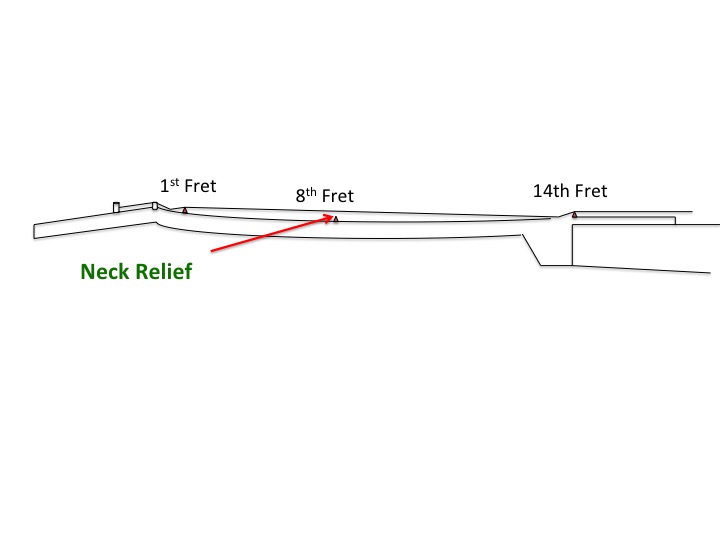
Exaggeregated for demonstration purposes. If a neck is ALL straight, and all frets level, regardless of nut or zero fret, all strings will buzz severely. All of us knows this, and thus, conclusion, first fret, zero fret, and the nut is ALWAYS higher/taller THANKS TO the relief a neck must have. Period.

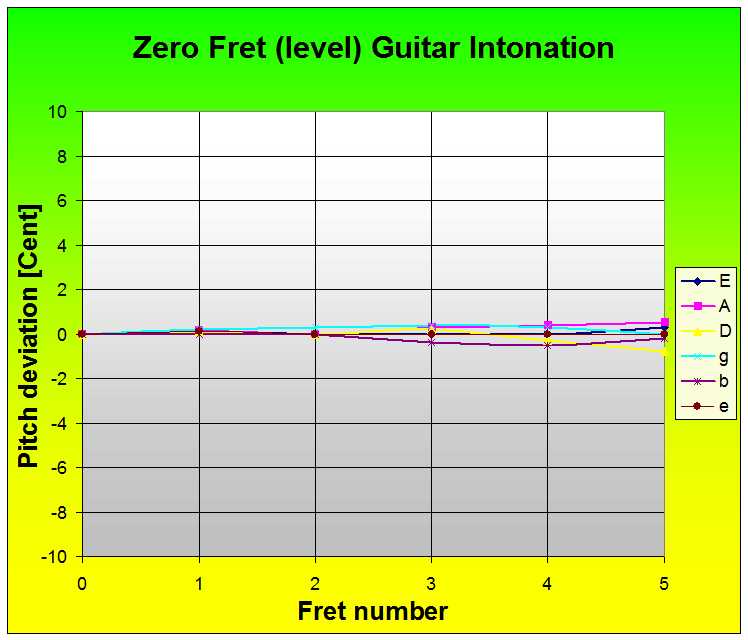
This is if nut (or really, slots) is at equal height as the zero fret. Christ, it's nothing new, just set a capo at 1st fret,tune down a half step, and then you'll have your zero fret, not suddenly higher or lower than the next to it. I have never seen a zero fret higher/taller than the rest of the frets. But boy, most nuts are on new guitars. If not all.
So conclusion: If a zero fret is levelled together with the rest of the frets, and set to the same level, exactly, it will reside just a tad higher (a hair) than the rest of the frets later on, due to/thanks to the natural relief you must put into the neck, when adjusting truss rod. Any nut or nut slots for the strings are ALWAYS too higher than this even and can't be remedied with truss rod adjustments only.
Last edited by Honch on Sun Aug 30, 2020 6:00 pm, edited 1 time in total.
Re: Intonation: Nut compensation
I've never seen one that isn't... There is a reason why nuts and zero frets are always higher than the first fret. I agree that nuts on mass produced new guitars are almost aways too much higher though.
Last edited by Sam Spoons on Sun Aug 30, 2020 5:59 pm, edited 2 times in total.
-
- Sam Spoons
Forum Aficionado - Posts: 22910 Joined: Thu Jan 23, 2003 12:00 am Location: Manchester UK
Still mourning the loss of my 'Jedi Poster" status
People often mistake me for a grown-up because of my age.
People often mistake me for a grown-up because of my age.
Re: Intonation: Nut compensation
Sam Spoons wrote: High frets are more likely to be over-fretted and mess up the pitch than lower frets (that is why scalloped fingerboards are so hard to play in tune).
.
Nahh, on electrics with thin gauge strings only. If you have an acoustic with thicker gauge, it stops you in the tracks. Remember, a pedal steel guitar player uses a stainless steel rod as a fret, and the only thing he does is damping with the rest of the fingers behind the rod, he doesn't press at all.
And yes, a very good incentive to not press down too hard on the frets, and start to get rid of bad habits you collected as a beginner. I can press alright on my railroad tracks equipped guitars, and the fretboard below doesn't act as a speed bump, brake, when bending, no friction. The frets doesn't need to be the tallest or widest or thickest, but a step or two above those "fretless wonders" frets that are almost flush with the fretboard. I do have a very staunch opinion at these, as if you don't have to press down as hard, you will not wear the frets out as fast either. The fret dents made are not from bending but always follows the strings "idle" line when you're just chording.
What I have experienced with all "low" frets is that players usually can't grip them properly when playing chords that involves more than three fingers, so they inadvertently BEND certain fingers and notes INSIDE a chord, bringing THOSE out of pitch as well, and then complains their guitars isn't in tune with itself. I see people bending strings when playing bass, one note at a time too, as they have not looked in the mirrors while playing.