I’ve been doing this a lot lately, it has many uses.
It can mask an annoying low level noise, it can glue things together, it can make a homogenous soundscape, it can make things sound more exciting, and like a lace veil over a woman’s face, in a similar way it can make music more beautiful and alluring.
It also turns the whole technical quality issue on its head, technical quality no longer becomes an issue, as you’re degrading things anyway.
This means you can now use anything to make your music as long as it makes a sound or records something, so now I use cassettes a lot, as they add some noise too, which you can shape and emphasise with EQ.
Noise on its own through effects can be interesting too, not in an obvious way, like plain white noise from a synthesiser, but something like pink noise put through unusual effects and added at a very low level to create a subtle underlying texture.
Even what we’re annoying hums and buzzes can be seen in a new light, depends what sort of music you make sure, but it’s worth experimenting with, if you haven’t done so already.
Adding noise.

Re: Adding noise.
I know what you mean Tony - sometimes it's the extra layer of 'grunge' that can turn a boring sound into something magical 
I also find it even more effective when placed against pristine sounds, as the contrast benefits them both.
It's even more fun if you find tools that let you alter the noise according to the dynamics of your musical signal.
Here's the fascinating freebie Noiiz Filter plug-in that does is: https://www.noiiz.com/plugins/3

And here's another low-cost yet even more flexible Noize2 plug-in from Denise Audio that also works well for me: https://www.denise.io/store/denise/Noize2
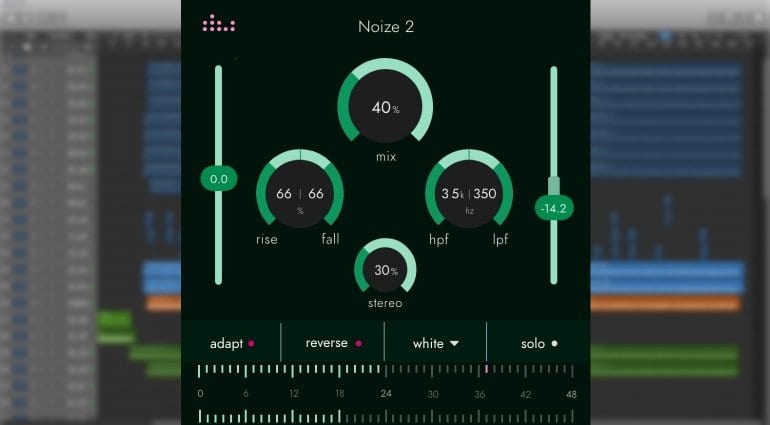
Great fun!
Martin
I also find it even more effective when placed against pristine sounds, as the contrast benefits them both.
It's even more fun if you find tools that let you alter the noise according to the dynamics of your musical signal.
Here's the fascinating freebie Noiiz Filter plug-in that does is: https://www.noiiz.com/plugins/3
And here's another low-cost yet even more flexible Noize2 plug-in from Denise Audio that also works well for me: https://www.denise.io/store/denise/Noize2
Great fun!
Martin
Last edited by Martin Walker on Tue Aug 11, 2020 1:15 am, edited 3 times in total.
-

- Martin Walker
Moderator -
Posts: 22574 Joined: Wed Jan 13, 2010 8:44 am
Location: Cornwall, UK
Contact:
Re: Adding noise.
ef37a wrote:THE WORLD HAS GONE MAD!!

How much of your career was spent trying to minimise noise?

-

- Drew Stephenson
Apprentice Guru -
Posts: 29713 Joined: Sun Jul 05, 2015 12:00 am
Location: York
Contact:
(The forumuser formerly known as Blinddrew)
Ignore the post count, I have no idea what I'm doing...
https://drewstephenson.bandcamp.com/
Ignore the post count, I have no idea what I'm doing...
https://drewstephenson.bandcamp.com/
Re: Adding noise.
blinddrew wrote:ef37a wrote:THE WORLD HAS GONE MAD!!
How much of your career was spent trying to minimise noise?
Well mot mine exactly Drew but all of the audio industry!
The rot set in with the arrival of those Aphex 'Enhancers' !!
To be fair I LOVED Switched on Bach and I guess noise was a factor in the makeup of the sounds but the result did not SOUND 'noisy'! I am also old enough to remember the fans battling to get pop onto FM and someone from the BBC had the temerity to say "Pop music doesn't really warrant a high quality sound channel". Snobby b*****d!
Dave.
Re: Adding noise.
I love the sound of an FM radio station that Is just a bit too far away so you can’t make out the material as it is as loud as the static. Radio static is an interesting noise.
-

- ManFromGlass
Longtime Poster - Posts: 7858 Joined: Sun Jul 24, 2011 12:00 am Location: O Canada
Re: Adding noise.
ManFromGlass wrote:I love the sound of an FM radio station that Is just a bit too far away so you can’t make out the material as it is as loud as the static. Radio static is an interesting noise.
Indeed it is, and I specifically bought a Koma Field Kit (among many other features) for its shortwave antenna input, because shortwave sounds can be even more fascinating. Sadly I need a far better aerial, as currently ti doesn't pick up anything useful down here in Cornwall

I must have another go and see if I can improve my shortwave reception, especially if my Internet connection has finally repaired itself
Martin
-
- Martin Walker
Moderator -
Posts: 22574 Joined: Wed Jan 13, 2010 8:44 am
Location: Cornwall, UK
Contact:
Re: Adding noise.
Bloody Americanism!
I often wonder how 'static' came to be the name for radio noise? By definition a static charge cannot generate any electro-magnetic energy.
Very confusingly people use the term in audio to mean anything from pre amp hiss to mains hum!
And, I was once told that about one spot per second of noise on a TV screen is a cosmic ray! (or is it from the Sun?)
Dave.
I often wonder how 'static' came to be the name for radio noise? By definition a static charge cannot generate any electro-magnetic energy.
Very confusingly people use the term in audio to mean anything from pre amp hiss to mains hum!
And, I was once told that about one spot per second of noise on a TV screen is a cosmic ray! (or is it from the Sun?)
Dave.
Re: Adding noise.
Martin Walker wrote:Sadly I need a far better aerial, as currently ti doesn't pick up anything useful down here in Cornwall
That's one of the reasons they sited the Goonhilly radio station there! Minimal interference!

-

- Hugh Robjohns
Moderator -
Posts: 43688 Joined: Fri Jul 25, 2003 12:00 am
Location: Worcestershire, UK
Contact:
Technical Editor, Sound On Sound...
(But generally posting my own personal views and not necessarily those of SOS, the company or the magazine!)
In my world, things get less strange when I read the manual...
(But generally posting my own personal views and not necessarily those of SOS, the company or the magazine!)
In my world, things get less strange when I read the manual...
Re: Adding noise.
Although it seems contradictory, I think there is something in the idea that a little noise can be helpful, and not just in audio terms.
Compare material shot on video and film. The grain 'noise' of film lends a quality which is absent on video, and which most people seem to find preferable. Dither for the eyes?
Compare material shot on video and film. The grain 'noise' of film lends a quality which is absent on video, and which most people seem to find preferable. Dither for the eyes?
-
- Hugh Robjohns
Moderator -
Posts: 43688 Joined: Fri Jul 25, 2003 12:00 am
Location: Worcestershire, UK
Contact:
Technical Editor, Sound On Sound...
(But generally posting my own personal views and not necessarily those of SOS, the company or the magazine!)
In my world, things get less strange when I read the manual...
(But generally posting my own personal views and not necessarily those of SOS, the company or the magazine!)
In my world, things get less strange when I read the manual...
Re: Adding noise.
Ah! Don't mind me, moaning old git.
I do find as I get older, deafer and blinder I need clearer sources not just for pleasure but for basic understanding!
Anyone who reads the Radio Times letters page (remember those? Letters?) will know that the vast majority of complaints about arty-fart programming with pitch dark scenes and mumbled dialogue come from the older and sensory challenge public. You know, the ones that pay the bulk of the license fee but get sidelined by the BBC whizzkids who want to sweep the 'old' stuff away in favour of the latest 'iTech.
Dave.
I do find as I get older, deafer and blinder I need clearer sources not just for pleasure but for basic understanding!
Anyone who reads the Radio Times letters page (remember those? Letters?) will know that the vast majority of complaints about arty-fart programming with pitch dark scenes and mumbled dialogue come from the older and sensory challenge public. You know, the ones that pay the bulk of the license fee but get sidelined by the BBC whizzkids who want to sweep the 'old' stuff away in favour of the latest 'iTech.
Dave.
Last edited by ef37a on Tue Aug 11, 2020 6:07 pm, edited 1 time in total.
Re: Adding noise.
ef37a wrote:Ah! Don't mind me, moaning old git.
I do find as I get older, deafer and blinder I need clearer sources not just for pleasure but for basic understanding!
Anyone who reads the Radio Times letters page (remember those? Letters?) will know that the vast majority of complaints about arty-fart programming with pitch dark scenes and mumbled dialogue come from the older and sensory challenge public. You know, the ones that pay the bulk of the license fee but get sidelined by the BBC whizzkids who want to sweep the 'old' stuff away in favour of the latest 'iTech.
Dave.
I wonder if the dark and mumbled dramas happen because the editors are using extremely high quality equipment and everything looks and sounds very clear to them?
Re: Adding noise.
RichardT wrote:ef37a wrote:Ah! Don't mind me, moaning old git.
I do find as I get older, deafer and blinder I need clearer sources not just for pleasure but for basic understanding!
Anyone who reads the Radio Times letters page (remember those? Letters?) will know that the vast majority of complaints about arty-fart programming with pitch dark scenes and mumbled dialogue come from the older and sensory challenge public. You know, the ones that pay the bulk of the license fee but get sidelined by the BBC whizzkids who want to sweep the 'old' stuff away in favour of the latest 'iTech.
Dave.
I wonder if the dark and mumbled dramas happen because the editors are using extremely high quality equipment and everything looks and sounds very clear to them?
Yes, they have been told that time out of number. For sure, IF I sit in the dark, in the dead quiet and listen on my Tannoys at 70-80dB I can hear pretty much everything and the (incessant!) background music even makes SOME kind of sense. I can see as well, once dark adapted but people don't WATCH telly like that! We watch cinema like that.
Dave.
Re: Adding noise.
I don't train BBC staff anymore (matter of policy!) but i was involved in a lot of BBC training in the run up to the launch of HDTV and for quite a few years afterwards. My input was covering all aspects of multichannel sound production, but I sat through the presentations from my colleagues on cameras, lighting, editing, QC and so forth. Most of it was for technical staff, obviously, but we also did a lot of courses specifically for production staff, making them aware of the possibilities and traps.
In my experience, the technical 'whizz kids' are usually well aware of what I shall call 'domestic compatibility' issues, and routinely point out potential problems before they become real problems.... But it seems depressingly common for production staff to ignore that advice, often through a combination of a lack of technical training and understanding, ambitions of Hollywood film epic dire tion, and general god-delusions!
I know for a fact that the mumbled dialogue in the Jamaica Inn series was flagged up by the sound recordist during on set blocking and the actual takes, and again by the editors during the editing, and again by the dubbing mixer in the dubbing... All ignored.
In my experience, the technical 'whizz kids' are usually well aware of what I shall call 'domestic compatibility' issues, and routinely point out potential problems before they become real problems.... But it seems depressingly common for production staff to ignore that advice, often through a combination of a lack of technical training and understanding, ambitions of Hollywood film epic dire tion, and general god-delusions!
I know for a fact that the mumbled dialogue in the Jamaica Inn series was flagged up by the sound recordist during on set blocking and the actual takes, and again by the editors during the editing, and again by the dubbing mixer in the dubbing... All ignored.
Last edited by Hugh Robjohns on Tue Aug 11, 2020 9:30 pm, edited 1 time in total.
-
- Hugh Robjohns
Moderator -
Posts: 43688 Joined: Fri Jul 25, 2003 12:00 am
Location: Worcestershire, UK
Contact:
Technical Editor, Sound On Sound...
(But generally posting my own personal views and not necessarily those of SOS, the company or the magazine!)
In my world, things get less strange when I read the manual...
(But generally posting my own personal views and not necessarily those of SOS, the company or the magazine!)
In my world, things get less strange when I read the manual...
Re: Adding noise.
Hugh Robjohns wrote:Although it seems contradictory, I think there is something in the idea that a little noise can be helpful, and not just in audio terms.
Before I got into the restoration business I remember reading about some trials that Cedar did where they found that people preferred the samples where they had left a little noise rather than removing it completely. Apparently the samples with no noise sounded too dull (although the actual balance of the wanted audio was the same).
I'm not sure where I read this but it was possibly an old internet post by Gordon Reid.
-

- James Perrett
Moderator -
Posts: 16986 Joined: Mon Sep 10, 2001 12:00 am
Location: The wilds of Hampshire
Contact:
JRP Music - Audio Mastering and Restoration. JRP Music Facebook Page
Re: Adding noise.
Fun fact.
There is a brain disorder where people can't filter out noise from 'useful' information. I knew someone who suffered from it. If you were talking to him and there was even a quite low level of background sound, he had great difficulty understanding you. You won't be surprised to know he never went into pubs or busy markets etc.
There is a brain disorder where people can't filter out noise from 'useful' information. I knew someone who suffered from it. If you were talking to him and there was even a quite low level of background sound, he had great difficulty understanding you. You won't be surprised to know he never went into pubs or busy markets etc.
-

- Folderol
Forum Aficionado -
Posts: 20879 Joined: Sat Nov 15, 2008 12:00 am
Location: The Mudway Towns, UK
Contact:
Seemingly no longer an 'elderly'.
Now a 'Senior'. Is that promotion?
Now a 'Senior'. Is that promotion?
Re: Adding noise.
Folderol wrote:Fun fact.
There is a brain disorder where people can't filter out noise from 'useful' information. I knew someone who suffered from it. If you were talking to him and there was even a quite low level of background sound, he had great difficulty understanding you. You won't be surprised to know he never went into pubs or busy markets etc.
I suffer from this. I find it really hard to hear what people are saying if there are other conversations going on. I never knew it was a thing! I hate pubs too...
I also suffer from mild face blindness which can make watching TV dramas a little confusing.
Re: Adding noise.
Hugh Robjohns wrote:Although it seems contradictory, I think there is something in the idea that a little noise can be helpful, and not just in audio terms.
Compare material shot on video and film. The grain 'noise' of film lends a quality which is absent on video, and which most people seem to find preferable. Dither for the eyes?
I dont think most people do like film grain per se. These days some people so used to modern HD video complain when older films are presented with the film grain intact. So "degrain" software has been developed. It may have some benefit but as so often it tends to be used to excess, basically defocussing the picture...Master film restorationist Robert A. Harris has some choice words about "degraining" film remasterings...
Then audio tape noise. Some of us recently listened to a Dire Straits track from "Love over Gold". In the quiet intro and ending there is audible hiss. Does it add to the experience? For me it adds nothing but only detracts. It's an intruder. But if I'm transferring an analog audio tape I aim to capture every bit of the programme, including the tape hiss, because that is the information on the tape. If I've captured that I have likely also captured all of the HF information in the programme. I also check that the hiss that I am hearing really is tape hiss and not repro preamp hiss, which is so often assumed to be the same thing. But that's another issue.
The problem is that both in film and audio, there is no clear demarcation line between the background "noise" and the quiet programme. They are mixed together like scrambled eggs and cant be easily unmixed. I know I can bang on about it but so much of "Degraining" and Denoising" involves removing noise AND low level wanted information - and not even noticing we have done it. Part of this seems from a failure to listen critically and look critically, comparing the original with our "restoration" effort.
I will tolerate the grain and the hiss not because they are good in themselves but because so often mixed in with them is the finer picture and sound detail. The best sound and picture transfers give us everything that is on the film or tape that is wanted programme and if they do that they will often unavoidably include some noise.
I've just been loaned from the owner a small 8mm film I shot for him back in 1976 (I hadnt made or kept a copy) plus the digitised transfer he later had made of it by a transfer house. The complaint from the owner is that on the transfer he cant make out some people's faces because "it's too dark" which it is. A lot of the shadow detail is missing on the transfer. I know that because I have just projected the original film then the digitised copy and compared. Face detail in dark sections of the film is intact but in the digitised copy it's just gray nothingness.
There is also loss of picture detail (even though it is only 8mm film and so not much detail to begin with) and no surprise, the film grain is largely absent. But we cant have one without the other. I'm planning to have the film retransferred paying attention to shadow detail and resolution of fine detail. Inevitably there will be visible grain that is not visible in the poor transfer. But that's not the point. Now we will see all of the picture!
If we can retain all of the sound and picture detail while removing extraneous noise, so much the better. If we cant, I for one prefer to see and hear all of the wanted detail and put up with some noise.
I dont think most people do enjoy film grain or tape noise and audio and video production seems to reflect that. The exception seems to be special/artistic effects.
Last edited by Tim Gillett on Wed Aug 12, 2020 12:22 am, edited 7 times in total.
-
- Tim Gillett
Frequent Poster - Posts: 2707 Joined: Wed Jan 30, 2013 12:00 am Location: Perth, Western Australia
Re: Adding noise.
Maybe we like this noise because it’s like being in the womb? It makes us feel cozy, and secure.
We have the luxury now of using noise as a creative tool, and, as time goes on, certain types of noise help us reference certain times in the past when some decades had a different flavour of noise, the sound of static on the radio, the sound of 78 rpm shellac records, the sound of vinyl, and of tape, the texture of 8 mm film, the look of VHS video, Technicolour, Delux, etc.
What were problems at the time because we had no choice, have become sounds in their own right.
We have the luxury now of using noise as a creative tool, and, as time goes on, certain types of noise help us reference certain times in the past when some decades had a different flavour of noise, the sound of static on the radio, the sound of 78 rpm shellac records, the sound of vinyl, and of tape, the texture of 8 mm film, the look of VHS video, Technicolour, Delux, etc.
What were problems at the time because we had no choice, have become sounds in their own right.
Last edited by Arpangel on Wed Aug 12, 2020 7:01 am, edited 3 times in total.
"I will not say: do not weep; for not all tears are an evil" Gandalf - J.R.R. Tolkien.
Re: Adding noise.
James Perrett wrote:Hugh Robjohns wrote:Although it seems contradictory, I think there is something in the idea that a little noise can be helpful, and not just in audio terms.
Before I got into the restoration business I remember reading about some trials that Cedar did where they found that people preferred the samples where they had left a little noise rather than removing it completely. Apparently the samples with no noise sounded too dull (although the actual balance of the wanted audio was the same).
I'm not sure where I read this but it was possibly an old internet post by Gordon Reid.
This may have been in the midst of the Dolby arguments? Dolby tests found people preferred un-decoded, i.e. noisy samples to processed ones even though the Dolbyed version had a flat response. However, if they added a little noise back into the Dolbyed track folks could not tell it from the original.
The tests were not about 'noise' but to prove that Dolby processing did not add artifacts as many were claiming at the time. The effect is similar I supposed to the fact that given a choice, people like the louder version of a clip most of the time.
Dave.
Re: Adding noise.
Folderol wrote:Fun fact.
There is a brain disorder where people can't filter out noise from 'useful' information. I knew someone who suffered from it. If you were talking to him and there was even a quite low level of background sound, he had great difficulty understanding you. You won't be surprised to know he never went into pubs or busy markets etc.
That is how my deafness affects me. I am 20dB down at 2kHz and then go down at 6dB/oct.
Most of the top string of violin is absent for me as is the last octave of a grand Joe. But understanding people goes further than that. One on one without noise competition (TVs should be banned in chippies!) I am very good but any kind of background noise and I am buggered. Especially 'voices off'. Whoever thought up the Open Office wants shooting!
Any kind of strong accent, be it Indian sub C or Glaswegian and I am stuffed. There are many doctors and nurses at our GH that I simply don't 'get'. People also speak to quickly. I ask them to slow down and they do, for a bit but I have to constantly get them to back up.
Phones are nightmare. ANY company you call has a robotic menu system. That is fine and generally I can understand it but, once through to a person the level invariably drops by 10dB! I then have to switch to speaker phone to boost them. Put on hold and the music is always very loud compared to speech.
Fewer and fewer companies have email contact. I am seriously considering moving my bank from Nat West!
Again, judging by the letters in RT I am not that rare? A lot of complaints are about loud music masking dialogue.
Dave.
Re: Adding noise.
ef37a wrote:Again, judging by the letters in RT I am not that rare? A lot of complaints are about loud music masking dialogue.
No, you're not rare at all, and there are very active lobbies -- both on the consumer and professional technical side -- campaigning constantly to try and find ways of addressing the problem.... Some progress has been made but it's very much an uphill struggle, with the trend being towards finding technologies that provide special options for the HoH , rather than encouraging a more universally-compatible mix balance.
In days of old, when the broadcasting companies trained their own staff, made their own programmes entirely in house, and had engineering directorates that set and maintained standards, there were policies and practices in place to avoid these kinds of problems as much as possible.
Today, none of those things exist... and programmes are made, in general, by relatively young people who don't have hearing issues (yet), who don't appreciate the problem, and who wouldn't follow any guidance even if some were offered.
-
- Hugh Robjohns
Moderator -
Posts: 43688 Joined: Fri Jul 25, 2003 12:00 am
Location: Worcestershire, UK
Contact:
Technical Editor, Sound On Sound...
(But generally posting my own personal views and not necessarily those of SOS, the company or the magazine!)
In my world, things get less strange when I read the manual...
(But generally posting my own personal views and not necessarily those of SOS, the company or the magazine!)
In my world, things get less strange when I read the manual...
Re: Adding noise.
Thanks Hugh. The American documentaries are the worst offenders. Why we need crashing music while the camera flies through some glorious autumn forest I cannot understand!
Even home grown stuff offends. I recall a sequence showing the silent(!) flight of an owl to its handler, with of course the obligatory underlying music!
I doubt they can even claim they are giving work to musicians? Probably just a kid with a box of samples doing it for naff all!
Dave.
Even home grown stuff offends. I recall a sequence showing the silent(!) flight of an owl to its handler, with of course the obligatory underlying music!
I doubt they can even claim they are giving work to musicians? Probably just a kid with a box of samples doing it for naff all!
Dave.