I was surprised recently to discover that my Beyer DT990 Pro studio headphones (impedance 250Ohms) and AKG K702 studio headphones (65Ohms) sound quite different when plugged into my Steinberg UR22c interface (output impedance 40Ohms).
I gather they're both /fairly/ well thought of for monitoring purposes, so, all things being equal you'd hope there was some resemblance. But they're not equal!
Experienced hands will immediately recognise the problem: I read that leaving aside the question of volume inside the cans, headphone impedance should usually be 2.5x-8x the amp output impedance in order for the amp to properly control the voicecoils. This is called the 'damping factor'.
The DT990s are therefore apparently within range when used with the UR22c (and produce quite enough volume for my taste), but the k702s are not, for their damping factor is just a hair over 1.5, when it should be a minimum of 2.5.
So here's my question: is there a recommended cheap as chips low output impedance headphone amp that would sit between the interface and the k702s without screwing up the sound in some interesting new way please? Some inexpensive battery powered thingie might do it, I guess, but few sellers publish specs, that I've seen.
Or is there some other technical fix, such as an in-line impedance?
Or have I misunderstood the whole thing, or been hopelessly misled? (I only vaguely remember damping factors from studying physics 45 years ago...)
Thanks, Gavin
Matching usb interface output impedance with k702 headphones
Matching usb interface output impedance with k702 headphones
Last edited by forumuser915213 on Tue Apr 13, 2021 10:20 pm, edited 3 times in total.
-
- forumuser915213
Regular - Posts: 143 Joined: Fri Jan 26, 2018 1:08 pm Location: Kent
Re: Matching usb interface output impedance with k702 headphones
If you're into D.I.Y a pair of LM386 chips with a handful of components would run happily off a PP3. This would cost about a fiver all told. The box to put it in would cost more!
Distortion when driving an 8 ohm load is 0.2%, and that would be a lot lower at headphone impedance.
You can also get single chip ones, but they are far more fiddly to set up.
Distortion when driving an 8 ohm load is 0.2%, and that would be a lot lower at headphone impedance.
You can also get single chip ones, but they are far more fiddly to set up.
Last edited by Folderol on Tue Apr 13, 2021 9:47 pm, edited 4 times in total.
-

- Folderol
Forum Aficionado -
Posts: 20876 Joined: Sat Nov 15, 2008 12:00 am
Location: The Mudway Towns, UK
Contact:
Seemingly no longer an 'elderly'.
Now a 'Senior'. Is that promotion?
Now a 'Senior'. Is that promotion?
Re: Matching usb interface output impedance with k702 headphones
If you look at the plots on the Sonarworks review for the DT990 you'll find that it has nothing like a flat response. The actually curve resembles a typical smiley curve. I couldn't find a review for the K702 but the K712 has a very different frequency response to the DT990. So I don't think your headphone amp is the problem - you're just listening to two pairs of headphones with very different sounds.
-

- James Perrett
Moderator -
Posts: 16984 Joined: Mon Sep 10, 2001 12:00 am
Location: The wilds of Hampshire
Contact:
JRP Music - Audio Mastering and Restoration. JRP Music Facebook Page
Re: Matching usb interface output impedance with k702 headphones
"Or have I misunderstood the whole thing, or been hopelessly mislead? (I only vaguely remember damping factors from studying physics 45 years ago... "
A bit I think, let me refresh both our memories? "Damping factor" is the ratio of load impedance to amplifier output impedance. Thinking of amps driving speakers for a moment, a high grade transistor amp might claim a DF of 200 for an 8 Ohm speaker. That means the output impedance of the amplifier is 8/200 =0.04 Ohms. Purveyors of amplifiers make great a fuss of this but never point out that the speaker has a DC resistance of about 6 Ohms and so an output Z much lower than say 0.1 Ohms is pretty pointless AFAICS but there are other opinions about this.
"Electro-magnetic damping" is proportional to magnet strength and the 'Ampere turns' in the coil. The current through headphones is of course proportional to drive voltage and total circuit resistance. Now, it turns out that the DC resistance of dynamic headphones is always just about the same as their stated impedance (just checked my AKG K92s, 33 Ohms DC resistance, Nom Z 32 Ohms)
For decades headphone amplifiers used a physical resistor in their output. This protected the circuit from shorts but also helped even out the drive to the various headphone impedances.
There has arisen in the last few years a 'fashion' for HP amps to have a very low, near zero OPZ but I have read of no good reason for this. BTW the UR22 has a headphone output of 40 Ohms. Typo?
I do not pretend any qualifications or expertise in the matter, just a smattering of casual learning. Perhaps some one could explain it all? Backed up by physical tests of course.
Dave.
A bit I think, let me refresh both our memories? "Damping factor" is the ratio of load impedance to amplifier output impedance. Thinking of amps driving speakers for a moment, a high grade transistor amp might claim a DF of 200 for an 8 Ohm speaker. That means the output impedance of the amplifier is 8/200 =0.04 Ohms. Purveyors of amplifiers make great a fuss of this but never point out that the speaker has a DC resistance of about 6 Ohms and so an output Z much lower than say 0.1 Ohms is pretty pointless AFAICS but there are other opinions about this.
"Electro-magnetic damping" is proportional to magnet strength and the 'Ampere turns' in the coil. The current through headphones is of course proportional to drive voltage and total circuit resistance. Now, it turns out that the DC resistance of dynamic headphones is always just about the same as their stated impedance (just checked my AKG K92s, 33 Ohms DC resistance, Nom Z 32 Ohms)
For decades headphone amplifiers used a physical resistor in their output. This protected the circuit from shorts but also helped even out the drive to the various headphone impedances.
There has arisen in the last few years a 'fashion' for HP amps to have a very low, near zero OPZ but I have read of no good reason for this. BTW the UR22 has a headphone output of 40 Ohms. Typo?
I do not pretend any qualifications or expertise in the matter, just a smattering of casual learning. Perhaps some one could explain it all? Backed up by physical tests of course.
Dave.
Re: Matching usb interface output impedance with k702 headphones
Thanks for your thoughts folks.
I wasn't thinking of getting into diy... Maybe if things become desperate
I've seen the Sonarworks plots. The differences are striking, and I don't want to add to them!
I would point out that while the Sonarworks demo makes the two sets of headphones sound more similar, they're still far from identical and I don't know which is more nearly correct.
It may be that I've been misled by what I've read. It was online after all
It turns out there are little combination DAC-headphone amps with 3.5mm input sockets for sale out there, and a few sellers quote appropriate headphone impedances. They say nothing about linearity or distortion, however..
Gavin
I wasn't thinking of getting into diy... Maybe if things become desperate
I've seen the Sonarworks plots. The differences are striking, and I don't want to add to them!
I would point out that while the Sonarworks demo makes the two sets of headphones sound more similar, they're still far from identical and I don't know which is more nearly correct.
It may be that I've been misled by what I've read. It was online after all
It turns out there are little combination DAC-headphone amps with 3.5mm input sockets for sale out there, and a few sellers quote appropriate headphone impedances. They say nothing about linearity or distortion, however..
Gavin
Last edited by forumuser915213 on Tue Apr 13, 2021 10:42 pm, edited 1 time in total.
-
- forumuser915213
Regular - Posts: 143 Joined: Fri Jan 26, 2018 1:08 pm Location: Kent
Re: Matching usb interface output impedance with k702 headphones
Hi Gavin!
I suspect James has the correct answer - those two pairs of headphones are likely to sound rather different whatever headphone amp you feed them from. Your brain can however eventually get used to the sound of particular headphones and let you create mixes that translate, or you can use EQ software to compensate for their different sounds so that whichever headphones you use they sound similar.
And for Dave & Gavin, here are some sensible facts and figures about headphones and their amps:
QUOTE "The IEC 61938 standard goes even further in recommending an output resistance of 120 ohms, noting that "For most types of headphones, the source impedance has very little effect on the performance."
However, many headphones exhibit a wide variation of impedance across the frequency range, so read on here for a good explanation (and some graphs for Dave) of the resultant effects:
https://www.stereophile.com/content/bet ... nes-page-4
Martin
I suspect James has the correct answer - those two pairs of headphones are likely to sound rather different whatever headphone amp you feed them from. Your brain can however eventually get used to the sound of particular headphones and let you create mixes that translate, or you can use EQ software to compensate for their different sounds so that whichever headphones you use they sound similar.
And for Dave & Gavin, here are some sensible facts and figures about headphones and their amps:
QUOTE "The IEC 61938 standard goes even further in recommending an output resistance of 120 ohms, noting that "For most types of headphones, the source impedance has very little effect on the performance."
However, many headphones exhibit a wide variation of impedance across the frequency range, so read on here for a good explanation (and some graphs for Dave
) of the resultant effects:https://www.stereophile.com/content/bet ... nes-page-4
Martin
Last edited by Martin Walker on Tue Apr 13, 2021 10:52 pm, edited 6 times in total.
-

- Martin Walker
Moderator -
Posts: 22574 Joined: Wed Jan 13, 2010 8:44 am
Location: Cornwall, UK
Contact:
Re: Matching usb interface output impedance with k702 headphones
I'm with James and Martin on this one; the tonal differences between the Beyer and AKG are intentional and down to the design of the specific headphones. I don't think the output impedance of the headphone amp will have a significant* impact on that aspect...
I have a couple of Benchmark DAC1 headphone amps with near zero output impedance, and my AKG k702s still sound very different both to my Beyer DT990s and my Sennheiser HD600s...
*Edited to add: I didn't realise the Behringer interface had a 90-ish Ohm output impedance which is pretty high by modern standards...
...but even then the resulting frequency response peaks/troughs due to the high source impedance will rarely amount to more than a dB or two unless the headphone's nominal impedance is particularly low and the tonal differences between different brands of headphone typically outweigh that quite comprehensively, especially at the frequency extremes!
That said, you will always get less amp/headphone interaction if the headphone's nominal impedance is much higher than the amp's output impedance -- so choosing phone's with a 250 Ohm (or higher) impedance will largely circumvent the problem of different amp output impedances... But the downside will be lower maximum volume, especially with portable devices.
I have a couple of Benchmark DAC1 headphone amps with near zero output impedance, and my AKG k702s still sound very different both to my Beyer DT990s and my Sennheiser HD600s...
*Edited to add: I didn't realise the Behringer interface had a 90-ish Ohm output impedance which is pretty high by modern standards...
...but even then the resulting frequency response peaks/troughs due to the high source impedance will rarely amount to more than a dB or two unless the headphone's nominal impedance is particularly low and the tonal differences between different brands of headphone typically outweigh that quite comprehensively, especially at the frequency extremes!
That said, you will always get less amp/headphone interaction if the headphone's nominal impedance is much higher than the amp's output impedance -- so choosing phone's with a 250 Ohm (or higher) impedance will largely circumvent the problem of different amp output impedances... But the downside will be lower maximum volume, especially with portable devices.
Last edited by Hugh Robjohns on Wed Apr 14, 2021 11:27 am, edited 2 times in total.
-

- Hugh Robjohns
Moderator -
Posts: 43685 Joined: Fri Jul 25, 2003 12:00 am
Location: Worcestershire, UK
Contact:
Technical Editor, Sound On Sound...
(But generally posting my own personal views and not necessarily those of SOS, the company or the magazine!)
In my world, things get less strange when I read the manual...
(But generally posting my own personal views and not necessarily those of SOS, the company or the magazine!)
In my world, things get less strange when I read the manual...
Re: Matching usb interface output impedance with k702 headphones
Martin Walker wrote:Hi Gavin!
However, most headphones exhibit a wide variation of impedance across the frequency range, so read on here for a good explanation of the resultant effects:
https://www.stereophile.com/content/bet ... nes-page-4
Martin
I learned long ago that transducers such as turntable cartridges, speakers and mics are widely variable between models, even when they look similar, are made of similar materials and likely have similar design aims.
So I wasn't surprised to find them different - yet I was surprised to find them so very different. I'm not sure I could ever 'know' a pair of headphones well enough to compensate for their weaknesses. I instinctively appreciate the detail of the AKGs and the pleasing if more smeary tone of the Beyerdynamics - and daren't trust my judgement based on either.
I guess this is just another of life's questions with no very clear answer. Thanks for all your thoughts once more.
Gavin
Last edited by forumuser915213 on Tue Apr 13, 2021 11:10 pm, edited 5 times in total.
-
- forumuser915213
Regular - Posts: 143 Joined: Fri Jan 26, 2018 1:08 pm Location: Kent
Re: Matching usb interface output impedance with k702 headphones
forumuser915213 wrote:I'm not sure I could ever 'know' a pair of headphones well enough to compensate for their weaknesses. I instinctively appreciate the detail of the AKGs and the pleasing if more smeary tone of the Beyerdynamics - and daren't trust my judgement based on either.
I'm from the school that prefers to equalise different headphones using Sonarworks to make them sound more 'similar', both to each other, and to the loudspeakers in my little studio.
The Elf on the other hand prefers to get used to the (IMO) unique sound of his AKG K701/702's 'as is', doesn't like using corrective EQ, AND gets great translatable mixes.
There's no one right way!
Martin
Last edited by Martin Walker on Tue Apr 13, 2021 11:39 pm, edited 1 time in total.
-
- Martin Walker
Moderator -
Posts: 22574 Joined: Wed Jan 13, 2010 8:44 am
Location: Cornwall, UK
Contact:
Re: Matching usb interface output impedance with k702 headphones
The other thing to bear in mind when talking about Sonarworks correction and why different models / makes of phones still sound different even after correction with the demo is - those are just applying the "Average" profiles.
I would think that if you compared sets of phones across different manufacturers and models that have had them do a custom measurement, you would find a far closer match.
I would think that if you compared sets of phones across different manufacturers and models that have had them do a custom measurement, you would find a far closer match.
-
- n o i s e f l e ur
Regular - Posts: 424 Joined: Sat Aug 04, 2018 6:20 am
Re: Matching usb interface output impedance with k702 headphones
Martin Walker wrote:forumuser915213 wrote:I'm not sure I could ever 'know' a pair of headphones well enough to compensate for their weaknesses. I instinctively appreciate the detail of the AKGs and the pleasing if more smeary tone of the Beyerdynamics - and daren't trust my judgement based on either.
I'm from the school that prefers to equalise different headphones using Sonarworks to make them sound more 'similar', both to each other, and to the loudspeakers in my little studio.
The Elf on the other hand prefers to get used to the (IMO) unique sound of his AKG K701/702's 'as is', doesn't like using corrective EQ, AND gets great translatable mixes.
There's no one right way!
Martin
Could yourself Martin and the other highly experienced chaps at SoS comment on whether the differences between high end monitor speakers are as great as they seem to be for 'so called reference' headphones? After all, you and the likes of Hugh, Paul et al get to audition vastly more high end kit that us mere mortals could in several lifetimes.
My guess is that monitors at the £2000+ per pr are more consistent brand to brand than similarly 'high end' headphones. That, IMHO would go some way to answer the increasingly posed question "can I make good mixes on headphones?" My suspicion is "yes" but top end monitors (in a good room) will always be better?
Dave.
Re: Matching usb interface output impedance with k702 headphones
n o i s e f l e ur wrote:The other thing to bear in mind when talking about Sonarworks correction and why different models / makes of phones still sound different even after correction with the demo is - those are just applying the "Average" profiles.
I would think that if you compared sets of phones across different manufacturers and models that have had them do a custom measurement, you would find a far closer match.
Hmm... the definition of "good manufacturer" is that the variance between different items of the same model will be small. A custom measurement will go the extra mile, but all the previous miles are the ones that matter most! I would be very surprised if two different DT990Pro would sound _very_ different, in an obvious way.
I have a number of AT M50x for tracking here, and one AT M40x. The former all sound pretty much the same to me and the clients, they're literally interchangeable. The M40x sounds a little different though - not much, but for example you need to adjust the listening volume level as they are noticeably harder to drive.
Also by definition, headphone correcting software can take into account only the headphones, and there's more in the chain that the headphone. Try to put the same headphones and a correction software on a laptop's phones out vs. a good monitor controller and you will need to adjust.
It's not like these softwares aren't useful - they obviously are, as many people here attest; and what works, works. But they can do only so much without having data on the full chain at every single desk.
I guess the reason for which they are useful is because - for mixing - absolute sound is (within reason) less important than the ability to discern details and not mix up the relative relationships between the various frequency bands.
With the usual color analogy, all glasses will alter the whites a little bit, but what's important is that yellows stay yellowish and the reds stay reddish and if there's a hue change between two reds, the relative difference is preserved. In these conditions, the precise yellow and reds become less important (so long they don't become blues and greens!), because human perception is based much more on relative differences than absolute values.
If Sonarworks and similar brings different headphones a bit closer in that respect, it can become easier for many not to have to re-adapt as much as otherwise.
Last edited by CS70 on Wed Apr 14, 2021 8:50 am, edited 6 times in total.

Silver Spoon - Check out our latest video and the FB page
Re: Matching usb interface output impedance with k702 headphones
Do you have a custom profile for any phones from Sonarworks and have you made that comparison?
-
- n o i s e f l e ur
Regular - Posts: 424 Joined: Sat Aug 04, 2018 6:20 am
Re: Matching usb interface output impedance with k702 headphones
n o i s e f l e ur wrote:Do you have a custom profile for any phones from Sonarworks and have you made that comparison?
No, still have my ears
 If several different phones aren't the different, any customization can't find any difference, right? Or do you mean something else?
Silver Spoon - Check out our latest video and the FB page
Re: Matching usb interface output impedance with k702 headphones
ef37a wrote:Could yourself Martin and the other highly experienced chaps at SOS comment on whether the differences between high end monitor speakers are as great as they seem to be for 'so called reference' headphones?
I don't think they are quite as great, but there are certainly significant differences both in the on-axis response and, possibly more importantly, in their off-axis response which affects the way they integrate into different rooms.
My guess is that monitors at the £2000+ per pr are more consistent brand to brand than similarly 'high end' headphones.
Yes, I'd agree to that.
-
- Hugh Robjohns
Moderator -
Posts: 43685 Joined: Fri Jul 25, 2003 12:00 am
Location: Worcestershire, UK
Contact:
Technical Editor, Sound On Sound...
(But generally posting my own personal views and not necessarily those of SOS, the company or the magazine!)
In my world, things get less strange when I read the manual...
(But generally posting my own personal views and not necessarily those of SOS, the company or the magazine!)
In my world, things get less strange when I read the manual...
Re: Matching usb interface output impedance with k702 headphones
CS70 wrote:With the usual color analogy, all glasses will alter the whites a little bit, but what's important is that yellows stay yellowish and the reds stay reddish and if there's a hue change between two reds, the relative difference is preserved. In these conditions, the precise yellow and reds become less important (so long they don't become blues and greens!), because human perception is based much more on relative differences than absolute values.
If Sonarworks and similar brings different headphones a bit closer in that respect, it can become easier for many not to have to re-adapt as much as otherwise.
I think this is why I use Sonarworks. I find that with it engaged the tonal balance of my monitors is close enough to my headphones that I don't feel the need to reach for the EQ when toggling between them. Without it, there's a different emphasis in the highs that would have me second guessing myself a bit.
I could learn it, but it's easier for me not to have to.
But I always mix in the same room with the same kit. For more peregrinetic people this won't be the case.
-

- Drew Stephenson
Apprentice Guru -
Posts: 29709 Joined: Sun Jul 05, 2015 12:00 am
Location: York
Contact:
(The forumuser formerly known as Blinddrew)
Ignore the post count, I have no idea what I'm doing...
https://drewstephenson.bandcamp.com/
Ignore the post count, I have no idea what I'm doing...
https://drewstephenson.bandcamp.com/
Re: Matching usb interface output impedance with k702 headphones
I recently viewed this (what appears to be a technically decent) test of the headphone output of a range of current audio interfaces. Quite interesting results and showing how different they all are.
https://youtu.be/xLShpyzwvJs
According the video, their test results showed a 90 ohm output impedance at 1kHz for the UR22C. Well worth a look.
https://youtu.be/xLShpyzwvJs
According the video, their test results showed a 90 ohm output impedance at 1kHz for the UR22C. Well worth a look.

Reliably fallible.
Re: Matching usb interface output impedance with k702 headphones
Douglas Self has written a good explanation of the workings of headphone amps in Chapter 20 of his Small Signal Audio Design book: https://www.soundonsound.com/reviews/small-signal-audio-design-2nd-edition
In it he explains that the the signal voltage required to generate, say, 110dB SPL across a range of typical headphone impedances (30-600 Ohms) ranges from 0.11 to 1.1V, with higher impedances obviously needing more voltage.
The potential problem, then, is that if a 1.1V swing intended to generate a loud output on 600 Ohms phones was applied to 30 Ohm phones it would either destroy the phones, or the ears, or both...
The 'traditional solution' to this problem was to connect the headphones via a series resistor of between 50-100 Ohms since this approach automatically reduces the maximum voltage available for lower impedance headphones -- so it is a 'safety feature'. It also protects the amp from output short circuits, of course.
It would appear that this is the policy adopted by the Behringer interface headphone amp which, at 90 Ohms, is remarkably high for a modern headphone amp and smacks of an 'old-school' approach!
There are various ways of reducing or removing the output resistor to achieve a near-zero output impedance, and Self explains some of the them in the chapter... but, interestingly, most of his own designs seem to keep a resistor in place of between 47 and 66 Ohms.
There's a fascinating white paper here from Benchmark about why they design and use '0-Ohm' headphone amps... but even there the frequency response variations between a '0-Ohm' output impedance and a 30 Ohm output is only about 0.7dB at maximum (at the system resonance), while most of the amplitude variation is below 0.2dB... so not really noticeable!
In it he explains that the the signal voltage required to generate, say, 110dB SPL across a range of typical headphone impedances (30-600 Ohms) ranges from 0.11 to 1.1V, with higher impedances obviously needing more voltage.
The potential problem, then, is that if a 1.1V swing intended to generate a loud output on 600 Ohms phones was applied to 30 Ohm phones it would either destroy the phones, or the ears, or both...
The 'traditional solution' to this problem was to connect the headphones via a series resistor of between 50-100 Ohms since this approach automatically reduces the maximum voltage available for lower impedance headphones -- so it is a 'safety feature'. It also protects the amp from output short circuits, of course.
It would appear that this is the policy adopted by the Behringer interface headphone amp which, at 90 Ohms, is remarkably high for a modern headphone amp and smacks of an 'old-school' approach!
There are various ways of reducing or removing the output resistor to achieve a near-zero output impedance, and Self explains some of the them in the chapter... but, interestingly, most of his own designs seem to keep a resistor in place of between 47 and 66 Ohms.
There's a fascinating white paper here from Benchmark about why they design and use '0-Ohm' headphone amps... but even there the frequency response variations between a '0-Ohm' output impedance and a 30 Ohm output is only about 0.7dB at maximum (at the system resonance), while most of the amplitude variation is below 0.2dB... so not really noticeable!
-
- Hugh Robjohns
Moderator -
Posts: 43685 Joined: Fri Jul 25, 2003 12:00 am
Location: Worcestershire, UK
Contact:
Technical Editor, Sound On Sound...
(But generally posting my own personal views and not necessarily those of SOS, the company or the magazine!)
In my world, things get less strange when I read the manual...
(But generally posting my own personal views and not necessarily those of SOS, the company or the magazine!)
In my world, things get less strange when I read the manual...
Re: Matching usb interface output impedance with k702 headphones
Hugh, I have read the print off my 'Small Signal" book and I don't recall a part dealing with near zero headphone amplifiers?
I do remember the near zero impedance technique for low power line outputs and I have wondered if the same technique could be scaled up for a headphone amplifier? The resistor would be kept as short protection but 'cancelled' by the feedback arrangement.
Do you perhaps have a newer edition?
I have reservations about 'protected, very low output impedance' amplifiers because any form of VI limiting 'can' impinge on sound quality. I will give the top people like Benchmark their due, expensive, superbly designed equipment but the 'fashion' is now being seen in the prosumer market and the circuits are maybe not so sophisticated? There was nothing wrong with 'A Resistor' IMHO. K.I.S.S! (Any chance of a few ad hoc THD test?)
Finally I have to think that the designers of headphones knew that they would be driven from a significant pure resistance over the range 22 to maybe 120 Ohms and built them accordingly.
I shall have a look at that link.
Dave.
I do remember the near zero impedance technique for low power line outputs and I have wondered if the same technique could be scaled up for a headphone amplifier? The resistor would be kept as short protection but 'cancelled' by the feedback arrangement.
Do you perhaps have a newer edition?
I have reservations about 'protected, very low output impedance' amplifiers because any form of VI limiting 'can' impinge on sound quality. I will give the top people like Benchmark their due, expensive, superbly designed equipment but the 'fashion' is now being seen in the prosumer market and the circuits are maybe not so sophisticated? There was nothing wrong with 'A Resistor' IMHO. K.I.S.S! (Any chance of a few ad hoc THD test?)
Finally I have to think that the designers of headphones knew that they would be driven from a significant pure resistance over the range 22 to maybe 120 Ohms and built them accordingly.
I shall have a look at that link.
Dave.
Last edited by ef37a on Wed Apr 14, 2021 12:40 pm, edited 1 time in total.
Re: Matching usb interface output impedance with k702 headphones
ef37a wrote:Hugh, I have read the print off my 'Small Signal" book and I don't recall a part dealing with near zero headphone amplifiers?
He briefly discusses enclosing the output Z within the feedback loop, but suggests that this approach would also require a zobel network to ensure stability.
Do you perhaps have a newer edition?
I was referring to the 2nd edition. I have the first edition too, upstairs, but I haven't checked
whether that covers the same grounds. The 2nd edition discusses reducing the output Z on page 560 (third para).
Last edited by Hugh Robjohns on Wed Apr 14, 2021 12:46 pm, edited 1 time in total.
-
- Hugh Robjohns
Moderator -
Posts: 43685 Joined: Fri Jul 25, 2003 12:00 am
Location: Worcestershire, UK
Contact:
Technical Editor, Sound On Sound...
(But generally posting my own personal views and not necessarily those of SOS, the company or the magazine!)
In my world, things get less strange when I read the manual...
(But generally posting my own personal views and not necessarily those of SOS, the company or the magazine!)
In my world, things get less strange when I read the manual...
Re: Matching usb interface output impedance with k702 headphones
ef37a wrote:Could yourself Martin and the other highly experienced chaps at SOS comment on whether the differences between high end monitor speakers are as great as they seem to be for 'so called reference' headphones? After all, you and the likes of Hugh, Paul et al get to audition vastly more high end kit that us mere mortals could in several lifetimes.
I'm sure Hugh and Paul have listened to a far bigger variety of high end monitor speakers than me, but all monitor speakers are at least attempting to make music sound 'natural' to life, as well as revealing as many of the small details as possible to help us make good mix decisions.
On the other hand, headphone manufacturers, even at the design phase, use different 'head models' and ideal responses. This can create a lot of confusion among users, because when headphones are described as having a largely 'flat' sound, the manufacturers don't mean a flat frequency response, but one that 'sounds flat' when compared with loudspeakers, aka a 'target response'.
To compound these different design goals, our individual heads and ears (in particular the pinnae, or flappy bits
) affect what we hear, as does the seal between phones and ears, which also impinges on the comfort factor (no use having a wonderfully consistent bass response if it means a tight clamp round your ears), and even taking your phones off and then putting them on again in a slightly different position relative to your ears can change their sound slightly.All I can say overall is I personally find the generic (average) Sonarworks curves for my Sennheiser HD650 and AKG K712 Pro headphones make them both sound considerably closer to each other, and to my small ATC loudspeakers, which apart from acoustic treatment also use the Sonarworks Reference 4 utility and a calibrated Sonarworks measurement mic in my room.
All of this gives me more confidence in my mix decisions, since as Drew mentions you can switch from one playback setup to another without worrying that moving the goalposts.
Martin
Last edited by Martin Walker on Wed Apr 14, 2021 1:40 pm, edited 2 times in total.
-
- Martin Walker
Moderator -
Posts: 22574 Joined: Wed Jan 13, 2010 8:44 am
Location: Cornwall, UK
Contact:
Re: Matching usb interface output impedance with k702 headphones
Hugh Robjohns wrote:...but even then the resulting frequency response peaks/troughs due to the high source impedance will rarely amount to more than a dB or two unless the headphone's nominal impedance is particularly low and the tonal differences between different brands of headphone typically outweigh that quite comprehensively, especially at the frequency extremes!
Agreed - most headphones don't have a large enough impedance variation across their frequency response to make such anomalies a real problem. However, some headphones make life more difficult. Here are the measured impedance variations of four sets of headphones from a Hi-Fi News group test. The orange trace is that of the AKG K530, while the others in this group test were Audio-Technica ATH-AD700, Beyerdynamic DT440, and Grado SR80.
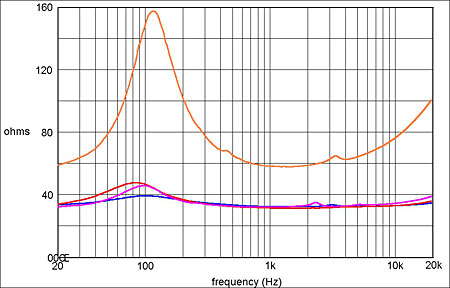
Now here's the simulation of how that impedance variation will translate into the frequency response with these four headphones fed from a headphone amp with an output impedance of 120 ohms:
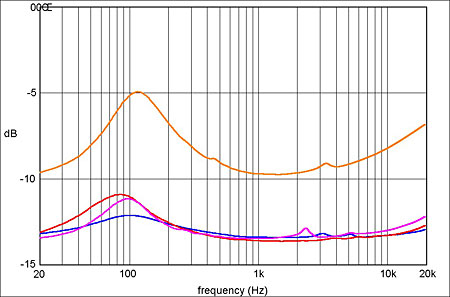
As you rightly say Hugh, many (if not most) phones will end up with only a dB or two of variation whatever headphone amp is used, but if you have a pair of these AKG K530 phones do make sure your headphone amp has a low output impedance!
Martin
Last edited by Martin Walker on Wed Apr 14, 2021 1:41 pm, edited 12 times in total.
-
- Martin Walker
Moderator -
Posts: 22574 Joined: Wed Jan 13, 2010 8:44 am
Location: Cornwall, UK
Contact:
Re: Matching usb interface output impedance with k702 headphones
... and I dare say more than a few people will really like the extra oomph around the kickdrum frequency and be upset if it's missing when they use a higher quality amp! 
Last edited by Hugh Robjohns on Wed Apr 14, 2021 1:25 pm, edited 1 time in total.
-
- Hugh Robjohns
Moderator -
Posts: 43685 Joined: Fri Jul 25, 2003 12:00 am
Location: Worcestershire, UK
Contact:
Technical Editor, Sound On Sound...
(But generally posting my own personal views and not necessarily those of SOS, the company or the magazine!)
In my world, things get less strange when I read the manual...
(But generally posting my own personal views and not necessarily those of SOS, the company or the magazine!)
In my world, things get less strange when I read the manual...
Re: Matching usb interface output impedance with k702 headphones
CS70 wrote:n o i s e f l e ur wrote:Do you have a custom profile for any phones from Sonarworks and have you made that comparison?
No, still have my ears
Ears that haven't heard the difference between a custom Sonarworks profile and generic among and between different sets of phones you mean?
I guess I mean I don't understand the point of your diatribe or why it was addressed to me?
Last edited by n o i s e f l e ur on Wed Apr 14, 2021 1:49 pm, edited 1 time in total.
-
- n o i s e f l e ur
Regular - Posts: 424 Joined: Sat Aug 04, 2018 6:20 am
Re: Matching usb interface output impedance with k702 headphones
Hugh Robjohns wrote:ef37a wrote:Hugh, I have read the print off my 'Small Signal" book and I don't recall a part dealing with near zero headphone amplifiers?
He briefly discusses enclosing the output Z within the feedback loop, but suggests that this approach would also require a zobel network to ensure stability.Do you perhaps have a newer edition?
I was referring to the 2nd edition. I have the first edition too, upstairs, but I haven't checked
whether that covers the same grounds. The 2nd edition discusses reducing the output Z on page 560 (third para).
Hmm, the book is quite a serious wedge. Might drop some hints around Pop's day!
I have actually read that test report before Hugh and, whilst in NO way qualified to argue! (don't have the kit for one thing) I have some reservations about the methodology?
It speaks of a Damping Factor of 6000! As I have said most headphones have a resistance equal to the nominal impedance (ok, MW found a rouge!) Thus the current in the circuit for zero zout and 60 R cans will be little more than that with a series 30 Ohms inserted. Where does massive electro-dynamic damping effect come from? There is the same argument about speakers.
Then, where does the distortion come from and what has it to do with DF? Distortion needs a non linear element. Where is it? If I might offer a suggestion? It seems the 'distortion' is being measured across a 'current sensing' 30R? Dynamic headphones are effectively half of a transformer and it is a fact of physics that magnetic materials cause (mainly ) 3rd harmonic distortion. Distortion moreover that is proportional to the inverse of F!
Why are we not shown the distortion across the CANS? And why has no one ever noticed this horror in headphones in the last 50 years?
Dave.