I’m considering the options available to remedy the inherent tuning “offset” caused, if I understand it correctly, by the string bend involved in fretting a string. This is naturally greater at the first few frets and exacerbated on a short scale neck where tuning inconsistencies are a greater proportion of the scale length.
Initially I thought I was imagining the effect but Professor Google suggests it’s “a thing” and Monte Allums, to whom I am indebted for a Boss GE-7 mod-kit that makes no appreciable difference to my sound, suggested both an explanation and a technical remedy:
https://monteallums.com/enut_tuning.html
It strikes me that an existing nut with a small undercut that would allow the nut to “overhang” the end of the fingerboard by a mm or less would be the ideal solution.
Any thoughts?
Short scale tuning issues
Forum rules
For all tech discussions relating to Guitars, Basses, Amps, Pedals & Guitar Accessories.
For all tech discussions relating to Guitars, Basses, Amps, Pedals & Guitar Accessories.
Short scale tuning issues
-
- shufflebeat
Jedi Poster - Posts: 10110 Joined: Sun Dec 09, 2007 12:00 am Location: Manchester, UK
“…I can tell you I don't have money, but what I do have are a very particular set of skills. Skills I have acquired over a very long career” - (folk musician, Manchester).
Re: Short scale tuning issues
If they put the frets and the bridge in in the right positions then there shouldn’t be any tuning issues. If they aren’t, then nothing is going to fix that.
My Squire Strat Mini (22.75”) plays in tune, and I have two mandolins (14.25”) that play in tune.
If you have tuning issues on the first few frets, and the fret distances are correct and the fret crown is in the middle of the fret and they aren’t flattened or pitted, then it’s probably because the nut slots are too high. Cut the slots lower and you remove a lot of the extra tension caused by fretting near the nut.
My Squire Strat Mini (22.75”) plays in tune, and I have two mandolins (14.25”) that play in tune.
If you have tuning issues on the first few frets, and the fret distances are correct and the fret crown is in the middle of the fret and they aren’t flattened or pitted, then it’s probably because the nut slots are too high. Cut the slots lower and you remove a lot of the extra tension caused by fretting near the nut.

Reliably fallible.
Re: Short scale tuning issues
There is no fundamental problem with the way fret positions are calculated. modern manufacturing is very accurate, but where I do occasionally see a risk of error (due to the way some fretting templates work) the risk is that the nut is cut too close to the 1st fret, not too far away.
If there is a problem the most likely causes are poorly cut nut slots, too much relief, or a combination of both.
It is only a tiny percentage of players who experience this "problem". I am inclined to think that the issue lies with the difference between equal temperament and scales derived from harmonic relationships. In a sense, 12 tone equal temperament tuning is supposed to sound out of tune relative to harmonic scales. That's the point.
Andy
If there is a problem the most likely causes are poorly cut nut slots, too much relief, or a combination of both.
It is only a tiny percentage of players who experience this "problem". I am inclined to think that the issue lies with the difference between equal temperament and scales derived from harmonic relationships. In a sense, 12 tone equal temperament tuning is supposed to sound out of tune relative to harmonic scales. That's the point.
Andy

There is a profound African saying, "A white man who cannot dance is a victimless crime, whereas a white man with a djembe drum ..."
Re: Short scale tuning issues
Guitar is a Taylor bt2, so no excuse really, which has been fettled to within an inch of its life, action is approaching too low. My tuner(s) and my teeth say there are pitch issues on 5th/6th strings, comparing fretted/open strings, most noticeable at lower frets. The only way I can get fretted notes to be 100%(ish) results in open strings being unacceptably (to me) flat.
I’m pretty sure I’m not imagining this.
I’m pretty sure I’m not imagining this.
-
- shufflebeat
Jedi Poster - Posts: 10110 Joined: Sun Dec 09, 2007 12:00 am Location: Manchester, UK
“…I can tell you I don't have money, but what I do have are a very particular set of skills. Skills I have acquired over a very long career” - (folk musician, Manchester).
Re: Short scale tuning issues
What does your unicorn think?
Reliably fallible.
-
- shufflebeat
Jedi Poster - Posts: 10110 Joined: Sun Dec 09, 2007 12:00 am Location: Manchester, UK
“…I can tell you I don't have money, but what I do have are a very particular set of skills. Skills I have acquired over a very long career” - (folk musician, Manchester).
Re: Short scale tuning issues

I also have a Vintage (brand) tenor guitar with a 22" scale and that's fine for tuning.
I'd still be looking at the nut slots to make sure they are angled back from the fingerboard and that there's a decent break angle for the strings.
I'd still be checking the fret distances from the nut. Just because it's Taylor doesn't mean they can't make the odd mistake in the Mexican factory.
https://www.stewmac.com/fret-calculator/
And what gauge strings are you using? And how is it tuned (and don't say 'using the machine heads')?
What tuner are you using to check tunings? I use the Peterson iStrobosoft on my iPhone for acoustic instruments. At least that tells you what pitch of note you're playing e.g. E2, E3 or E4 and if it gets the octave wrong you will see a slight tuning discrepancy.
Reliably fallible.
Re: Short scale tuning issues
Yup, as alluded to, I’ve been back and forward with the nut-wrangler several times to combat this. He’s of the opinion it’s not a problem, I’m not.
I'd still be checking the fret distances from the nut. Just because it's Taylor doesn't mean they can't make the odd mistake in the Mexican factory.
https://www.stewmac.com/fret-calculator/
And what gauge strings are you using? And how is it tuned (and don't say 'using the machine heads')?
I’m usually a 13-56 (ej16) kinda guy but have gone a smidge lighter on this one as the heavy metal approach seemed to choke any movement in the top.
Tuning is drop D, which it’s tempting to blame but the same issue exists to the same extent in standard
What tuner are you using to check tunings? I use the Peterson iStrobosoft on my iPhone for acoustic instruments. At least that tells you what pitch of note you're playing e.g. E2, E3 or E4 and if it gets the octave wrong you will see a slight tuning discrepancy.
I am a man of many tuners including the TC clip-on and the Airyware app on the phone/iPad (my fave).
-
- shufflebeat
Jedi Poster - Posts: 10110 Joined: Sun Dec 09, 2007 12:00 am Location: Manchester, UK
“…I can tell you I don't have money, but what I do have are a very particular set of skills. Skills I have acquired over a very long career” - (folk musician, Manchester).
Re: Short scale tuning issues
EJ-16s are 12-53, so were you indicating that's what's on there now, as EJ17s are the 13-56s?
Have you tried a different brand of string? Presumably you've not stuck with the same set of strings and several sets have given you this problem?
Have you tried a different brand of string? Presumably you've not stuck with the same set of strings and several sets have given you this problem?
Reliably fallible.
Re: Short scale tuning issues
It will certainly help us if you could take a photo of you playing the guitar with your right leg in a bowl of custard.
It won't help you but it will cheer us up no end!
It won't help you but it will cheer us up no end!
Reliably fallible.
Re: Short scale tuning issues
oooh, did somebody say custard? !!!!!
-

- ManFromGlass
Longtime Poster - Posts: 7858 Joined: Sun Jul 24, 2011 12:00 am Location: O Canada
Re: Short scale tuning issues
Doh!!
You’re right, of course. My usual order is for ej17s but my head has been turned by the chiffon-like slenderness of the ej16s.
Must concentrate.
At the minute there are 12-53 80/20 ej11s on but I’ve been through a year’s supply of various in a few months.
Please help, it’s bankrupting me! I have no money for custard.
-
- shufflebeat
Jedi Poster - Posts: 10110 Joined: Sun Dec 09, 2007 12:00 am Location: Manchester, UK
“…I can tell you I don't have money, but what I do have are a very particular set of skills. Skills I have acquired over a very long career” - (folk musician, Manchester).
Re: Short scale tuning issues
I have found that using a tuner for the upper strings and using 5th fret harmonics for the bottom two can sometimes give a better sounding result.
It might also be worth trying some round core strings like DR Sunbeams or Thomastik Infeld Plectrums. Because the wrap doesn’t grip the core so tightly, you may get a smaller transition length at the nut where the string goes from not vibrating to vibrating. The wound strings do feel a bit softer to fret.
With round cores, just make sure you don’t cut the string end until after you’ve got it wound round the post. The core can slide under the wrap as there’s a lot less grip, so the very end of the string is squashed so it grips the core. Once you’ve got a couple of 90°+ bends on the tuner post you’re OK, but cutting to length before the string is on the post allows the wrap to move over the core, so you get a change in mass/unit length so a change in tension. It also won’t move evenly as some lengths of wrap will move more than others, so you get uneven mass/unit length and tuning issues as you move to different frets.
It might also be worth trying some round core strings like DR Sunbeams or Thomastik Infeld Plectrums. Because the wrap doesn’t grip the core so tightly, you may get a smaller transition length at the nut where the string goes from not vibrating to vibrating. The wound strings do feel a bit softer to fret.
With round cores, just make sure you don’t cut the string end until after you’ve got it wound round the post. The core can slide under the wrap as there’s a lot less grip, so the very end of the string is squashed so it grips the core. Once you’ve got a couple of 90°+ bends on the tuner post you’re OK, but cutting to length before the string is on the post allows the wrap to move over the core, so you get a change in mass/unit length so a change in tension. It also won’t move evenly as some lengths of wrap will move more than others, so you get uneven mass/unit length and tuning issues as you move to different frets.
Reliably fallible.
Re: Short scale tuning issues
It may be worth checking how the low E and A strings pass over the saddle. Sometimes the string doesn't bend down sharply to the bridge pin, but gently rounds over it, which can dull the sound slightly and cause some tuning issues. If this looks to be the case, slacken the string off, remove the bridge pin, pull the ball-end out and bend the string with thin-nosed pliers where it goes over the saddle. Then put it all back as before.
I've seen this recommended in a couple of books.
It may improve things, but it won't harm anything and only takes a minute to do.
I've seen this recommended in a couple of books.
It may improve things, but it won't harm anything and only takes a minute to do.
Reliably fallible.
Re: Short scale tuning issues
It sounds like you're talking about intonation. As you said, the string bends out of tune when pressed down, so the bridge is compensated so that fretted notes are in tune.
If the intonation is off, it usually gets worse the higher up the neck you go.
It may sound daft, but are you pressing too hard? The intonation can't be exactly the same on the E string in standard and drop D -- there will be a (very) slight difference.
We could maybe pin it down a bit -- how far out of tune does the tuner say the notes are? Sharp or flat?
If the intonation is off, it usually gets worse the higher up the neck you go.
It may sound daft, but are you pressing too hard? The intonation can't be exactly the same on the E string in standard and drop D -- there will be a (very) slight difference.
We could maybe pin it down a bit -- how far out of tune does the tuner say the notes are? Sharp or flat?
It ain't what you don't know. It's what you know that ain't so.
Re: Short scale tuning issues
The video posted by Wonks was most interesting. I have a Les Paul that causes me no problems, a telecaster which I'm trying to intonate across the fret board and a strat mini which sounds out of tune with any open strings so needs fettling.
I'm not totally convinced by the zero fret concept he espouses. Presumably you have to cut the nut slot lower than the height of the zero fret so it becomes the new anchor point if the string? I'm slightly tempted to try it.
Can anyone suggest a good reference for slotting the nut?
More interesting still was the concept of stretch tuning on the guitar, definitely going to give that a try. My ears aren't good enough for +5 cents.
Ben
I'm not totally convinced by the zero fret concept he espouses. Presumably you have to cut the nut slot lower than the height of the zero fret so it becomes the new anchor point if the string? I'm slightly tempted to try it.
Can anyone suggest a good reference for slotting the nut?
More interesting still was the concept of stretch tuning on the guitar, definitely going to give that a try. My ears aren't good enough for +5 cents.
Ben
Re: Short scale tuning issues
Shufflebeat, not me. Like Zen, I think it's an unnecessary bodge and is more likely to mess up your tuning than fix it. But whatever makes you happy.
Yes, if you have a zero fret, the nut slots behind it need to be cut deeper so the strings only rest on the zero fret and the nut slots just act to keep the string in the right place. If they are much higher then the zero fret, then the zero fret does nothing, and if roughly level, then you just get a sitar-like buzz.
But he's correct about otherwise getting your nut slots as low as possible to minimise the pressure required to fret on the first couple of frets.
The only time you won't want to do this is if your guitar is set up just for slide work with a high action and fairly heavy strings, when you'll need a decent distance between the strings and 1st fret to stop the slide fretting the strings.
Reliably fallible.
Re: Short scale tuning issues
Oh dear no. I watched the Monte Allums video and the bottom E sounds 9 cents flat ... because it is. It doesn't sound bad necessarily, as tempered tuning is a compromise. At one point he says "I've tried adjusting the saddles, but I've found it doesn't work". Eh ... not sure what to make of that. Maybe this tuning system sounds OK on its own, but I can't imagine it working with a band. Certainly not for me.
I would wonder if Monte Allums could get the tuning he wanted by pressing less hard when playing at the lowest three frets. Is it light strings and pressing too hard that is the problem?
I would wonder if Monte Allums could get the tuning he wanted by pressing less hard when playing at the lowest three frets. Is it light strings and pressing too hard that is the problem?
It ain't what you don't know. It's what you know that ain't so.
Re: Short scale tuning issues
After another look using reaTune in Reaper, I've decided the telecaster is intonating well and it's probably my technique, or lack thereof causing tuning issues.
Back to the Strat mini and I've got the saddles adjusted so the 12 fret is in tune. However the first few frets are 10c sharp, even at the absolute minimum finger pressure. The action at fret 1 is higher than on the 1:1 Tele.
Does this mean some work on deepening the nut slot could help?
I'll need some files, are cheap ones ok for a student guitar?
Back to the Strat mini and I've got the saddles adjusted so the 12 fret is in tune. However the first few frets are 10c sharp, even at the absolute minimum finger pressure. The action at fret 1 is higher than on the 1:1 Tele.
Does this mean some work on deepening the nut slot could help?
I'll need some files, are cheap ones ok for a student guitar?
Re: Short scale tuning issues
For a guide, here's the first fret action on my Strat Mini and that plays in tune.

Unfortunately there are no cheap nut files worthy of the name that I've yet found. With so much reasonable cheap stuff coming from China, I've never understood why you can't get a decent cheap set these days.
Generally at the low-cost end you get offered either a) 'needle files' on a ring or fold-away penknife style housing or b) a set of three double edged files with yellow, blue and orange handles.
Type a) are welding nozzle cleaning files being re-purposed for guitar use. These can often be used once, but the thinner files are very easy to bend, so you need to be very careful.
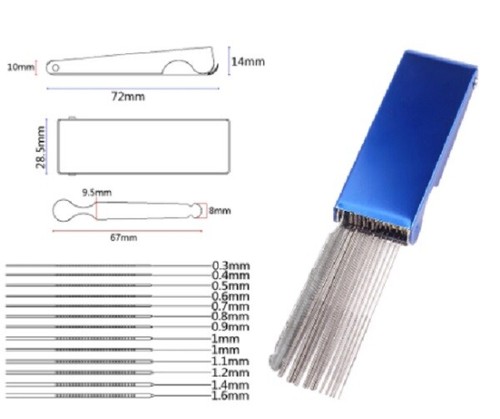
You'll also need to use some digital calipers to measure the diameter of each one, to find the right one for each string slot as they aren't marked and tolerances aren't great either.
The thinnest file is just thin enough for a high E slot. 0.3mm is about 0.012", which will do for a 0.09" string, but ideally it would be a touch smaller.
Type b) are really bad copies of one style of Hosco nut files.
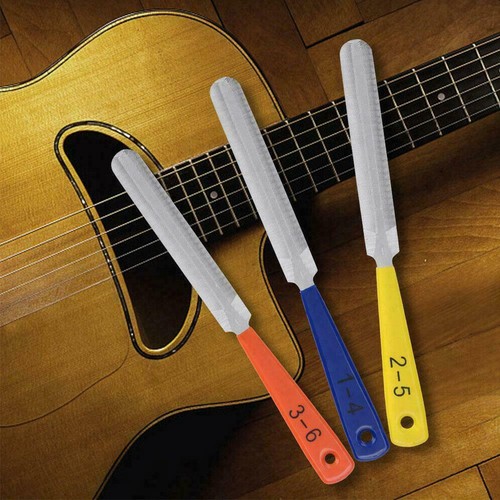
Some give wildly optimistic width measurements, others just have a string number on. But they are all the same files, and are almost all the same width and none will be any use for cutting decent slots for the thinner strings.
You'll also find standard needle file sets sold as nut slotting files - which they definitely aren't!
To do a good job you do need a good set of nut files. But they are expensive for what you get. A good investment if you have several guitars or are interested in setting up guitars for other people, but for a one-off nut, it's more cost effective to get a good guitar store or luthier to do it for you.
So I'd suggest either trying out the type a) files, or using the alternative slot lowering method of removing the nut; sanding the base of the nut down*.
It's easy enough to knock the nut out sideways using repeated gentle knocks with a hammer and large screwdriver (or similar), something with an end that's just thinner than the nut. Whilst you can lightly tap the nut from the sides as well to help break any glue bonds, it is very easy if tapping towards the headstock to tap too hard and knock the nut off along with a decent chunk of wood from the end of the fretboard.
I've seen a friend do this, despite telling him to be very gentle, he whacked it hard and the nut and fretboard end flew off across the room. Luckily we found all the bits of wood and could glue them back in place.
You can take the strings off completely, but I tend to loosen the strings enough so they pull down to the sides of the neck below nut level, and then tape them in place with masking tape whilst working on removing the nut. It's probably going to be new string time when you do all this, but do it after the nut is fully sorted and mess about setting the height with the old strings to avoid kinking the new strings.
Clean out the old glue from the nut slot, then sand the bottom of the nut down a bit, put it back loose in the slot, refit the strings and tune and see how far you've got. Repeat as necessary (slackening the strings just enough to slide the nut out) until you feel the slots are low enough for you. If you go too far, and you get buzzing on the first fret you can stick a thin shim of wood or plastic under the nut, though it's better to get a new nut (bone ones from Amazon are fine and better than the fairly soft plastic of the original nut) and repeat the process. Always check height above the frets with the strings up to tension.
Once the nut is at the right height, you can stick it in place with a bit of wood glue. I use standard Titebond. Wipe off any excess glue with a damp cloth, then fit the strings again and tune up so the nut is clamped in place; making sure the nut is central and doesn't stick out at either side.
Then leave for a few hours (ideally overnight) for the glue to dry before re-tuning and playing.
*Note that whilst a lot of vintage-style Strats/Teles have curved bases to the nut, which makes it hard to use the sanding method, the Strat Mini nut (like most Asian made Fender-style guitars) has a flat base.
Unfortunately there are no cheap nut files worthy of the name that I've yet found. With so much reasonable cheap stuff coming from China, I've never understood why you can't get a decent cheap set these days.
Generally at the low-cost end you get offered either a) 'needle files' on a ring or fold-away penknife style housing or b) a set of three double edged files with yellow, blue and orange handles.
Type a) are welding nozzle cleaning files being re-purposed for guitar use. These can often be used once, but the thinner files are very easy to bend, so you need to be very careful.
You'll also need to use some digital calipers to measure the diameter of each one, to find the right one for each string slot as they aren't marked and tolerances aren't great either.
The thinnest file is just thin enough for a high E slot. 0.3mm is about 0.012", which will do for a 0.09" string, but ideally it would be a touch smaller.
Type b) are really bad copies of one style of Hosco nut files.
Some give wildly optimistic width measurements, others just have a string number on. But they are all the same files, and are almost all the same width and none will be any use for cutting decent slots for the thinner strings.
You'll also find standard needle file sets sold as nut slotting files - which they definitely aren't!
To do a good job you do need a good set of nut files. But they are expensive for what you get. A good investment if you have several guitars or are interested in setting up guitars for other people, but for a one-off nut, it's more cost effective to get a good guitar store or luthier to do it for you.
So I'd suggest either trying out the type a) files, or using the alternative slot lowering method of removing the nut; sanding the base of the nut down*.
It's easy enough to knock the nut out sideways using repeated gentle knocks with a hammer and large screwdriver (or similar), something with an end that's just thinner than the nut. Whilst you can lightly tap the nut from the sides as well to help break any glue bonds, it is very easy if tapping towards the headstock to tap too hard and knock the nut off along with a decent chunk of wood from the end of the fretboard.
I've seen a friend do this, despite telling him to be very gentle, he whacked it hard and the nut and fretboard end flew off across the room. Luckily we found all the bits of wood and could glue them back in place.
You can take the strings off completely, but I tend to loosen the strings enough so they pull down to the sides of the neck below nut level, and then tape them in place with masking tape whilst working on removing the nut. It's probably going to be new string time when you do all this, but do it after the nut is fully sorted and mess about setting the height with the old strings to avoid kinking the new strings.
Clean out the old glue from the nut slot, then sand the bottom of the nut down a bit, put it back loose in the slot, refit the strings and tune and see how far you've got. Repeat as necessary (slackening the strings just enough to slide the nut out) until you feel the slots are low enough for you. If you go too far, and you get buzzing on the first fret you can stick a thin shim of wood or plastic under the nut, though it's better to get a new nut (bone ones from Amazon are fine and better than the fairly soft plastic of the original nut) and repeat the process. Always check height above the frets with the strings up to tension.
Once the nut is at the right height, you can stick it in place with a bit of wood glue. I use standard Titebond. Wipe off any excess glue with a damp cloth, then fit the strings again and tune up so the nut is clamped in place; making sure the nut is central and doesn't stick out at either side.
Then leave for a few hours (ideally overnight) for the glue to dry before re-tuning and playing.
*Note that whilst a lot of vintage-style Strats/Teles have curved bases to the nut, which makes it hard to use the sanding method, the Strat Mini nut (like most Asian made Fender-style guitars) has a flat base.
Reliably fallible.
Re: Short scale tuning issues
It's worth mentioning that when sanding the base of the nut put the sandpaper on a flat surface and gently move the nut across the paper - being careful to keep it as vertical as possible. I regularly swap which way round I'm holding the nut as it's easy to accidentally apply a bit of rotational pressure that can create an angled base.
-

- Drew Stephenson
Apprentice Guru -
Posts: 29715 Joined: Sun Jul 05, 2015 12:00 am
Location: York
Contact:
(The forumuser formerly known as Blinddrew)
Ignore the post count, I have no idea what I'm doing...
https://drewstephenson.bandcamp.com/
Ignore the post count, I have no idea what I'm doing...
https://drewstephenson.bandcamp.com/
Re: Short scale tuning issues
Wonks wrote: ↑Thu May 18, 2023 1:43 pm For a guide, here's the first fret action on my Strat Mini and that plays in tune.
Unfortunately there are no cheap nut files worthy of the name that I've yet found. With so much reasonable cheap stuff coming from China, I've never understood why you can't get a decent cheap set these days.
Generally at the low-cost end you get offered either a) 'needle files' on a ring or fold-away penknife style housing or b) a set of three double edged files with yellow, blue and orange handles.
Type a) are welding nozzle cleaning files being re-purposed for guitar use. These can often be used once, but the thinner files are very easy to bend, so you need to be very careful.
You'll also need to use some digital calipers to measure the diameter of each one, to find the right one for each string slot as they aren't marked and tolerances aren't great either.
The thinnest file is just thin enough for a high E slot. 0.3mm is about 0.012", which will do for a 0.09" string, but ideally it would be a touch smaller.
Type b) are really bad copies of one style of Hosco nut files.
Some give wildly optimistic width measurements, others just have a string number on. But they are all the same files, and are almost all the same width and none will be any use for cutting decent slots for the thinner strings.
You'll also find standard needle file sets sold as nut slotting files - which they definitely aren't!
To do a good job you do need a good set of nut files. But they are expensive for what you get. A good investment if you have several guitars or are interested in setting up guitars for other people, but for a one-off nut, it's more cost effective to get a good guitar store or luthier to do it for you.
So I'd suggest either trying out the type a) files, or using the alternative slot lowering method of removing the nut; sanding the base of the nut down*.
It's easy enough to knock the nut out sideways using repeated gentle knocks with a hammer and large screwdriver (or similar), something with an end that's just thinner than the nut. Whilst you can lightly tap the nut from the sides as well to help break any glue bonds, it is very easy if tapping towards the headstock to tap too hard and knock the nut off along with a decent chunk of wood from the end of the fretboard.
I've seen a friend do this, despite telling him to be very gentle, he whacked it hard and the nut and fretboard end flew off across the room. Luckily we found all the bits of wood and could glue them back in place.
You can take the strings off completely, but I tend to loosen the strings enough so they pull down to the sides of the neck below nut level, and then tape them in place with masking tape whilst working on removing the nut. It's probably going to be new string time when you do all this, but do it after the nut is fully sorted and mess about setting the height with the old strings to avoid kinking the new strings.
Clean out the old glue from the nut slot, then sand the bottom of the nut down a bit, put it back loose in the slot, refit the strings and tune and see how far you've got. Repeat as necessary (slackening the strings just enough to slide the nut out) until you feel the slots are low enough for you. If you go too far, and you get buzzing on the first fret you can stick a thin shim of wood or plastic under the nut, though it's better to get a new nut (bone ones from Amazon are fine and better than the fairly soft plastic of the original nut) and repeat the process. Always check height above the frets with the strings up to tension.
Once the nut is at the right height, you can stick it in place with a bit of wood glue. I use standard Titebond. Wipe off any excess glue with a damp cloth, then fit the strings again and tune up so the nut is clamped in place; making sure the nut is central and doesn't stick out at either side.
Then leave for a few hours (ideally overnight) for the glue to dry before re-tuning and playing.
*Note that whilst a lot of vintage-style Strats/Teles have curved bases to the nut, which makes it hard to use the sanding method, the Strat Mini nut (like most Asian made Fender-style guitars) has a flat base.
What a great post! I have needed to do this on every guitar that I have bought recently, and this is the first time that I have found all of this information in one place. I wonder if the moderators could consider making it a sticky? (Just this post, not the preceding pages). Or maybe it could be added to the the existing sticky on "fitting and cutting a replacement nut"?
Learning from the experts on this forum