ART S8 "Eight Channel Balanced Mic Splitter"

Discuss hardware/software tools and techniques involved in capturing sound, in the studio, live or on location.
Post Reply

ART S8 "Eight Channel Balanced Mic Splitter"

Post by Casey Butt »

I recently bought and tested an ART T8 eight channel isolator (results here: http://www.soundonsound.com/forum/showf ... =1#1179706) and also an ART S8 eight channel mic splitter.

I tested both using a Zoom R24 and ART Pro Channel II as interfaces (of which I also took baseline measurements for reference).

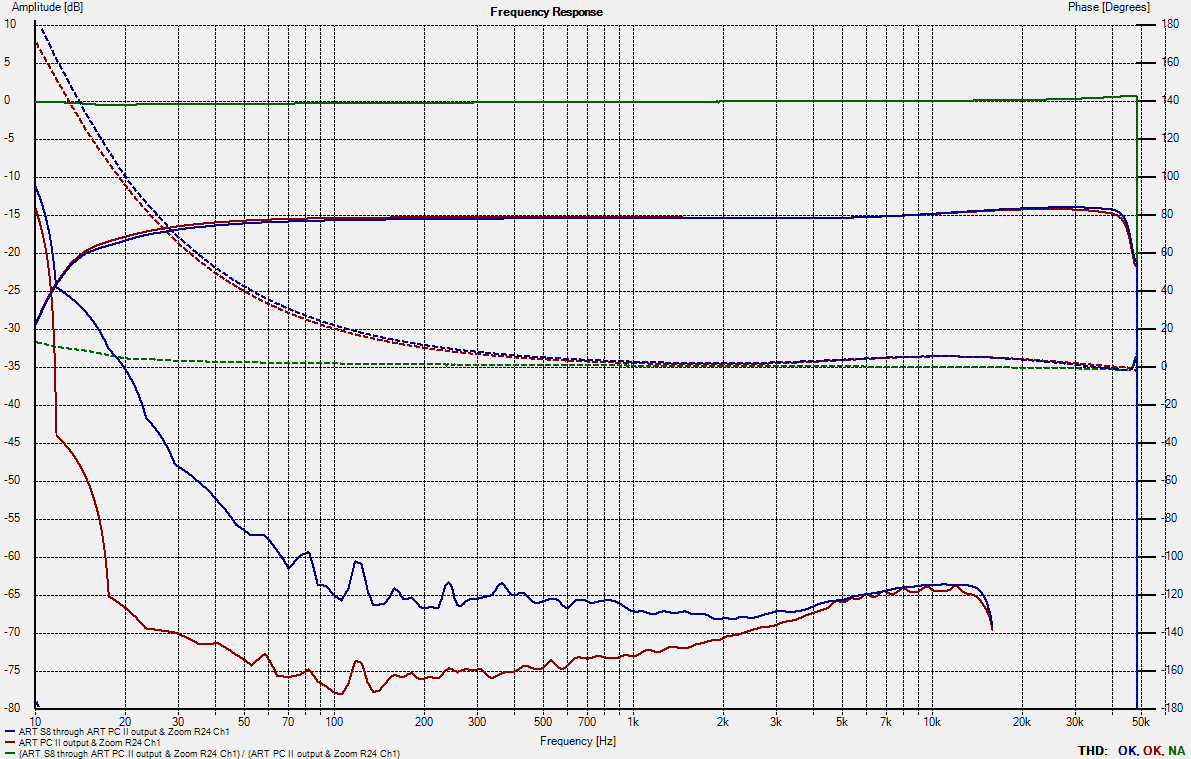
Below is a graph of the S8 through the ART Pro Channel II and Zoom R24. The R24 is driving the PCII, which is in turn driving the S8. The output of the S8 is then fed back to Channel 1 of the R24. The PCII is driving the S8 at 600 ohms (balanced) and the R24 is loading the S8 with 1 kOhm (balanced). The red lines are the PCII & R24 without the S8 in line, the blue lines are with the S8 in line, and the green line is the S8 frequency response with the PCII and R24 responses removed (i.e. the difference in their frequency responses). The flat-ish lines are obviously the frequency responses, the dashed lines are the phase responses, and the downward sloping lines on the bottom half of the graph are THD.
Image

The frequency response of the S8 is roughly in the ±0.3 dB range from 20Hz-18kHz. The phase response is quite good - about 6 degrees from 20Hz-50kHz. But what surprised me most was the shape of the THD curve. It has the negative exponential shape you'd see with nickel alloy core transformers, rather than the more linear type THD response you get with cheaper, no nickel, steel transformers (which the ART T8 clearly appears to have).

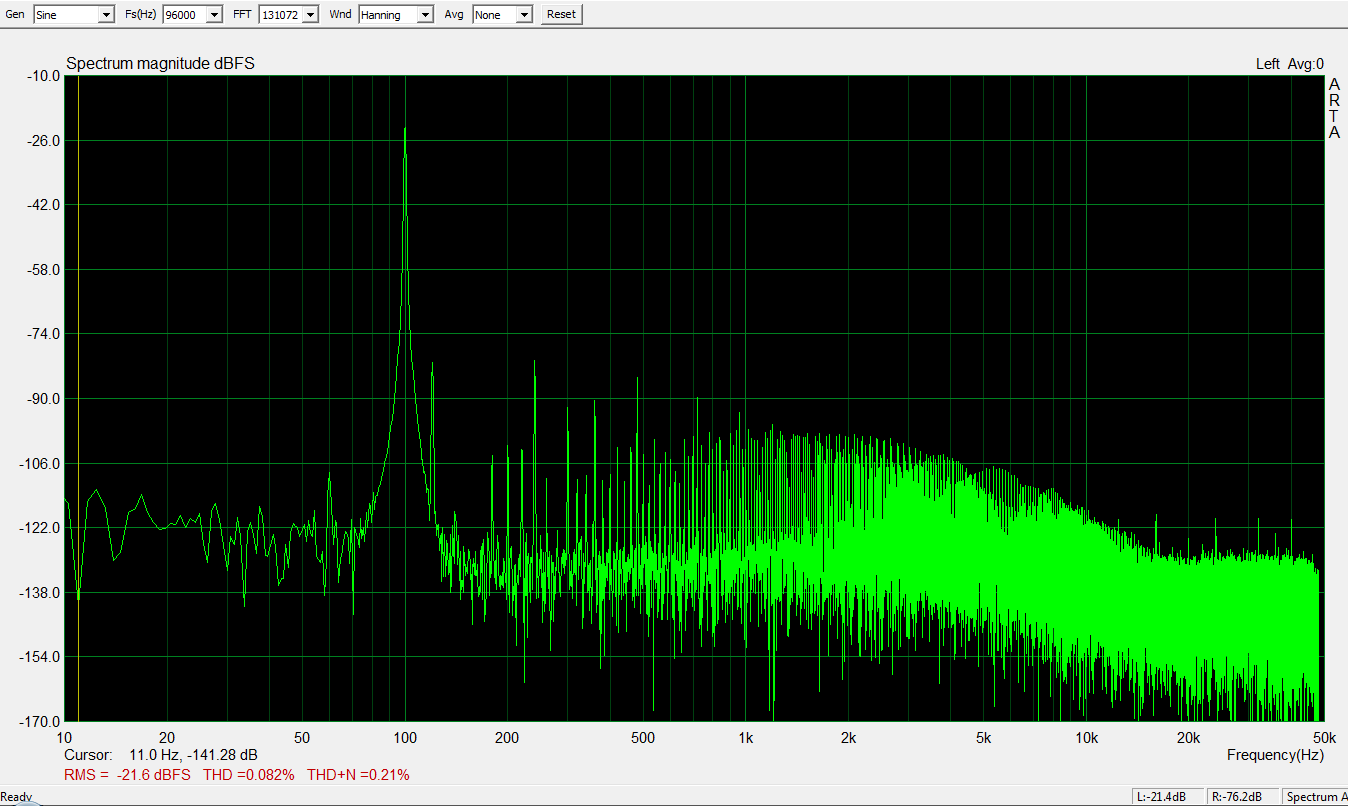
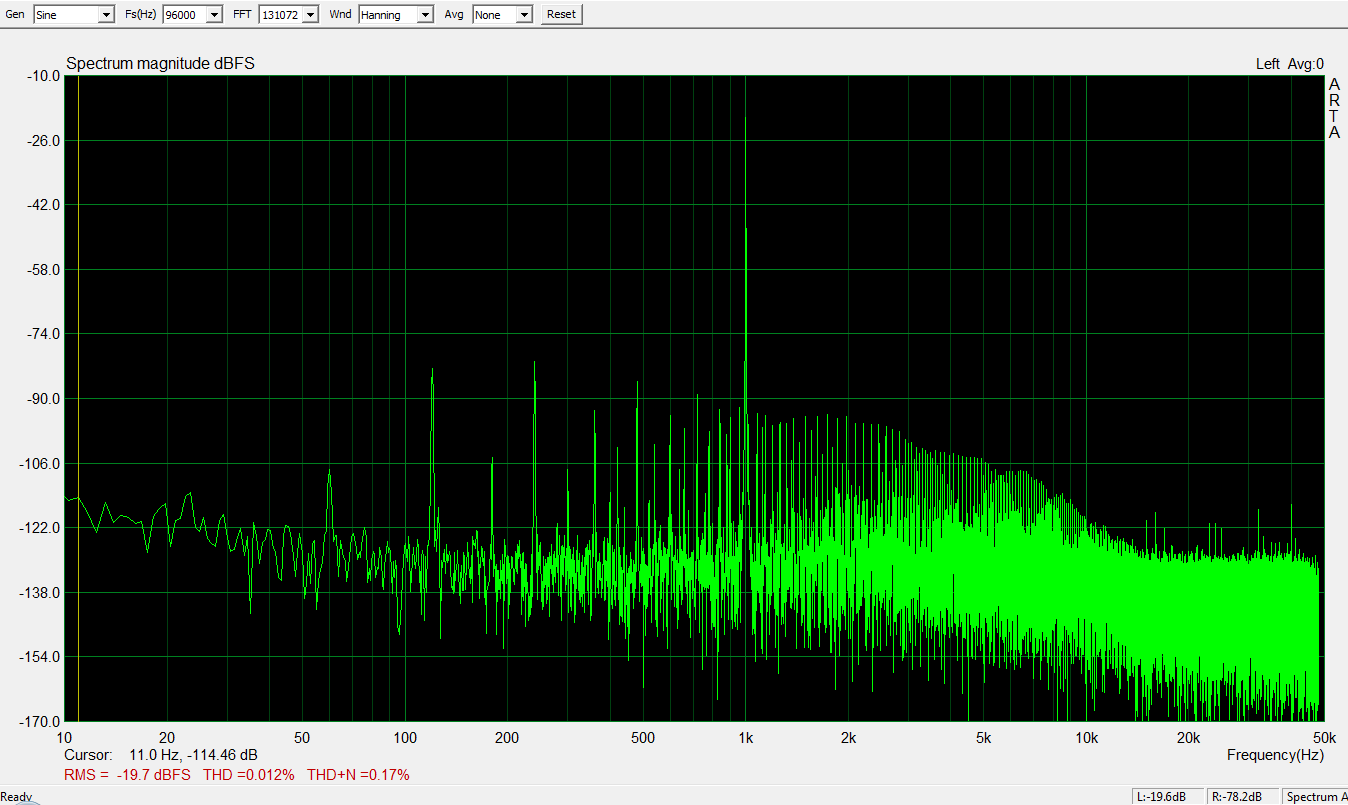
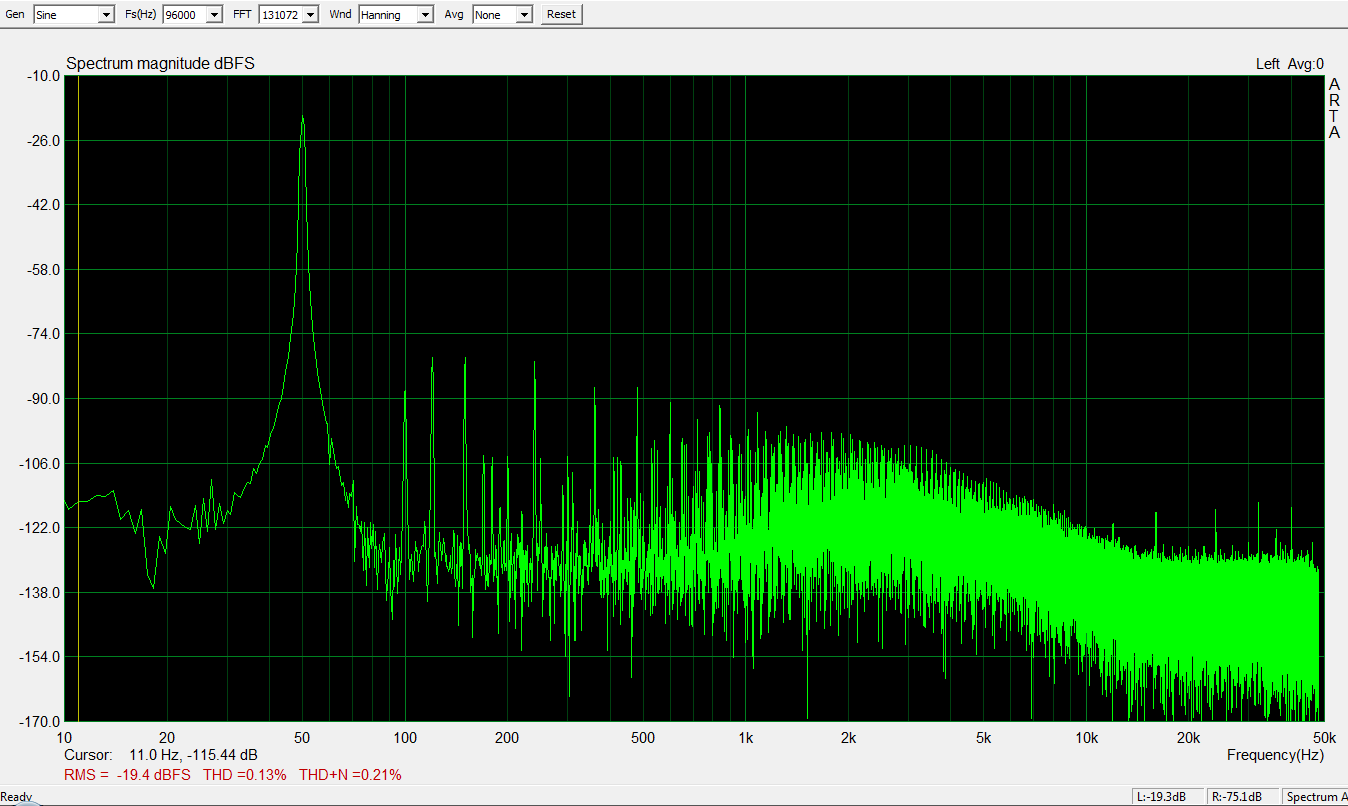
I also took THD levels directly at 50Hz, 100Hz and 1kHz. The graphs are below.
Image

Image

Image

At 50Hz, the S8 graph shows 0.13% THD, but of that, 0.053% is coming from the PCII and R24, leaving the S8 with approximately 0.077% THD @ 50Hz under these conditions. Below is the response of the PCII + R24 @ 50Hz.
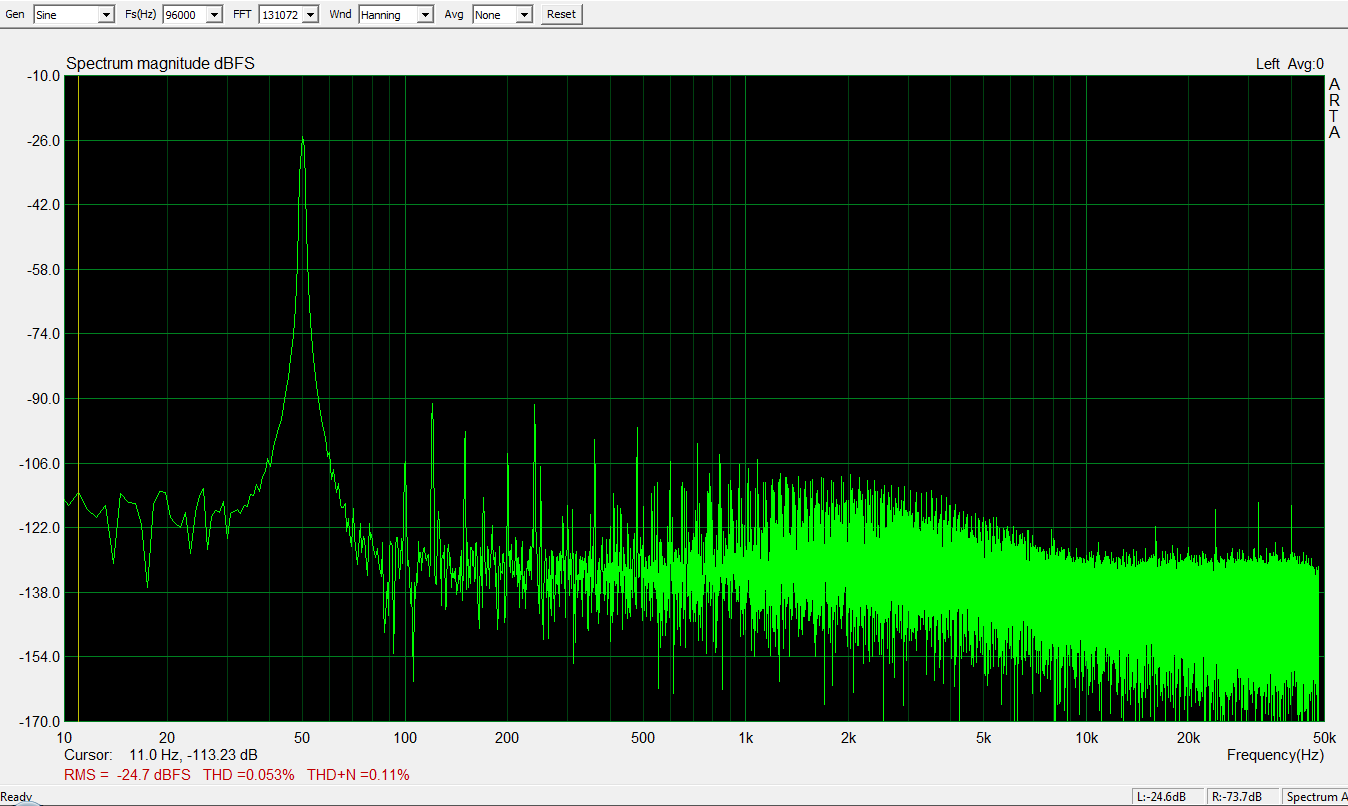
Image

Summing up the THD responses for the S8:
50Hz: .077%
100Hz: .031%
1kHz: .001%

T8 Frequency Response:
20Hz-18kHz, +/-0.3dB

Phase Error:
<7 degrees, 20Hz~50kHz

Sure, that's not quite on the level of the best Jensens or Lundahls, but in my opinion that's damn good for such a cheap piece of equipment... and actually as good as I'd be interested in unless I was absolutely obsessive over exact recording of classical music or something. And I'm sure I wasn't driving the S8 under its most ideal conditions... driving source impedance should be more like 150 Ohms rather than the 600 Ohms I was putting up front.

These THD and phase results are right in line with ART's published specs for the S8, but my frequency results are actually a little outside ART's specs of 20Hz-20kHz, ±0.25dB @ -15dBu, though I'm willing to suspect my large input impedance was a factor there.

I hope that was useful to someone.
Casey Butt
New here
Posts: 10 Joined: Sun Dec 13, 2015 12:00 am

Re: ART S8 "Eight Channel Balanced Mic Splitter"

Post by Casey Butt »

The above tests were don't at LINE level, which IS NOT the intended level for the S8 to be used with - even though the S8 performs quite well at those levels and even better than the ART T8 (which is designed for line levels) in some respects and in all respects above 35Hz.

Below are tests done within the actual design intentions of the S8 - signals at mic level (padded down -29dB by the pad feature on the S8) and through a 200 Ohm driving impedence (provided by an Ashly CLX52 compressor in bypass mode) into the 1 kOhm balanced XLR input on the Zoom R24.

The blue lines are the S8 frequency and THD responses and the red lines are the system with the S8 removed.

Image

Below is a blow-up of the frequency responses.

Image

Below is the frequency response of just the S8, with the rest of the system subtracted.

Image

Below is the phase response of the S8.

Image

These results are simply excellent for such a cheap piece of equipment, IMO (or even a higher priced splitter). The frequency response is within +/- 0.23dB from 20Hz-20kHz. The phase shift is less than ~5.3 degrees from 20Hz-20kHz. At 50Hz the THD of the S8 is approximately 0.012%. At 100Hz it's approximately 0.005%. And at 1kHz it's approximately 0.0009%.

Summing up:

S8 THD values:
50Hz: 0.012%
100Hz: 0.005%
1kHz: 0.0009%

T8 Frequency Response:
20Hz-20kHz, +/-0.23dB

Phase Error:
<5.3 degrees, 20Hz~20kHz

Even though that's still not quite on the level of high-end Jensens, Lundahls or Cinemags, it's really not that far off and is easily up to the task of transparently passing mic level signals. What I'd like to see is a noise comparison with the higher end transformers, but I don't have the data to make that comparison. As it was, I could only test noise performance of the ART S8 transformers vs its direct through lines and got values of THD+Noise ~0.023% @ 1kHz. The transformers actually have less THD than the direct out lines @ 1kHz, about the same @ 100Hz, and are up about 0.003% at 50Hz. In other words, other than an inaudible amount of extra noise (0.023% is not audible) the S8 transformers pass practically an audibly identical signal to the direct through line at mic levels with the spec'ed impedances.

Very impressive, especially considering that the S8 handles line levels quite well also.
Casey Butt
New here
Posts: 10 Joined: Sun Dec 13, 2015 12:00 am

Re: ART S8

Post by compucat »

Hi, pardon the necropost - can you repost the mic level testing results if you still have them? Links appear to have died sometime in the past decade.

Incidentally, thank you for posting these measurements in the first place. Much appreciated.

Cheers, compucat
compucat
Posts: 1 Joined: Fri Mar 08, 2024 3:13 pm

Re: ART S8

Post by jimjazzdad »

And thanks for reviving the necropost compucat. I have had a couple of these S8 splitters for a number of years and have always been pleased with how well they work, especially considering their price point. Its reassuring to see my confidence in them is well-deserved.
User avatar
jimjazzdad
Regular
Posts: 310 Joined: Sun Dec 15, 2013 12:00 am
Halifax, NS, CANADA
Post Reply