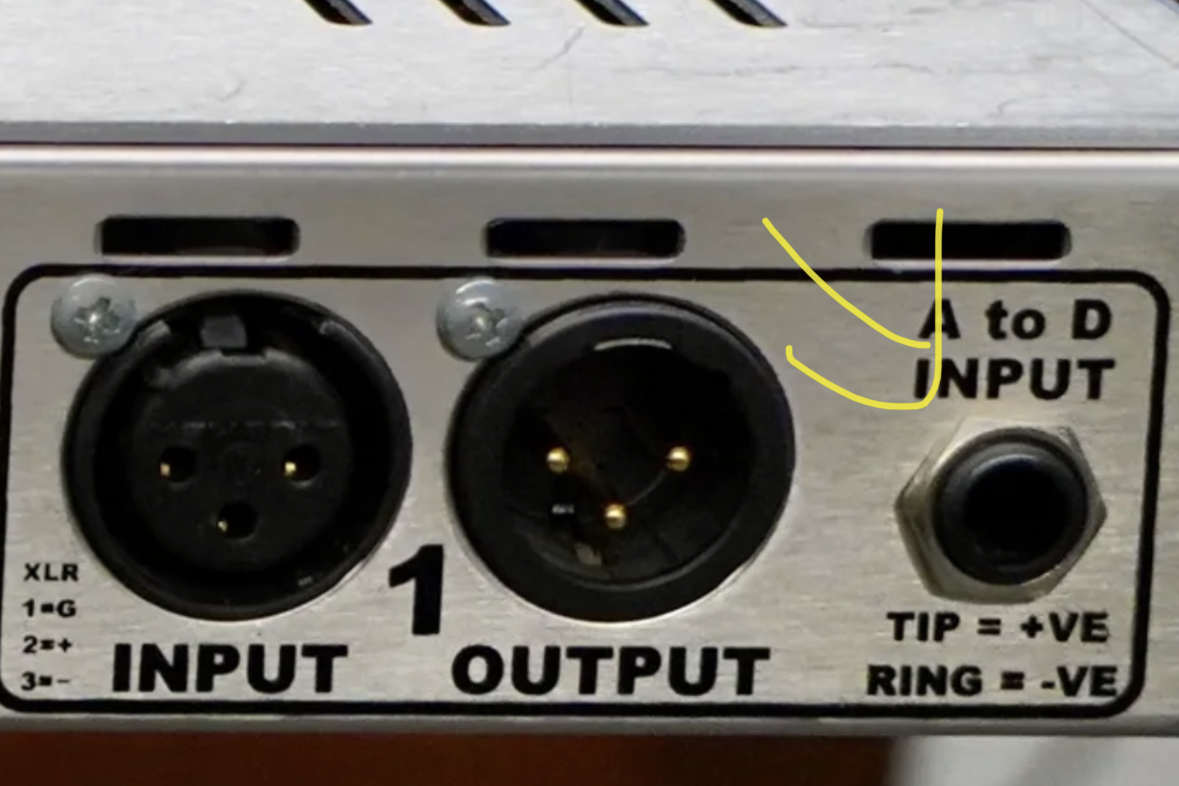
I have an old API A2D. It's a great unit from API with SPDIF out and its own onboard converters that are premium.
It has the usual XLR ins, Line ins... and then there's an extra option... direct tap into the conversion.
I've been told that Line in is the same... as that takes a line level from another unit, for example and puts it into the converters... but why then have the converter tap in option!?
My first thoughts were that it's there so a line-level input is present on the rear panel for convenience, or to be used in conjunction with the preamp output as an insert point. However, it's all explained on the product page on API's website.
API wrote:Rear panel analog connectors include an XLR input and output for each channel, as well as a balanced 1/4" TRS insert to the A/D converter. The TRS insert allows the A2D to have external analog processing devices inserted in the audio chain (EQs, compressors, etc.)
Yes, but I suppose the question remains... isn't that just a Line in in that case? There's something different about the 'direct to converter' jack plug VS the Line in (which it does also have).
Spells wrote: ↑Thu May 02, 2024 9:41 am
Yes, but I suppose the question remains... isn't that just a Line in in that case?
It is indeed.
Spells wrote: ↑Thu May 02, 2024 9:41 am
There's something different about the 'direct to converter' jack plug VS the Line in (which it does also have).
I've just had a nose at the manual, and confusingly, the front-panel "Line" input is actually an unbalanced, high-impedance input designed for connecting instruments. So that's your difference! That and the fact that the front-panel connector (presumably) runs through the preamp circuitry, and the rear one is placed afterwards directly in front of the converter.
You'll almost certainly get a more comprehensive answer from Hugh, but hopefully that helps in the meantime!
What you say makes sense and yes, I think it's about bypassing all and any preamp circuitry... and that begs the question, do Line ins typically do the same? I thought Line ins would still fall foul of the added circuitry and that's what makes the API unit unique in that it let you bypass it entirely with those jacks direct to converter.
I'm setting up a new studio space and trying to work out whether I need to keep certain pieces or if I can refine my gear!
Spells wrote: ↑Thu May 02, 2024 9:41 am
Yes, but I suppose the question remains... isn't that just a Line in in that case? There's something different about the 'direct to converter' jack plug VS the Line in (which it does also have).
Think of the XLR output and the A to D input as being a little patchbay with one channel, and the signal normalised from the first to the second.
The XLR output is the (line-level) output of the mic preamp. Normally this output is routed directly to the converters but if you want to run it through something else (such as a compressor or FX unit) then you can connect the XLR output to the input of that external unit and connect the output of that external unit to the A to D input.
In doing so you're routing the (line-level) output from the preamp through an external device and the output of that external device is then converted.
Thank you Eddy... that all makes sense, but is the A to D input not then doing the same as any Line-in input ? Maybe I'm getting hung up on the way they've labelled it? Is it just a Line-in that they've called "A to D Input" ?
I suppose I've always felt the unit was unique in this aspect - that the A to D input does bypass any other circuitry and taps straight into the converters, but perhaps not!
It is 'just' a line-level input, yes, but the reason it's been called an A to D input is to point out the fact that it feeds the converters directly. On many devices, line inputs still run through the mic preamps with a pad engaged to account for the hotter signal level. And what's important here, is that's how its able to be used to place other bits of gear between the preamp and converter, as Eddy mentions.
It's not a unique approach, there are other units that do the same. Audients ASP880 is the first that springs to mind.
Spells wrote: ↑Thu May 02, 2024 8:30 amI've been told that Line in is the same... as that takes a line level from another unit, for example and puts it into the converters... but why then have the converter tap in option!?
The manual is a much more reliable informer....
The front panel (high-impedance) unbalanced line input signal passes through the API's famous discrete op-amps (DOA's) and gain stages and is delivered to the balanced output at the rear-panel XLR.
The signal at the output XLR is also wired directly to the switch contacts on the AD input socket to then feed the converter.
Consequently, plugging into the balanced, fixed level, AD input socket bypasses the DOAs in the preamp. So not at all the same in terms of the signal path...
...EDIT — and sorry to be so late to the party, repeating what everyone else has already said.
Technical Editor, Sound On Sound...
(But generally posting my own personal views and not necessarily those of SOS, the company or the magazine!)
In my world, things get less strange when I read the manual...
Thank you Hugh, do you know of any other pieces of hardware that also have the direct to converter jack / bypassing any of the circuitry... and with SPDIF out?
S/PDIF out implies a two channel device, so the audient asp880 is ruled out.
The products I've first hand experience of with this facility include the DBX386 and ART Digital MPA ii preamps. They both have insert points where the return feeds the converter directly. I'm sure there are several others with the same arrangement.
Technical Editor, Sound On Sound...
(But generally posting my own personal views and not necessarily those of SOS, the company or the magazine!)
In my world, things get less strange when I read the manual...
A Focusrite ISA One with the optional A-D card fitted would also sort of tick the boxes. It's only a single-channel pre but does have an S/PDIF output when said card is fitted. It has a similar insert send/return arrangement to the API where the return feeds the A-D, and there's an external input which can be used to send a line-level signal to the second S/PDIF channel.
Whether it's of any use or not will depend on exactly how you wanted to use it, though.
Luke W wrote: ↑Thu May 02, 2024 1:48 pm
A Focusrite ISA One with the optional A-D card fitted would also sort of tick the boxes. It's only a single-channel pre but does have an S/PDIF output when said card is fitted. It has a similar insert send/return arrangement to the API where the return feeds the A-D, and there's an external input which can be used to send a line-level signal to the second S/PDIF channel.
Whether it's of any use or not will depend on exactly how you wanted to use it, though.