I always had a problem with guitar pedals especially compressors, that connecting my guitar to them I got a distorted sound. After asking about it at various places, I figured out it is caused by that certain humbucker guitars, regardless of quality, project such a high voltage signal that it makes pedals distort, no matter if they are compressors, delays or something else. The only quality guitar I have at hand is a Schecter Omen Extreme guitar with Schecter Diamond Plus humbucker pickups. I measured the output voltage Vpp on it, and based on my measurements I built a small device to tackle this problem without ruining the tone of the guitar signal and loose trebles.
For a while the problem seemed to be solved, but then I made an interesting discovery.
I noticed, that even if the voltage of the signal of the guitar fell below the limitations of the compressor input, there was still a kind of distortion present. It appeared when you played any interval at around the 20-24th fret positions, on the E-B-G strings. No matter how low the input voltage was (I tested it with as low as 5mV), that distortion on the interval was there. It was unbelieveable. When I switched the compressor off it disappeared, when I switched it on it came back. And it was not caused by my device, because this was the situation when I plugged the guitar directly into the compressor, and I used the guitar volume knob to turn down the guitar volume to avoid distortion on the input.
I had no idea what caused it, but then -listening to the problem intervals- I noticed the distortion is caused by a 3rd, mysterious note present besides the interval notes. But still I had no idea what causes it to be there.
It stayed like that until I borrowed the Schecter Omen guitar again to check if the 3rd note is present with it as well, and suddely I noticed that if I play the problem intervals on that guitar, I can hear the mysterious 3rd notes already present in the guitar signal.
I recorded a video about it. You can check it. But be careful!!!!! The video is loud. Turn down volume before you listen. First listen to it, then start raising the volume, and the 3rd note will appear when the volume is loud enough. You need to raise the volume quite much to hear it when I play the problem interval.
LISTEN ON QUALITY HEADPHONE OR SPEAKERS!!! Else you won't hear the problem note!!!
https://drive.google.com/file/d/1j-5zVS ... oQfIn/view
So for a while I thought it is the guitar that causes the problem, and very likely the compressor amplifies the silent parts in the signal as a byproduct of compression, that's why it is more audible after the compressor. You can listen to that here (again listen on good quality stuff, not built in speakers, please!!!!)
https://drive.google.com/file/d/1Hvt5U2 ... sp=sharing
So I asked about it from various sources what may cause this. Most of the time I got the reply that this is called "beating", an acoustic phenomemon. I knew that term from piano tuning, and I had a suspicion it can't be that. Thank good I searched further. Because this led me to an interesting discovery.
When you consider beating, the formula to calculate it is f1-f2=beating note.
I listened to my video again where you can hear the 3rd note in the problem interval in the guitar signal. I listened carefully, and I identified the mysterious note as 540hz.
The interval I am playing in the video is: A#5+E6. Those are 932Hz and 1318Hz. Lets calculate the beating: 1318-932=!!!! 386!!! That is not 540. So it is not beating we are dealing with here! I couldn't believe noone checked this before writing it is beating.
So, I figured out it is not beating, but what is it then? I came up with the idea to open the video where I demonstrate the 3rd note in the guitar signal in Spectralayers Pro. That makes it available to check notes present in the audio. But surprisingly, I found that there is no note at 540Hz, I saw a gap there:

I did not understand how it's possible that I hear the 3rd note, but it is not there. I concluded the volume of that note is so low relative to the fundamentals of the interval notes that Spectralayers cannot detect it. So, I decided to check a sample from the compressor instead. If I add the compressor after the guitar, it is much easier to catch the 3rd note, the compressor makes it much more audible. So I recorded a sample like that, and I opened it in Spectralayers. And TADAAAAM!!!! The problem note was there:

I checked with the cursor, it was exatly 540Hz!!! So it is proved: the problem note exsists, it is there, it is a real problem.
However, I still couldn't understand why it can't be seen in the other sample, in the signal of the guitar, when I can hear it. So I opened that signal again, and decided to start deleting the interval fundamentals and its harmonics, hoping maybe that way the 3rd note can be heard alone at least. And then a very surprising thing happened. As soon as I deleted 1 fundamental, the 3rd note disappered. I couldn't hear it any more. I was shocked. How is that possible?
I realized that there is gap in the dry guitar signal sample at 540Hz in the editor, because the 3rd note is not there in the signal in reality, but when you play the sample, you hear it. And!!! The compressor also adds it, because as I mentioned above, in the compressor signal it becomes visible in the editor.
I am running a discussion about it at the Steinberg forum as well, and I haven't received replies yet to my latest findings, but it was already mentioned that a phenomenon called intermodulation distortion exists in non linear systems. And as the human ear is a non linear system, maybe that's why we hear that 3rd note, even if it's not there in reality, only the interval. Or, it gets into the signal when we play back the sample when it passes some problem circuit until it reaches our ear (headphone, speaker, computer).
AND! Last but not least, the compressor also behaves as a non linear system, and it adds that 3rd note to the signal. That's why it appears in compressor signals when you check it in the editor.
The question is: what causes it in compressors, and how to modify them to stop this? You can say: OK, what's the use when even so by the time the signal reaches your brain, you will hear the 3rd note. Yes and no. If you check my video you can hear it is there in the dry signal, but actually it is very silent, You need to raise the volume quite much, you start hearing it afterwards. So there certainly is a space or "headroom" until you reach the volume so that it might become audible. In case the signal can leave the compressor without that 3rd note, at normal volume levels you won't notice it in recorded stuff.
So any ideas how to modify the compressors to get rid of this?
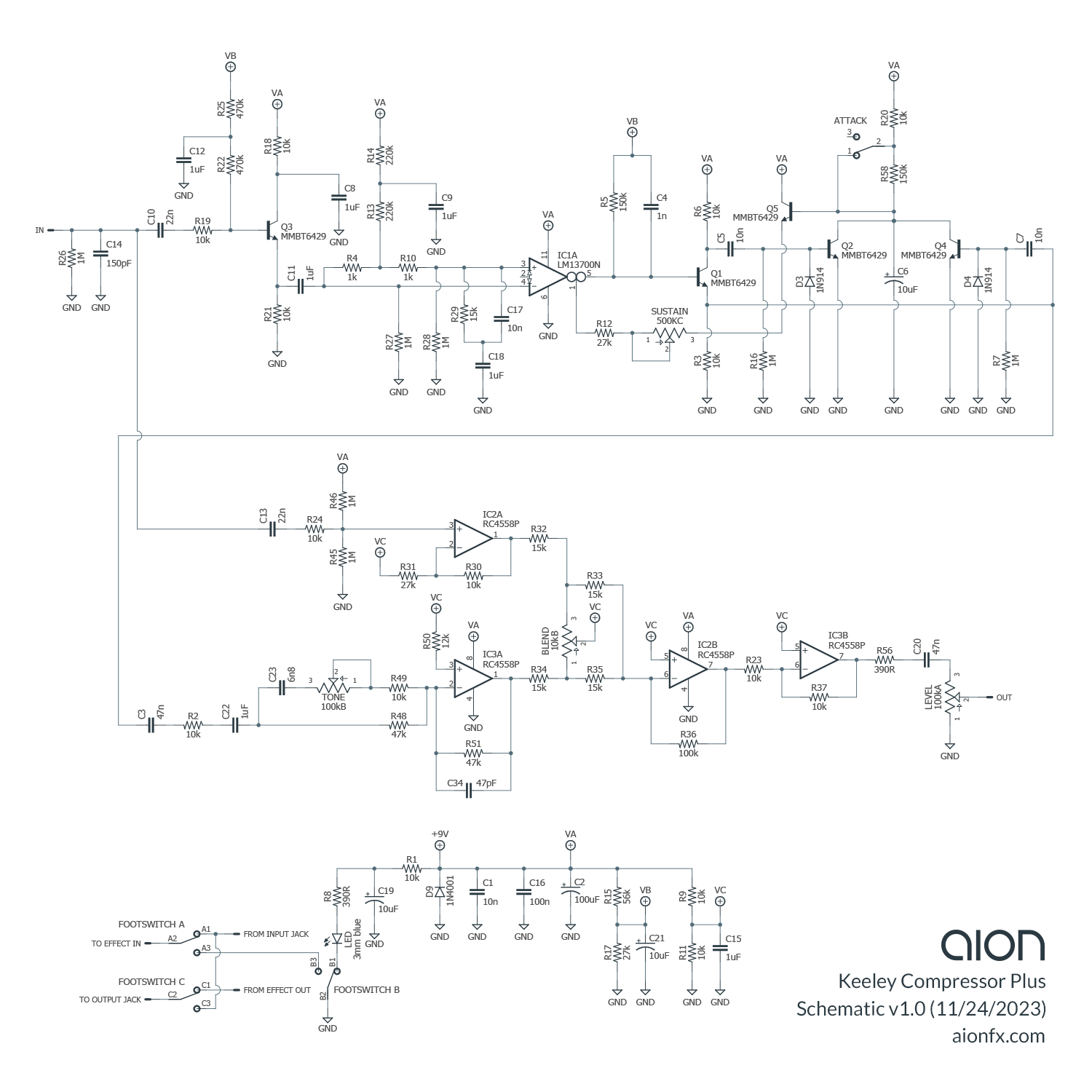
Let me emphasize something again before anyone would ask: this is present in all intervals at the problem fret locations in both of the guitars I checked. It is always a note lower than the fundamentals of the intervals. And all my compressors add it: Keeley Compressor Plus, Gurus Optivalve, Demeter Compulator, Carl Martin Compressor/Limiter. They all add it. However the Carl Martin is interesting, because once you lower the guitar signal voltage before it enters the pedal, in the compressed wet signal it is no more present. OR at least I didn't manage to spot it so far.
Thanks for reading!

 ) to look at each compressor, and its schematic, to find out where the non-linearities are and see if they can be fixed. It is likely to be much cheaper to buy a compressor that does not have this issue. But you seem to have one such compressor already?



 and most able technical resource for forum and magazine , a trouble maker , not least of them ,