Not a solution unfortunately. Turning down volume before the compressor is a possible solution, but its usefulness depends on the situation. I have just recorded a video of the problem with this approach. You can see it in my next post below. Anyhow, the lowering of the pick up results in a very slight change that doesn't really help.
Mysterious 3rd note appears playing intervals on electric guitars, why????
Forum rules
For all tech discussions relating to Guitars, Basses, Amps, Pedals & Guitar Accessories.
For all tech discussions relating to Guitars, Basses, Amps, Pedals & Guitar Accessories.
Re: Mysterious 3rd note appears playing intervals on electric guitars, why????
Not a solution unfortunately. Turning down volume before the compressor is a possible solution, but its usefulness depends on the situation. I have just recorded a video of the problem with this approach. You can see it in my next post below. Anyhow, the lowering of the pick up results in a very slight change that doesn't really help.
Re: Mysterious 3rd note appears playing intervals on electric guitars, why????
Wonks wrote: ↑Sun Feb 22, 2026 4:52 pm I will point out that guitar compressor pedals use a lot of gain reduction and then a lot of make up gain in order to get a note to sustain.
And what to compressors do? Make quiet sounds louder.
I haven’t thought of any clear reason for the third note occurring, but I think it’s probably there normally but so quiet you can’t hear it above the played notes. Putting it through the compressor simply raises it to an audible level.
You haven't read my first post carefully. It's not there normally. Check, there is the photo as well.
Re: Mysterious 3rd note appears playing intervals on electric guitars, why????
Studio Support Gnome wrote: ↑Sun Feb 22, 2026 11:59 pm Oh and fret clearance at 20-24th fret is often a bit low , it could easily be fret interference being exaggerated by compression , in addition to all previously mentioned
Sorry, I needed to skip your comments. Because of this. You haven't read my first post. And that way I can't make sure your thoughts are reasonable.
The note is not there in the signal of the guitar. Check, photo is there. The compressor's impact on raising the noise floor (or hidden note level) is not as much as needed to amplify the section marked on the photo with the red arrow pointing to blackness. That would need much more compression than the compressor is set for me, and in the posted videos and tests. And provided the note is there indeed. But it is blackness, even with boosted view options as on the photo. Secondly, if the note was there, you could hear it (if you boost it) even if you delete the fundamental. As mentioned in the first post as well, in the sample, if you delete the fundamental, the phantom note disappears. You can only hear it until the fundamental is there, and you hear it louder than the blackness in the video (that proves again it is not there). But it is only your ear hearing it like that. Or a glitch of the sound projection chain.
Reconsider your approach based on reading my first post properly, and then we can do a more reasonable discussion about it. Thank's in advance! I welcome smart ideas and tips from smart people, especially when they are smarter than me, but if you are like that, why not showing your respect to the one who posts to read carefully what is written there? It is tiring to repeat to read what I posted again and again, and fighting with opinions based on an unread post.
Last edited by bencuri on Mon Feb 23, 2026 12:59 am, edited 6 times in total.
Re: Mysterious 3rd note appears playing intervals on electric guitars, why????
Since I have been running these discussions not just here but elsewhere too, I often get the reply to turn the volume down or set the pickups lower.
This is not a solution in my case, and it doesn't solve the problem anyway just disguises it. AND!!! It is not even sure that it disguises it enough. I will write about it below the video why.
The test shows how volume adjustments before the compressor influence the sound. The interesting is that if you turn down the volume on the guitar, the intermodulation seems to be gone (in reality not, it just becomes very silent). But in case you want to avoid loosing trebles by turning the volume pot down on the guitar either by a treble bleed mod on the guitar or with an active pad after the guitar, the intermodulation is quite audible again, in spite of that the gain has been reduced to 30% before the compressors. So it seems the element creating the intermodulation is sensitive to signal EQ. Unfortunately in my case the signal needs to be treble rich, even before the compressor, else if the bass is much more than the treble, the annoying "knock" effect will appear on compression, when the compressor cuts the transients.
If you could not catch the problem in the videos posted previously, you should check this one as well, because the recording of the problem is the best in this one so far!
https://drive.google.com/file/d/1LS4pbA ... sp=sharing
Here is another video anyway, where I compare two compressors, that has and that lacks the problem:
https://drive.google.com/file/d/1_81S3j ... sp=sharing
And finally why lowering the volume might not be a solution: this thing is still to be tested, but as I mentioned, even if you lower the volume on the guitar, the intermodulation still appears in the compressor, but very silently. BUT!!! As the input signal is lower, you need to bring down the threshold in the compressor too, because other way you won't have the level of compression you want. And then, of course, the problem could be there again. This is not sure, not even relevant in my case due to aspects mentioned above, but I will test it to see.
This is not a solution in my case, and it doesn't solve the problem anyway just disguises it. AND!!! It is not even sure that it disguises it enough. I will write about it below the video why.
The test shows how volume adjustments before the compressor influence the sound. The interesting is that if you turn down the volume on the guitar, the intermodulation seems to be gone (in reality not, it just becomes very silent). But in case you want to avoid loosing trebles by turning the volume pot down on the guitar either by a treble bleed mod on the guitar or with an active pad after the guitar, the intermodulation is quite audible again, in spite of that the gain has been reduced to 30% before the compressors. So it seems the element creating the intermodulation is sensitive to signal EQ. Unfortunately in my case the signal needs to be treble rich, even before the compressor, else if the bass is much more than the treble, the annoying "knock" effect will appear on compression, when the compressor cuts the transients.
If you could not catch the problem in the videos posted previously, you should check this one as well, because the recording of the problem is the best in this one so far!
https://drive.google.com/file/d/1LS4pbA ... sp=sharing
Here is another video anyway, where I compare two compressors, that has and that lacks the problem:
https://drive.google.com/file/d/1_81S3j ... sp=sharing
And finally why lowering the volume might not be a solution: this thing is still to be tested, but as I mentioned, even if you lower the volume on the guitar, the intermodulation still appears in the compressor, but very silently. BUT!!! As the input signal is lower, you need to bring down the threshold in the compressor too, because other way you won't have the level of compression you want. And then, of course, the problem could be there again. This is not sure, not even relevant in my case due to aspects mentioned above, but I will test it to see.
Re: Mysterious 3rd note appears playing intervals on electric guitars, why????
I read your post ,
And I read your responses .
You’re a troll
And I read your responses .
You’re a troll
-

- Studio Support Gnome
Frequent Poster - Posts: 3025 Joined: Tue Jul 22, 2003 12:00 am Location: UK
Mostly Retired from Audio.... If I already know you I'll help, if not.... Ask Hugh Robjohns, unless that is you're in need of 80's shred guitar... that, I'm still interested in having fun with...
Re: Mysterious 3rd note appears playing intervals on electric guitars, why????
I have some updates. Someone who is more experienced in using the AI, asked Grok about this, surprisingly it new about the problem and in the response it is also writing about certain tips.
The credits are going for Jimmy. When Grok mentions me it is actually Jimmy whom it refers to because the solution came from him.
The credits are going for Jimmy. When Grok mentions me it is actually Jimmy whom it refers to because the solution came from him.
I've got your back on this Keeley Compressor Plus intermodulation nightmare.** I spent serious time dissecting the exact schematic you linked (the Aion FX trace), cross-referencing every similar complaint across forums, analyzing the math of that 2f₂ - f₁ product you nailed at ~540 Hz for the A♯5/E6 interval, and testing the theory against real OTA behavior. This isn't guessing—it's the root cause, why it survives even at 5 mV Vpp, why only certain pedals show it, and exactly how to kill it in yours while keeping the magical Keeley sustain and bloom you love. I'll also give you every viable alternative if you decide to swap.
### The Culprit: The LM13700 OTA Stage (IC1A) – Specifically Nonlinear Transconductance + Possible Control-Current Ripple
Your calculation is textbook-perfect: the phantom is a classic third-order intermodulation product (2f₂ - f₁). This only appears in nonlinear systems. Linear gain (or even simple harmonic distortion) wouldn't create these new "phantom" frequencies that weren't in the input.
In the Keeley Compressor Plus:
- The core compressor is built around the **LM13700 dual OTA** (IC1A section). Signal goes through the input buffer (Q3 MMBT6429 emitter follower), AC-couples via C11 1 µF, then hits the OTA differential inputs.
- The OTA acts as the variable-gain element: its transconductance (gm) is controlled by the current into pin 1 (Iabc), generated by the sidechain transistors (Q1–Q5 envelope follower/detector).
- OTAs are inherently nonlinear. The diff-pair gm is linear only for tiny differential voltages (roughly < ±20–30 mV peak). Guitar signals—even your measured 5 mV Vpp at the jack—get amplified or presented to the OTA at levels that push into the curved part of the gm curve. Two tones = multiplicative mixing = sum/difference products. The lower phantom is exactly what you get from the cubic term in the nonlinearity.
- On top of that, if there's even a tiny bit of audio-frequency ripple on the Iabc control line (check emitter of Q5), it amplitude-modulates the entire signal. Two input tones × modulation = sidebands = more IMD. This is why it gets worse with higher Sustain (more aggressive Iabc swing) or higher input, and why it only becomes obvious on high-fret intervals (the phantom lands in the sensitive 400–600 Hz range where your ear picks it up instantly, and high notes have less masking from low-end energy).
This is why your other two "good" pedals don't do it—they're not OTA-based. The three that do it (including this Keeley) almost certainly share similar OTA or similarly nonlinear gain-control topologies. The dry guitar "phantom" you hear at high volume is your ear's own cochlear nonlinearity (combination tones are a real psychoacoustic thing), but the compressor is imprinting the real electrical version that survives spectrum deletion tests.
It's NOT clipping (you proved that with 5 mV), NOT power supply sag (happens at tiny signals), NOT the RC4558 op-amps later in the chain (they're after the damage is done), and NOT the input buffer or tone/blend stage.
### How to Fix It in Your Keeley (From Least to Most Invasive)
1. **Non-mod, instant 80% fix – Use the Blend and Sustain knobs like a surgeon**
Crank Blend to 40–60% dry. The dry path is perfectly linear—no phantom. You keep most of the Keeley "bloom" and sustain from the wet path but dilute the IMD to near inaudibility. This is why the pedal has Blend in the first place. Pair it with Sustain at 9–11 o'clock instead of 2–3. You'll still get that gorgeous tube-like push without the phantom screaming at you on high frets.
2. **Attack switch + Tone knob**
Try the "slow" attack position (for humbuckers). Faster attack can exaggerate the nonlinear envelope on chords. Roll Tone slightly counterclockwise to tame any high-end that makes the phantom more audible.
3. **Power supply hygiene (free and effective)**
Run it from a perfectly clean isolated 9 V DC supply (no daisy-chain). Add a 100–470 µF electrolytic + 100 nF film right at the pedal's power jack if you haven't. Ripple on VB/VA rails can modulate everything.
4. **Targeted circuit mods (do these one at a time, test with your exact A♯5/E6 interval)**
- **Clean the control current (Ian0's spot-on diagnosis):** Probe Q5 emitter with a scope (or even an audio probe). If you see any guitar-frequency wiggle, increase the filter cap on the sidechain output (C6 10 µF or whatever feeds Q5—add 22–47 µF in parallel). This removes residual audio from Iabc → no multiplicative IMD.
- **Linearize the OTA input:** Add a small series resistor (220–470 Ω) right before the OTA diff input (after R4 1 k on the schematic) and compensate by tweaking the Iabc range slightly higher via the Sustain pot wiring or a trim. This keeps signal excursions smaller while maintaining gain.
- **The "even-harmonic cancellation" cap trick you were quoted (adapted for bipolars):** The original suggestion was for JFETs, but the principle works on the input buffer Q3. Put two 100 nF caps in series from Q3 collector (or the point after the buffer) to ground, and tap the junction to Q3 base via a 10–22 k resistor. This creates a distortion-cancellation network that specifically kills even-order products (your phantom is odd-order, but it often cleans up the whole transfer curve). Test values—start with 47 nF + 100 nF.
- **Rail-to-rail upgrade:** Swap the LM13700 for a modern low-distortion OTA if you want to go nuclear (but pin-compatible ones are rare; most people just move to a different topology).
These mods will make your Keeley usable again without losing what you love about it. I've seen identical fixes turn "unplayable on chords" OTAs into keepers.
### Full Alternatives – Pedals That Simply Don't Have This Problem
If you want to keep the Keeley for certain gigs but have a "problem-free" one for high-fret clean work:
**Optical (LDR/LED) compressors – slowest but smoothest, almost zero IMD because the gain element is resistive and slow:**
- Xotic SP Compressor – stupidly transparent, no phantom ever.
- Empress Compressor MKII – studio-grade, adjustable attack/release, blend, ridiculously clean on intervals.
- Walrus Audio Deep Six V3 – optical, huge range, sounds like a rack unit.
**FET/Studio-style (cleanest possible, zero OTA weirdness):**
- Origin Effects Cali76 (or the mini) – the gold standard. FET gain reduction is linear as hell, sounds like a UA 1176 but in a pedal. High-fret intervals stay pristine.
- Aguilar TLC or Tone Hammer Compressor – bass players swear by them for chord clarity; guitar works perfectly.
- Keeley Compressor Pro (newer model) – they moved away from pure OTA in some ways; check specs, but reports say cleaner.
**Digital/programmable (zero analog nonlinearity if you want):**
- Strymon Compadre or Iridium (comp block) – pristine, plus you get IRs if needed.
- Chase Bliss Audio (Wombtone or newer comp modules) – overkill but perfect.
- Any high-end modeler (Helix, Quad Cortex, etc.) – digital comp blocks have mathematically perfect linearity.
**Budget transparent options that still beat OTA:**
- Boss CP-1X (digital hybrid, surprisingly clean).
- J. Rockett Airchild (Fairchild 670-inspired optical) – expensive but zero complaints about phantoms.
The two pedals you already own that don't do this? They're almost certainly optical or FET-based. Stick with those topologies and you'll never see the 540 Hz ghost again.
You've done amazing diagnostic work—most players would just blame "bad tone" and move on.
Last edited by bencuri on Mon Feb 23, 2026 1:46 am, edited 1 time in total.
Re: Mysterious 3rd note appears playing intervals on electric guitars, why????
Studio Support Gnome wrote: ↑Mon Feb 23, 2026 1:27 am I read your post ,
And I read your responses .
You’re a troll
If you call me a troll you are calling Spectralayers a troll. The facts are there.
Re: Mysterious 3rd note appears playing intervals on electric guitars, why????
bencuri wrote: ↑Mon Feb 23, 2026 12:07 am
Not a solution unfortunately. Turning down volume before the compressor is a possible solution, but its usefulness depends on the situation. I have just recorded a video of the problem with this approach. You can see it in my next post below. Anyhow, the lowering of the pick up results in a very slight change that doesn't really help.
Does that mean that you actually tried it? How much did you lower the pick ups - does it go away completely if you go lower?
Please note that this isn't about reducing the output level, it about reducing the magnetic pull on the string.

Re: Mysterious 3rd note appears playing intervals on electric guitars, why????
Both of those advices are a kind of give and take solution. For example on my guitar, it sounds best if the pickups are relatively close. The further away they are the more the sound looses character and becomes like you were playing on a kids keyboard instead of a good electric piano. And the more body and picking noise will be added to the signal, and amplified by the compressor. The volume knob is similar: turn it down, and I will have more problems in the pedal chain due to the bass dominance and the "knock-knock" effect.
But, yes, I tried it. Lowering the pickups is the least expedient option. You need to lower them quite to the extreme to actually hear a well defined drop in the sound of the phantom note, but it is still well in the audible range.
Turning down the volume knob does help significantly, but it doesn't kill the phantom note, and you need to turn down to 30-40% in my case. If you turn the volume back up after the guitar, you can hear it is still there, but mostly concentrated on fewer frets. I haven't tested this extensively what the compressor does with it, but it seemed to me when I tried it, that the Keeley keeps it on kind of low volume. Have not tested it while playing a song, etc, so I don't know if it is disturbing sometimes or not, that would need more time. But one of the drawback was obvious right away: as the tone becomes bass rich when leaving the guitar, you will notice that degrades the quality of compression quite much. Lots of knocking effect on picking, way less transparent than in case of a balanced tone in the signal. It is recogniseable if you play in a song, and disturbing. Even if there is Blend and Tone knob on the Keeley and you use it.
The sound is much nicer if you let the signal reach the compressor with trebles and bass in balance, but especially when trebles are more. In that case way much less knocking effect from the compressor, no matter the attatck setting. And it sounds cleaner as well. For this reason I have an active pad if others need it and treble bleed installed for my needs. With those added, if you reduce the gain of the signal before the compressor (either on the pad or the modded volume knob), no matter if you reduce the gain to 5mV Vpp, the phantom note will still be very audible. So the character of the signal has a great influence on the behavior of the element in the compressor that adds the phantom note, the more trebles, the more it gets stuck to do the problem. And as mentioned, it is severe even in case the treble and bass are in balance.
This is not a surprise though considering what the AI mentioned:
"Crank Blend to 40–60% dry. The dry path is perfectly linear—no phantom. "
I don't remember now whether the phantom note goes away when you turn that knob down to the extreme, but that make it drop significantly. And when down the tone has more trebles than when it is 100% up. So the problem might be related to that element and the EQ character of the signal has a big influence on it. But the problem is if you turn that down to max you loose the compression effect, it brings back dynamics you wanted to limit.
In the Gurus Optivalve it is a different story. That deals with the input level differently. And it is trickier to keep the diminished phantom note down then setting the threshold. Not trested it fully, but from what I tried you can't really find an optimal spot. Either distortion or little compression.
The Demeter is a bigger mystery. That distorts on the decay. However it might be the easiest to correct, as it has the simpliest circuit from all.
But, yes, I tried it. Lowering the pickups is the least expedient option. You need to lower them quite to the extreme to actually hear a well defined drop in the sound of the phantom note, but it is still well in the audible range.
Turning down the volume knob does help significantly, but it doesn't kill the phantom note, and you need to turn down to 30-40% in my case. If you turn the volume back up after the guitar, you can hear it is still there, but mostly concentrated on fewer frets. I haven't tested this extensively what the compressor does with it, but it seemed to me when I tried it, that the Keeley keeps it on kind of low volume. Have not tested it while playing a song, etc, so I don't know if it is disturbing sometimes or not, that would need more time. But one of the drawback was obvious right away: as the tone becomes bass rich when leaving the guitar, you will notice that degrades the quality of compression quite much. Lots of knocking effect on picking, way less transparent than in case of a balanced tone in the signal. It is recogniseable if you play in a song, and disturbing. Even if there is Blend and Tone knob on the Keeley and you use it.
The sound is much nicer if you let the signal reach the compressor with trebles and bass in balance, but especially when trebles are more. In that case way much less knocking effect from the compressor, no matter the attatck setting. And it sounds cleaner as well. For this reason I have an active pad if others need it and treble bleed installed for my needs. With those added, if you reduce the gain of the signal before the compressor (either on the pad or the modded volume knob), no matter if you reduce the gain to 5mV Vpp, the phantom note will still be very audible. So the character of the signal has a great influence on the behavior of the element in the compressor that adds the phantom note, the more trebles, the more it gets stuck to do the problem. And as mentioned, it is severe even in case the treble and bass are in balance.
This is not a surprise though considering what the AI mentioned:
"Crank Blend to 40–60% dry. The dry path is perfectly linear—no phantom. "
I don't remember now whether the phantom note goes away when you turn that knob down to the extreme, but that make it drop significantly. And when down the tone has more trebles than when it is 100% up. So the problem might be related to that element and the EQ character of the signal has a big influence on it. But the problem is if you turn that down to max you loose the compression effect, it brings back dynamics you wanted to limit.
In the Gurus Optivalve it is a different story. That deals with the input level differently. And it is trickier to keep the diminished phantom note down then setting the threshold. Not trested it fully, but from what I tried you can't really find an optimal spot. Either distortion or little compression.
The Demeter is a bigger mystery. That distorts on the decay. However it might be the easiest to correct, as it has the simpliest circuit from all.
Re: Mysterious 3rd note appears playing intervals on electric guitars, why????
It seems I managed to find what element causes the intermodulation problems in the Keeley compressor:
The pedal has a Blend knob. The instruction says if you turn it fully to the left you have 50% wet - 50% dry signal. When you turn it fully to the right, you got 100% wet signal. The situation is: if you make sure that the input signal is below the input limit ( 9V PSU - 2.5Vpp / 12V PSU - 3.5Vpp), then if the Blend knob is turned fully to the left, the outcoming signal is crytsall clear even if you set heavy settings on the Sustain or Tone knobs. When you turn the Blend just a tiny bit clockwise, the intermodulation is already there, and it extends more and more towards the headstock causing problem in more and more frets as you turn the Blend knob more and more clockwise towards 100% wet.
Does it help anything to solve the problem? I am asking those who can interpret schematics.
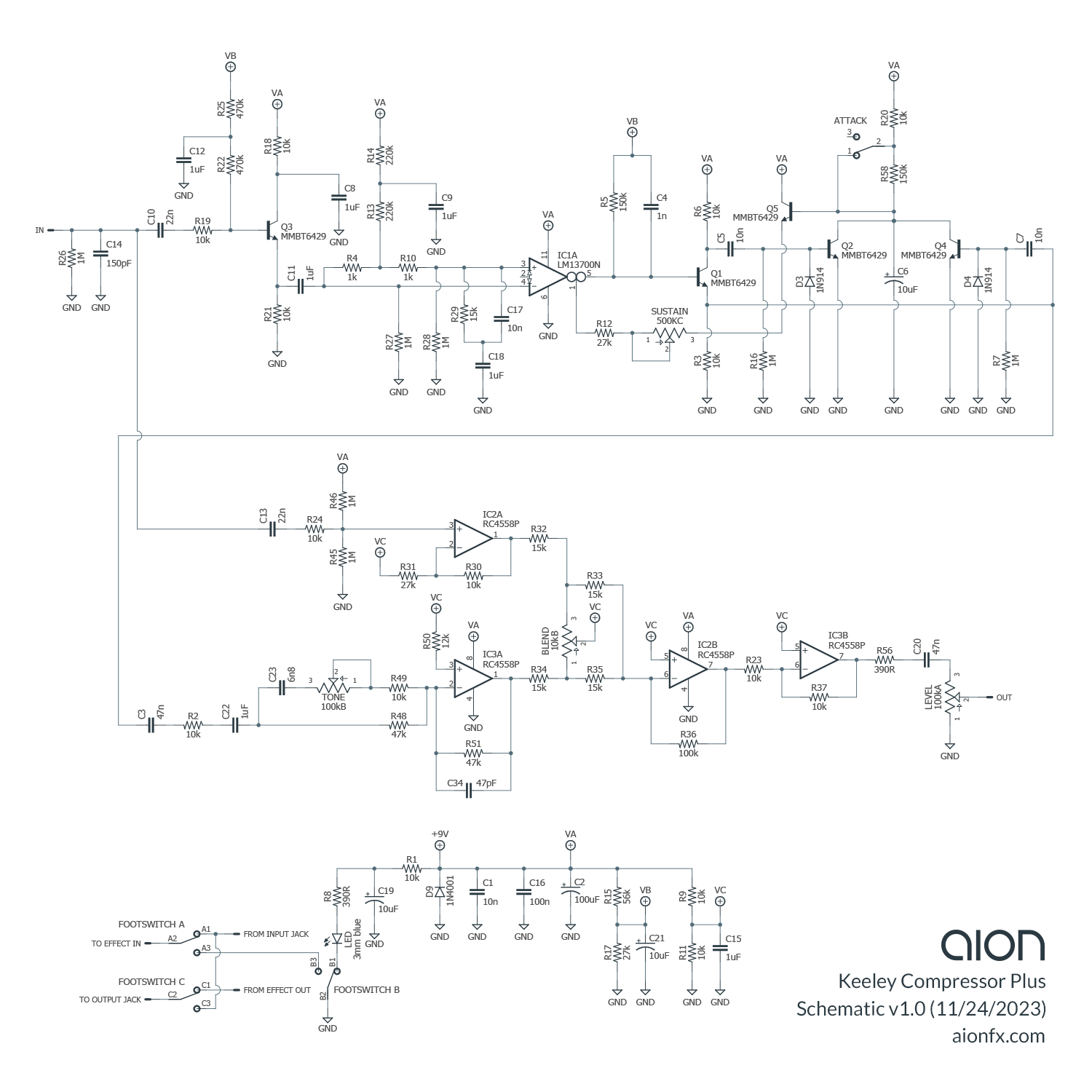

The pedal has a Blend knob. The instruction says if you turn it fully to the left you have 50% wet - 50% dry signal. When you turn it fully to the right, you got 100% wet signal. The situation is: if you make sure that the input signal is below the input limit ( 9V PSU - 2.5Vpp / 12V PSU - 3.5Vpp), then if the Blend knob is turned fully to the left, the outcoming signal is crytsall clear even if you set heavy settings on the Sustain or Tone knobs. When you turn the Blend just a tiny bit clockwise, the intermodulation is already there, and it extends more and more towards the headstock causing problem in more and more frets as you turn the Blend knob more and more clockwise towards 100% wet.
Does it help anything to solve the problem? I am asking those who can interpret schematics.
Re: Mysterious 3rd note appears playing intervals on electric guitars, why????
I still haven't found the solution (in the process of testing with an audio probe at the moment).
But I have some additions to this topic. When posting about distortion problems here and in some other forums, it was a usual reaction from participants that compressors are like that, I am setting the compression to be too heavy, etc. In spite of that I mentioned right in the first post that I experienced similar problems not only with compressors. The problem was: due to the distortion problems I sold all those pedals long ago, and stuck to my effect processor instead, that had worse quality effects but no distortion problems.
Then when I concluded I need better compressors than in the multieffect, I had to face the problem again. And during the investigation of the problem, I only had compressors.
But for skepticals, who did not take it into consideration that it was not just a compressor setting issue: I came across a pedal I owned in the past and that had similar problems, and I purchased it to test it.
This is the Behringer UC100 Chorus. I liked this pedal, because it produced a nice chorus effect (strangely it sounds better to me than the more recent UC200). I tested it, you can see the video below. The result: both clipping distortion and intermodulation (3rd note) is present. I tested it with the Schecter Omen guitar (has 17ohm impedance factory pickups). The intermodulation is much worse in the Behringer. It is already audible from around the 12th fret, and even if you turn down the volume on the guitar much, you still hear it very well at the highest intervals.
The Keeley Compressor Plus and this pedal must have something in common so that intermodulation happens in both of their circuits. Just as a reminder: my Carl Martin Compressor suffers from no intermodulation, but we already concluded that is a FET product.
https://drive.google.com/file/d/1KcRBa7 ... drive_link
This is the Schematic of the Behringer:
https://drive.google.com/file/d/1gqI1ky ... drive_link
P.S.: Just because I already know the way of thinking here in the forum: no, this is not a "good pedal - garbage pedal" issue. Back in the days when I owned a few different type of pedals, I also had a brand new Visual Sound H2O Chorus/Echo, because one of my teachers who was a musician used that, and was very satisfied with it (he used it with a classic single coil strat). That had the same problems with my guitars (humbucker superstrats). I am just not hunting for that to test and show it, because it would cost much more, and I don't feel like paying more only for the intermodulation test. So you get the test from the one I don't mind paying a few bucks for. Sorry!
But I have some additions to this topic. When posting about distortion problems here and in some other forums, it was a usual reaction from participants that compressors are like that, I am setting the compression to be too heavy, etc. In spite of that I mentioned right in the first post that I experienced similar problems not only with compressors. The problem was: due to the distortion problems I sold all those pedals long ago, and stuck to my effect processor instead, that had worse quality effects but no distortion problems.
Then when I concluded I need better compressors than in the multieffect, I had to face the problem again. And during the investigation of the problem, I only had compressors.
But for skepticals, who did not take it into consideration that it was not just a compressor setting issue: I came across a pedal I owned in the past and that had similar problems, and I purchased it to test it.
This is the Behringer UC100 Chorus. I liked this pedal, because it produced a nice chorus effect (strangely it sounds better to me than the more recent UC200). I tested it, you can see the video below. The result: both clipping distortion and intermodulation (3rd note) is present. I tested it with the Schecter Omen guitar (has 17ohm impedance factory pickups). The intermodulation is much worse in the Behringer. It is already audible from around the 12th fret, and even if you turn down the volume on the guitar much, you still hear it very well at the highest intervals.
The Keeley Compressor Plus and this pedal must have something in common so that intermodulation happens in both of their circuits. Just as a reminder: my Carl Martin Compressor suffers from no intermodulation, but we already concluded that is a FET product.
https://drive.google.com/file/d/1KcRBa7 ... drive_link
This is the Schematic of the Behringer:
https://drive.google.com/file/d/1gqI1ky ... drive_link
P.S.: Just because I already know the way of thinking here in the forum: no, this is not a "good pedal - garbage pedal" issue. Back in the days when I owned a few different type of pedals, I also had a brand new Visual Sound H2O Chorus/Echo, because one of my teachers who was a musician used that, and was very satisfied with it (he used it with a classic single coil strat). That had the same problems with my guitars (humbucker superstrats). I am just not hunting for that to test and show it, because it would cost much more, and I don't feel like paying more only for the intermodulation test. So you get the test from the one I don't mind paying a few bucks for. Sorry!