Hi,
I'm trying to get my head around just exactly how M/S produces a stereo image. I've used it, and like the sound, but I just don't understand how reversing the phase on a duplicate of the figure-8 mic channel produces a right side image. Is that, a signal reaching the fig-8 at 0 degrees, reaches the opposite side out of phase, so reversing the polarity on the duplicate (panned right) cancels this signal on the right? And is the fact that the signal is still present on the left side in this example due to the fact the fact that the two side signals are panned opposite each other, as obviously, in mono, they would theoretically cancel each other completely.
Also, does the 'mid' mic have anything to do with how the above, or is it purely just preventing there being a 'hole in the middle'?
Everything I've read has either been too simplistic and just covered the set-up and how to decode the signal, or has been too scientific - I need an explanation in layman's terms (I'll try not to be insulted by condescension)!
Thanks
Alex Siddall
M/S technicalities
M/S technicalities
-
- Alex Siddall
- Posts: 1 Joined: Mon Oct 19, 2009 12:00 am
Re: M/S technicalities
The ability of the MS decoding to produce a stereo signal is due to the way that the S and phase reversed S signals combine with the M signal.
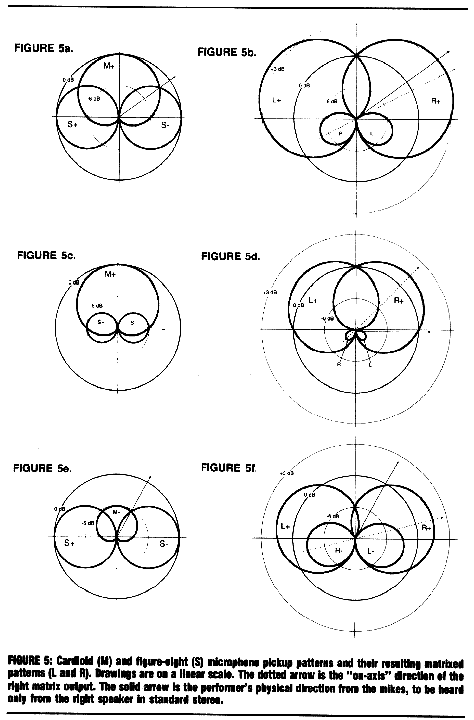
Figures 3 & 4 at the end of this paper give a rather useful diagrammatical representation of what happens when the M and S/-S signals are combined in various ratios (see also Fig 9.)
MS Recording Technique - Peus (1988)
These pics really helped me understand just what people meant when they said that decoding an MS pair produces a virtual coincident pair of microphones. You can see from fig. 9 that the angle and polar pattern of the virtual pair are interdependent and vary according to the amount of S/-S that is added.
Hope this helps
Figures 3 & 4 at the end of this paper give a rather useful diagrammatical representation of what happens when the M and S/-S signals are combined in various ratios (see also Fig 9.)
MS Recording Technique - Peus (1988)
These pics really helped me understand just what people meant when they said that decoding an MS pair produces a virtual coincident pair of microphones. You can see from fig. 9 that the angle and polar pattern of the virtual pair are interdependent and vary according to the amount of S/-S that is added.
Hope this helps
-
- TomCollins
New here - Posts: 9 Joined: Tue Dec 04, 2007 12:00 am
Re: M/S technicalities
Alex Siddall wrote:I just don't understand how reversing the phase on a duplicate of the figure-8 mic channel produces a right side image.
In a simple XY coincident stereo mic array, two directional mics (typically cardioid or hypercardioid) are angled apart slightly left and right. The nature of their polar patterns means that they tend to favour (ie are more sensitive to) sounds on their respective axes. So the mic pointing slightly left is more sensitive to sources on the left hand side, and vice versa.
The result is that the outputs from the two mics differ in level depending on the position of sound sources in front of the mics, getting louder on the left channel for left-sided sources and vice versa. That differeing level, when reproduced over stsreo loudspeakers, results inthe creation of the impression of a spatial stero image between the speakers.
MS stereo is also a coincident XY stereo array format, but it works with 'virtual' left and right facing mics instead of physical ones. In other words the physical M and S microphones are converted into 'virtual mics' -- and there are various advantages to that approach which I'll come back to in a moment. MS was invented by Blumlein in the 1930s at the same time as he developed the more conventional XY technques we use.
In an MS array there is a forward facing Mid mic (usually cardioid, but it can be anything), and a side facing Side mic (always a figure 8 pattern). The left side of the Side mic must have the same polarity as the front of the Mid mic for the maths and decoding matrices to work properly.
If you combine the outputs of any two coincident mics (coincident so that the sound waves arrive at both simultaneously -- we don't want arrival time differences to complicate things!), you create a new 'virtual' mic, the polar pattern and directional axis of which is determined by the two mics you start with.
To make this concept as simple as possible, let's start by considering a fig-8 Mid mic facing forward and a fig-8 Side mic facing left, and then combine them (mix their outputs) together at unity gain.
For a sound source from the front, only the Mid mic is contributing to the output because any sound from that direction hits the null of the Side mic. At 45 degrees left both mics are contributing pretty well and in the same polarity, so there is a lot of output for sources at that position -- more than there was at the front.
At 90 degrees left we have a similar situation to the front -- the Side mic is giving the entire output with nothing from the Mid, so the level falls slightly from the 45 degree position.
If you go around 135 degrees left, the Side mic is giving a moderate output, as is the Mid mic, but because we're now at the back of the latter its polarity is reversed. As a result there is no output at all. The same situation arises at 45 degrees right (but with the mic's respective polarities are reversed).
If you draw this out on a piece of paper you'll soon see the result. Combining two fig-8s aranged in this way produces a new 'virtual' fig-8 facing 45 degrees left.
And if you then combine the same Mid mic with a polarity-inverted version of the Side mic you'll create a new virtual fig-8 mic facing 45 degrees right.
So from a Mid and Side array using two fig-8s facing front and left, we can create a classic crossed-fig-8 (blumlein) array of 'virtual' mics facing half left and half right.
Mathmatically this can be expressed as:
Virtual Left mic = M+S
and
Virtual Right mic = M+(-S) .... or just M-S
Exactly the same process goes on if the Mid mic is a cardioid, except that the resulting virtual mics are hypercardioids and the outward angle they subtend is dependent on the relative sensitivities of the Mid and Side mics -- again, draw it out on paper and you'll see why. (or look at that Schoeps/Peus paper) mentioned above.
So, to decode an MS pair to extract the 'virtual' left and right facing mics, you need to recreate the maths above in the mixer or DAW.
To get the left mic we need to mix the Mid and Side mics together in the same polarity, and to get the right mic we need to mix the Mid and a polarity inverted version of the side mic together.
That's why you duplicate and invert the side mic. The Mid mic is panned centrally to feed both the left and right stereo outputs of your mixer or DAW. The original side mic signal is panned fully left so that it mixes with the Mid signal in the left output channel. The duplicated and inverted Side mic is panned fully right to combine with the Mid mic on the right output.
If you switch to mono, the original and inverted S signals will cancel each other out, leaving only the Mid mic's output.
If you listen in stereo but reduce the level of both Side mic signals (they must always be adjusted equally of course), the stereo image will narrow (just as if the two virtual mics are being rotated towards the centre axis).
And if you increase the level of both side mics (or reduce the mid mic level), the stereo image width will increase (just as if you were rotating the virtual mics outwards).
If you set the Side mic up the wrong way around (ie in-phase side facing right) then the decoded output with be left-right reversed. Or you can achieve the same thing by deliberately inverting the polarity of either the Mid or Side mic prior to decoding.
That ability to alter the stereo image width remotely is one very useful attribute of the MS approach. The other is to do with the physical nature of real world mics.
The frequency response of all mics, but large diaphragm mics in particular, tends to go wrong the further off axis you go. With conventional XY stereo arrays, anything happening at the centre of the sound stage is inherently off-axis to both the left and right mic -- and therefore the tonal quality might not be as good as it should be.
With an MS array, the Mid mic is pointing directly at the centre of the sound stage, so tonal quality is optimised. It's a subtle distinction, but can be important in some applications -- particuarly broadcasting.
Hope that helps.
Hugh
-

- Hugh Robjohns
Moderator -
Posts: 43689 Joined: Fri Jul 25, 2003 12:00 am
Location: Worcestershire, UK
Contact:
Technical Editor, Sound On Sound...
(But generally posting my own personal views and not necessarily those of SOS, the company or the magazine!)
In my world, things get less strange when I read the manual...
(But generally posting my own personal views and not necessarily those of SOS, the company or the magazine!)
In my world, things get less strange when I read the manual...
Re: M/S technicalities
You may find this useful:-
-

- John Willett
Longtime Poster -
Posts: 7297 Joined: Tue Mar 07, 2000 12:00 am
Location: Oxfordshire UK
Contact:
John
Sound-Link ProAudio
Circle Sound Services
Sound-Link are UK Distributors for: Microtech Gefell, ME-Geithain, AETA, HUM, Håkan, Meyer Turtle
Sound-Link ProAudio
Circle Sound Services
Sound-Link are UK Distributors for: Microtech Gefell, ME-Geithain, AETA, HUM, Håkan, Meyer Turtle
Re: M/S technicalities
Another one, also with non-cardioid 'M' microphones:
http://www.wesdooley.com/pdf/technique.pdf
Regards,
-j
http://www.wesdooley.com/pdf/technique.pdf
Regards,
-j
Re: M/S technicalities
In which case then, am I right in thinking that I need to decode at the tracking stage rather than after? i.e. If I track 1 x mid and 1 x side and then copy the side, pan 1 side hard left, 1 side hard right and reverse the polarity of 1 side will I get the required results?
I have an m-audio octane that is supposed to help me with this but have lost the destructions, sorry, instructions. Can anyone give me the step by step guide with this piece of kit?
I have an m-audio octane that is supposed to help me with this but have lost the destructions, sorry, instructions. Can anyone give me the step by step guide with this piece of kit?
-
- Peter Morley
Poster - Posts: 68 Joined: Thu Mar 27, 2008 12:00 am
Re: M/S technicalities
If you have the technology, use a Blumlein pair instead. It's a more accurate and natural stereo image, and it doesn't require any decoding. My $.02
-
- Andrew Hutchinson
Poster - Posts: 36 Joined: Mon Jun 30, 2008 12:00 am
Re: M/S technicalities
Andrew Hutchinson wrote:If you have the technology, use a Blumlein pair instead. It's a more accurate and natural stereo image, and it doesn't require any decoding. My $.02
Actually two figure-8s in MS is better than a "Blumlein" pair - and is actually what Blumlein himself used.

-
- John Willett
Longtime Poster -
Posts: 7297 Joined: Tue Mar 07, 2000 12:00 am
Location: Oxfordshire UK
Contact:
John
Sound-Link ProAudio
Circle Sound Services
Sound-Link are UK Distributors for: Microtech Gefell, ME-Geithain, AETA, HUM, Håkan, Meyer Turtle
Sound-Link ProAudio
Circle Sound Services
Sound-Link are UK Distributors for: Microtech Gefell, ME-Geithain, AETA, HUM, Håkan, Meyer Turtle
Re: M/S technicalities
Peter Morley wrote:In which case then, am I right in thinking that I need to decode at the tracking stage rather than after? i.e. If I track 1 x mid and 1 x side and then copy the side, pan 1 side hard left, 1 side hard right and reverse the polarity of 1 side will I get the required results?
I have an m-audio octane that is supposed to help me with this but have lost the destructions, sorry, instructions. Can anyone give me the step by step guide with this piece of kit?
Hi Peter,
Depends what you are trying to do really. If you want to monitor your MS recording in stereo you'll have to decode it on the way in somehow. I don't know the Octane but my RME will decode incoming M/S to L/R in it's internal mixer(e.g. M/S coming in on 1 & 2 can be decoded to L/R on outputs 3 & 4 for monitoring).
{edit - although I suppose if you don't mind the latency you can decode and monitor through your DAW instead}
Alternatively you can buy an MS decoder box.
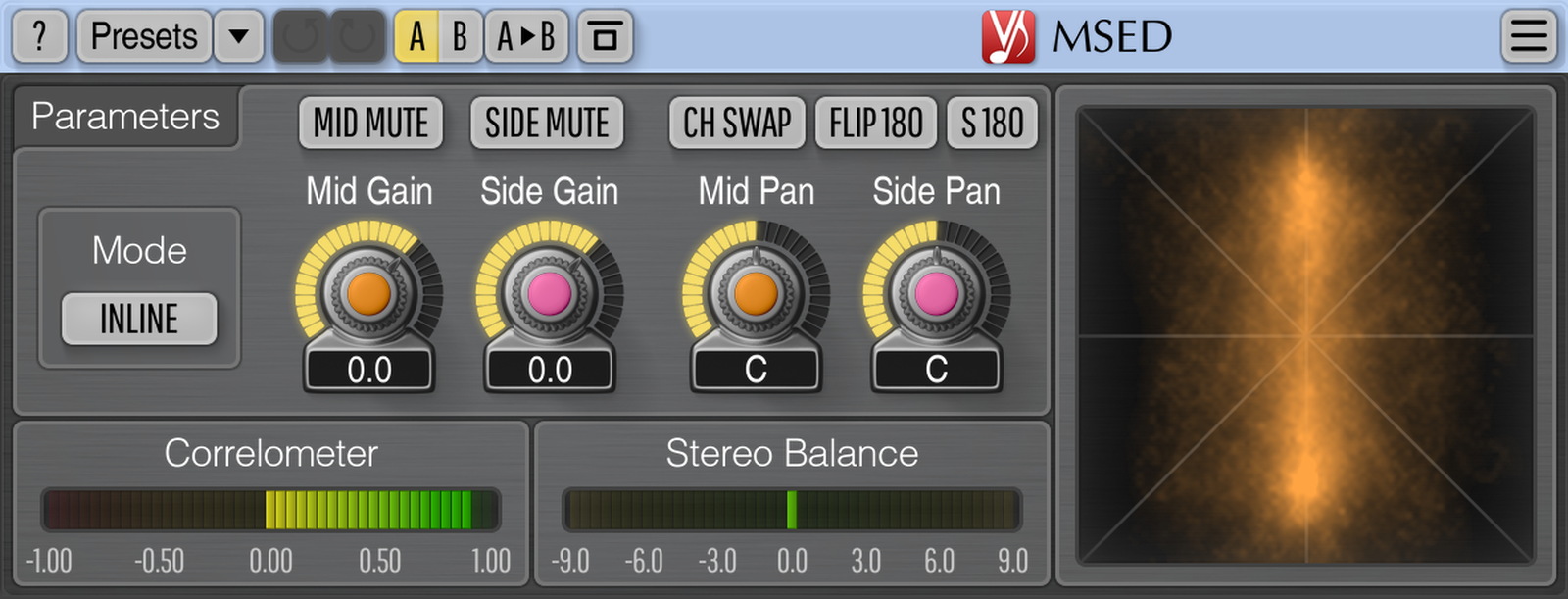
If you want to decode M/S within your DAW, and it doesn't have that facility built in, then one simple way is to Google for Voxengo's free MS decoder MSED. You'll need the M/S recording on a single 'Stereo' track with M in the left channel and S in the right. Insert MSED as an in-line effect and the output will be L/R.
cheers
A
Life is wealth. (John Ruskin)
Re: M/S technicalities
Peter Morley wrote:...but have lost the destructions, sorry, instructions.
Octane manual
It's always worth googling for the manual.
Life is wealth. (John Ruskin)
Re: M/S technicalities
adrian_k wrote: If you want to decode M/S within your DAW, and it doesn't have that facility built in, then one simple way is to Google for Voxengo's free MS decoder MSED. You'll need the M/S recording on a single 'Stereo' track with M in the left channel and S in the right. Insert MSED as an in-line effect and the output will be L/R.
This is what I use.
You can download the latest version 2.1 HERE.
-
- John Willett
Longtime Poster -
Posts: 7297 Joined: Tue Mar 07, 2000 12:00 am
Location: Oxfordshire UK
Contact:
John
Sound-Link ProAudio
Circle Sound Services
Sound-Link are UK Distributors for: Microtech Gefell, ME-Geithain, AETA, HUM, Håkan, Meyer Turtle
Sound-Link ProAudio
Circle Sound Services
Sound-Link are UK Distributors for: Microtech Gefell, ME-Geithain, AETA, HUM, Håkan, Meyer Turtle
Re: M/S technicalities
Peter Morley wrote:In which case then, am I right in thinking that I need to decode at the tracking stage rather than after?
You can do either -- it depends what you want to achieve. Maximum flexibility is to decode at the mixdown because you can then fine tune the stereo width to suit the mix.
But you usually need to decode during tracking too, just so that you can hear the notional stereo output of the mic to ensure you've put it in the right place.
generally, I do both -- I record the Mid and Side mics directly, ut also route them through a decoder of some kind to hear the image they produce when tracking. Sometiems I even record that too.
Although you can always convert between MS and left-right, and vice versa -- and therefore adjust the perceived stsreo width at any time, the results are subtly different between recording MS and adjusting the width to suit at the mix, as against recording the decoded MS and then re-converting to MS to adjust the width at the mix.
Hugh
-
- Hugh Robjohns
Moderator -
Posts: 43689 Joined: Fri Jul 25, 2003 12:00 am
Location: Worcestershire, UK
Contact:
Technical Editor, Sound On Sound...
(But generally posting my own personal views and not necessarily those of SOS, the company or the magazine!)
In my world, things get less strange when I read the manual...
(But generally posting my own personal views and not necessarily those of SOS, the company or the magazine!)
In my world, things get less strange when I read the manual...
Re: M/S technicalities
Andrew Hutchinson wrote:If you have the technology, use a Blumlein pair instead. It's a more accurate and natural stereo image, and it doesn't require any decoding.
It doesn't require decoding, true enough, but I'm not sure I agree on the other points. An MS array with a fig-8 centre has all the same naturalness, but in some cases will be more accurate -- especially for central sources. And as JW says, if it's good enough for Mr Blumlein....

Hugh
-
- Hugh Robjohns
Moderator -
Posts: 43689 Joined: Fri Jul 25, 2003 12:00 am
Location: Worcestershire, UK
Contact:
Technical Editor, Sound On Sound...
(But generally posting my own personal views and not necessarily those of SOS, the company or the magazine!)
In my world, things get less strange when I read the manual...
(But generally posting my own personal views and not necessarily those of SOS, the company or the magazine!)
In my world, things get less strange when I read the manual...
Re: M/S technicalities
Peter Morley wrote:In which case then, am I right in thinking that I need to decode at the tracking stage rather than after?
Not to discount any of your answers, gentlemen, but I'd like to add that the main points about M/S are:
Ability to process the stereo image in the simplest manner.
Ability to provide otherwise difficult enhancement such as differential EQ or dynamics.
Superb mono compatibility due to use of a mono mic.
Re: M/S technicalities
lead ears wrote:Ability to process the stereo image in the simplest manner.
Not quite sure whaat you mean by that. The simplest way to 'process' a stereo image is as left-right, surely? MS isn't, of itself, stereo in the accepted sense -- it has to be transcoded first, as we all know.
Ability to provide otherwise difficult enhancement such as differential EQ or dynamics.
Agreed. It is a very useful way to process a stereo signal in some situations.
Superb mono compatibility due to use of a mono mic.
Not so much the idea of a 'mono' mic -- after all the mono sum of a conventional coincident XY pair still produces an equivalent 'virtual' mono mic. The advantage is that the Mid mic points straight forward and thus central sources (which are inherently dominant in the derived mono soundstage) are capture mostly on-axis and thus in the highest fidelity the microphone is capable of.
In comparison, the 'virtual mono mic' derived from an conventional XY pair may, in some situations, suffer a less than perfect frequency response.
Hugh
hugh
-
- Hugh Robjohns
Moderator -
Posts: 43689 Joined: Fri Jul 25, 2003 12:00 am
Location: Worcestershire, UK
Contact:
Technical Editor, Sound On Sound...
(But generally posting my own personal views and not necessarily those of SOS, the company or the magazine!)
In my world, things get less strange when I read the manual...
(But generally posting my own personal views and not necessarily those of SOS, the company or the magazine!)
In my world, things get less strange when I read the manual...
Re: M/S technicalities
Hugh Robjohns wrote:lead ears wrote:Ability to process the stereo image in the simplest manner.
Not quite sure whaat you mean by that. The simplest way to 'process' a stereo image is as left-right, surely? MS isn't, of itself, stereo in the accepted sense -- it has to be transcoded first, as we all know.
Should have formulated differently: simplest way to adjust stereo width, with a single knob, in the M/S format, before transcoding to L/R. .
Superb mono compatibility due to use of a mono mic.
Not so much the idea of a 'mono' mic -- after all the mono sum of a conventional coincident XY pair still produces an equivalent 'virtual' mono mic. The advantage is that the Mid mic points straight forward and thus central sources (which are inherently dominant in the derived mono soundstage) are capture mostly on-axis and thus in the highest fidelity the microphone is capable of.
In comparison, the 'virtual mono mic' derived from an conventional XY pair may, in some situations, suffer a less than perfect frequency response.
Hugh
hugh
That's exactly what I meant. A virtual mono mic cannot be as good as a real one, if only because of mismatch, distance, improper alignment...
Re: M/S technicalities
Hugh Robjohns wrote:
Although you can always convert between MS and left-right, and vice versa -- and therefore adjust the perceived stsreo width at any time, the results are subtly different between recording MS and adjusting the width to suit at the mix, as against recording the decoded MS and then re-converting to MS to adjust the width at the mix.
Hugh
This is something I've recently been considering. Working entirely digitally, I'm wondering what the results might be if one goes back and forth a couple of times. Not having the time, and being a little lazy, I haven't tried this. Have you, Hugh, or anyone else done this and determined how far things go astray in the all digital realm?
And there are a few variants: Such as plugins that allow MS processing within the stereo realm, including panning the center right or left, & and panning the virtual side mic, etc.
Re: M/S technicalities
Alex Siddall wrote:Hi,
I'm trying to get my head around just exactly how M/S produces a stereo image. I've used it, and like the sound, but I just don't understand how reversing the phase on a duplicate of the figure-8 mic channel produces a right side image.
Just curious, if you've used an MS setup, have you used an analogue box or a software matrix? I ask, because I think that once someone does this completely manually on an analogue (or digital, I guess) mixer-without benefit of a plugin or a matrix box, the whole thing is immediately understood.
I know that most think the difference in meaning of "phase" and "polarity" is entirely semantic, but it really isn't, and thinking in terms of polarity and opposite polarity might be helpful in simplifying matters.
Re: M/S technicalities
lead ears wrote:That's exactly what I meant. A virtual mono mic cannot be as good as a real one, if only because of mismatch, distance, improper alignment...
Please - it's a MID mic.

MS = Mid / Sides (*not* Mono / Stereo).
Virtually *all* microphones are "mono" mics as they only have a single capsule.
To call the Mid mic. a Mono mic. is using the wrong word and confuses people who are struggling to understand what MS does.
-
- John Willett
Longtime Poster -
Posts: 7297 Joined: Tue Mar 07, 2000 12:00 am
Location: Oxfordshire UK
Contact:
John
Sound-Link ProAudio
Circle Sound Services
Sound-Link are UK Distributors for: Microtech Gefell, ME-Geithain, AETA, HUM, Håkan, Meyer Turtle
Sound-Link ProAudio
Circle Sound Services
Sound-Link are UK Distributors for: Microtech Gefell, ME-Geithain, AETA, HUM, Håkan, Meyer Turtle
Re: M/S technicalities
lead ears wrote:Should have formulated differently: simplest way to adjust stereo width, with a single knob, in the M/S format, before transcoding to L/R.
Er... it's the only way... isn't it?
Okay, so you can faff around with pan pots and mixing in reversed phase Left/right in opposite channels, but the maths end up being the same thing anyway.
That's exactly what I meant. A virtual mono mic cannot be as good as a real one, if only because of mismatch, distance, improper alignment...
I'm not so sure about that -- in principle it could be better and there are multi-capsule microphone systems starting to appear that can achieve better results than is possible with individual physical capsules -- but I agree in the context of simple LR mono summing and MS matrixing.
Hugh
-
- Hugh Robjohns
Moderator -
Posts: 43689 Joined: Fri Jul 25, 2003 12:00 am
Location: Worcestershire, UK
Contact:
Technical Editor, Sound On Sound...
(But generally posting my own personal views and not necessarily those of SOS, the company or the magazine!)
In my world, things get less strange when I read the manual...
(But generally posting my own personal views and not necessarily those of SOS, the company or the magazine!)
In my world, things get less strange when I read the manual...
Re: M/S technicalities
Jeraldo wrote:I'm wondering what the results might be if one goes back and forth a couple of times.
If you don't change the ratio of levels between Mid and Side, and you take care of the overall gain increase by reducing the level of each matrix process by 3dB, then you can transcode for ever and nothing changes. But as soon as you start adjusting the MS ratio you change the equivalent virtual microphones and that obviously affects the stereo image. In my experience, it then becomes impossible to get back to the original mics, although in practice it's rarely (if ever) a problem.
Hugh
-
- Hugh Robjohns
Moderator -
Posts: 43689 Joined: Fri Jul 25, 2003 12:00 am
Location: Worcestershire, UK
Contact:
Technical Editor, Sound On Sound...
(But generally posting my own personal views and not necessarily those of SOS, the company or the magazine!)
In my world, things get less strange when I read the manual...
(But generally posting my own personal views and not necessarily those of SOS, the company or the magazine!)
In my world, things get less strange when I read the manual...
Re: M/S technicalities
What’s the feeling about using unmatched mics for M/S recording?
The only mic I have capable of fig-8 is my U87 and I’m not about to raid the pot pig for another one any time soon! Should I at least go for a pair of LDCs, or try an SDC for the Mid? How about an omni cap for the Mid – what might that do (reduce the stereo imaging I'd guess?)?
I’ve not used M/S to present, though I’ve been curious about it for a long time – just not curious enough to try it out mid-session! I find myself hankering to turn up at a local carol concert this year with my portable rig and couple of mics set to M/S!
The only mic I have capable of fig-8 is my U87 and I’m not about to raid the pot pig for another one any time soon! Should I at least go for a pair of LDCs, or try an SDC for the Mid? How about an omni cap for the Mid – what might that do (reduce the stereo imaging I'd guess?)?
I’ve not used M/S to present, though I’ve been curious about it for a long time – just not curious enough to try it out mid-session! I find myself hankering to turn up at a local carol concert this year with my portable rig and couple of mics set to M/S!

An Eagle for an Emperor, A Kestrel for a Knave.
Re: M/S technicalities
The Elf wrote:What’s the feeling about using unmatched mics for M/S recording?
MS is the only stereo arrangement that you *can* do with unmatched mics as they have totally different patterns.
You can even do an MS "Blumlein" with two different fig-8 mics.
You just make up the level differences on the mixer / DAW.
-
- John Willett
Longtime Poster -
Posts: 7297 Joined: Tue Mar 07, 2000 12:00 am
Location: Oxfordshire UK
Contact:
John
Sound-Link ProAudio
Circle Sound Services
Sound-Link are UK Distributors for: Microtech Gefell, ME-Geithain, AETA, HUM, Håkan, Meyer Turtle
Sound-Link ProAudio
Circle Sound Services
Sound-Link are UK Distributors for: Microtech Gefell, ME-Geithain, AETA, HUM, Håkan, Meyer Turtle
Re: M/S technicalities
It's a bit more than just level differences... but John is right in that you can 'get away' with using unmatched mics for MS arrays with less obvious anomalies than you'd get with any other stereo arrangement.
The stereo image is derived from the matrixing of the M and S mics, and the equivalent virtual XY mics this system produces depend on the way the M and S signals add together.
A microphone's polar response isn't just a cardioid, or omni, or figure-8 -- it changes shape with frequency -- and especially so for large diaphragm mics.
So while your cardioid Mid microphone might well be cardioid at 1kHz, at 10kHz it could well be more like a hypercardioid or even a poor fig-8, and at 100Hz it could well be almost omnidirectional.
Consequently, when you matrix it with the fig-8 mic the level difference that defines the stereo image position between the left and right outputs will vary not only with the source's physical position around the MS array, but also with its frequency.
In practical ternms, what this means is that the stereo image width will tend to vary with frequency to some degree. If a broadband source moves from left to right (or vice versa) you may become aware that some frequency components traverse the distant at a different rate to others -- images tend to smear laterally.
It's a pretty subtle effect -- the ear isn't as sensitive to image widths as it is to image positions. So in all but the most extreme cases of mismatch, and unless you are trying to record fast moving broadband noise sources, you won't hear much to worry about.
But if you want pin-sharp imaging you need to find a Mid and Side mic with as similar a frequency respsonse as possible across as wide an angle as possible.
Hugh
The stereo image is derived from the matrixing of the M and S mics, and the equivalent virtual XY mics this system produces depend on the way the M and S signals add together.
A microphone's polar response isn't just a cardioid, or omni, or figure-8 -- it changes shape with frequency -- and especially so for large diaphragm mics.
So while your cardioid Mid microphone might well be cardioid at 1kHz, at 10kHz it could well be more like a hypercardioid or even a poor fig-8, and at 100Hz it could well be almost omnidirectional.
Consequently, when you matrix it with the fig-8 mic the level difference that defines the stereo image position between the left and right outputs will vary not only with the source's physical position around the MS array, but also with its frequency.
In practical ternms, what this means is that the stereo image width will tend to vary with frequency to some degree. If a broadband source moves from left to right (or vice versa) you may become aware that some frequency components traverse the distant at a different rate to others -- images tend to smear laterally.
It's a pretty subtle effect -- the ear isn't as sensitive to image widths as it is to image positions. So in all but the most extreme cases of mismatch, and unless you are trying to record fast moving broadband noise sources, you won't hear much to worry about.
But if you want pin-sharp imaging you need to find a Mid and Side mic with as similar a frequency respsonse as possible across as wide an angle as possible.
Hugh
-
- Hugh Robjohns
Moderator -
Posts: 43689 Joined: Fri Jul 25, 2003 12:00 am
Location: Worcestershire, UK
Contact:
Technical Editor, Sound On Sound...
(But generally posting my own personal views and not necessarily those of SOS, the company or the magazine!)
In my world, things get less strange when I read the manual...
(But generally posting my own personal views and not necessarily those of SOS, the company or the magazine!)
In my world, things get less strange when I read the manual...
Re: M/S technicalities
John Willett wrote:lead ears wrote:That's exactly what I meant. A virtual mono mic cannot be as good as a real one, if only because of mismatch, distance, improper alignment...
Please - it's a MID mic.
MS = Mid / Sides (*not* Mono / Stereo).
Virtually *all* microphones are "mono" mics as they only have a single capsule.
To call the Mid mic. a Mono mic. is using the wrong word and confuses people who are struggling to understand what MS does.
I didn't imply that the MID entity (which may very well be virtual) is a mono mic. But if I use an MS program recorded with a physical MID mic and I want to reduce it to MONO, that's the one I'll use exclusively. Please note that I have never referred to the SIDE mic as a stereo mic (would be ludicrous, wouldn't it?)