Fame is the in-house brand of Music Store Professional based in Cologne (who are fronted by DV247 in the UK) and covers a whole range of musical products including guitars, amplifiers, drums, keyboards, PA, microphones and all sorts of accessories. They are all budget priced and Chinese made items, but seemingly offering good value for money.
So here's the Fame MS 57 Mk II, along with its supplied Shure-alike clip (again with no 5/8" to 3/8" adapter).

At 146g, It's a very light mic. The Shure SM757 is a much heftier 284g. In comparison to the SM57's rotating plastic grille, the Fame's one is fixed. Whilst the Fame MS 58 is slightly larger than the SM58, the Fame MS 57 is almost exactly the same size as an SM57 (using Shure's data sheet measurements as I didn't have an SM 57 handy).
Unscrewing the body showed again no transformer, unlike an SM57. Releasing the XLR connector again showed that the mic was wired for unbalanced use. This time, pin 3 wasn't connected to pin 1, so is safe for use with phantom power. The XLR locating screw tab was correctly linked to pin 1.

When plugged in, there was no obvious noise from the mic. A test with a multimeter showed around 1 ohm resistance from pin 1 to the body, the coating of which is conductive. A test with a 'pup' sound showed that as wired, the signal went negative for a positive increase in pressure.
Whilst in theory, the same capsule should be used for both the MS 57 and the MS 58 (if truly based on the Shure mics), the circuit boards at the end of each of them were different, so it seems unlikely that the same capsule is used as in the Fame MS 58.
Here's the end of the Fame MS 57 Mk II capsule:

And here's the end of the Fame MS 58 Mk II capsule

The soldering iron then came out and the red wire was moved to pin 2. When plugged in, this was again tested with a 'pup' noise, which then gave a positive increase in signal for a positive increase in pressure. The signal output was approximately 6dB hotter than before, as could be expected. Handling noise was reasonable, with less high frequency component to it then with the Fame MS 58.
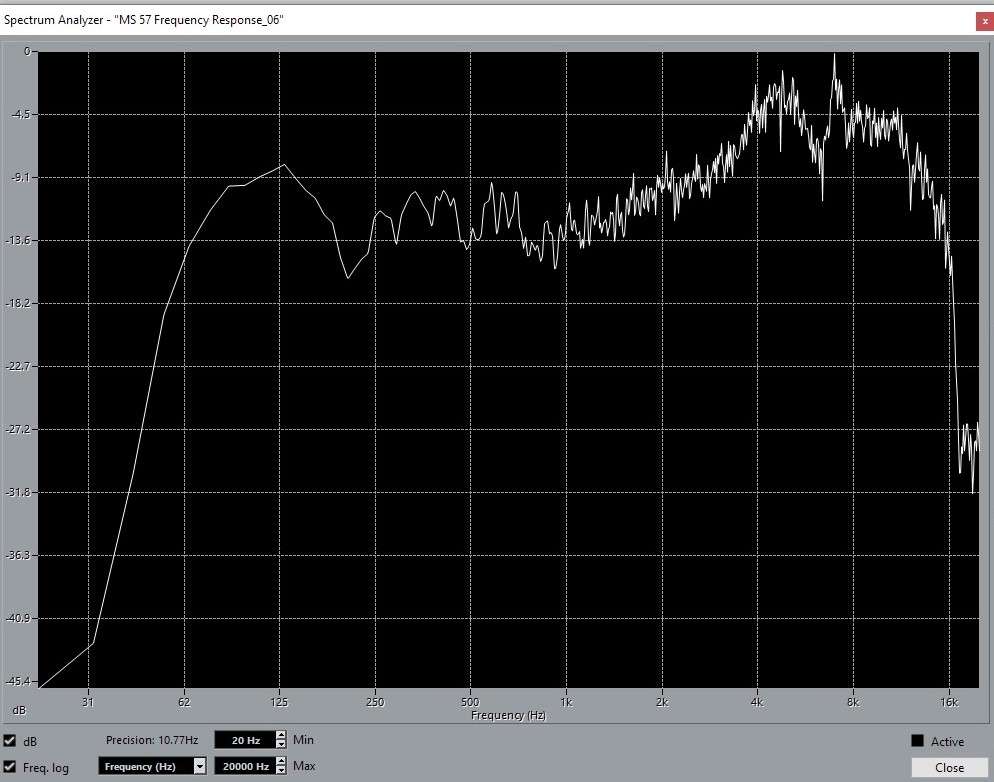
The MS 57 was then tested for frequency response by putting the mic 10cm away from a Genelec monitor, with the mic roughly halfway between the main driver and the tweeter whilst recording a long section of white noise and Cubase's offline frequency response tool used on the recorded wave file. I know it's not a perfect response test, but it can be compared to that of the one for the SM 58 response shown in my Fame MS 58 review. Here is the recorded response:
Without an SM57 for reference, I can only refer to Shure's idealised SM57 frequency response:

The top end boost appears to be greater than on a real SM57, especially when compared to the 1kHz value, by about 4dB or so, rather like the Fame MS 58, and again like it, the high frequency response seems extended by 2kHz or so, up to roughly 16kHz. The high-end frequency dip that appears between roughly 7kHz and 9kHz on the Shure chart, appears around 2kHz lower with the Fame MS 57, between 5kHz and 7kHz. So it's certainly not a near-identical SM57 copy.
So how does it sound in its own right? A quick listen to my voice showed a similar quite bright sound to the Fame MS 58, prone to highlighting sibilance. But as this is sold by Music Store Pro as an instrument mic, I thought I'd stick it in front of an amp along with a couple of other mics for a comparison. For convenience I stuck a 1982 Fender Vibro Champ on a stand, and miked it up with the MS 57 and without an SM57 to hand, I also used a Beyerdynamic M201 TG and a Sennheiser MD 421-U-5. All the mics were pointed at the cone at roughly a 45° angle, almost touching the amp and at a similar distance from the centre of the cone (the positions were fine tuned after I took the photo).

When setting the input gains on the A/I. to get similar recording levels from the three amps, the Fame MS 57 had the quietest signal, the M201 was about 3dB hotter and the MD421 about 6dB hotter than the Fame.
So I plugged in a Fender Strat and this is the result. No processing on the files apart from cleaning up the start and finish and normalising to -6dBFS. The uploaded files are 16-bit waves, so you can download them into your DAW if it makes it easier for you to compare them.
Clean and distorted sounds from the Fame MS 57:
https://soundcloud.com/stormy-simon/fam ... guitar-amp
Clean and distorted sounds from the M201:
https://soundcloud.com/stormy-simon/bey ... guitar-amp
Clean and distorted sounds from the MD421 (bass roll-off set on the M setting):
https://soundcloud.com/stormy-simon/md421
As there's not a lot coming off a guitar amp speaker above 6kHz (though the Vibro Champ has an 8" speaker so probably has a bit more HF output than a 12" speaker has), the boosted high-end of the Fame MS 57 is less likely to have much effect in this usage. However, the MD421 seems a little brighter than the Fame to me. And for live use, having a bit of a brighter top-end can often be an advantage (with the downside being an increased chance of high-end feedback).
Overall, I quite like this mic, especially for the price and more so than the Fame MS 58. Yes, it needs modifying to make it balanced to get the best from it. No, it may look like a Shure SM57 but it isn't one. But it has a useable sound and there are some instances where the brighter top-end may come in useful e.g. on a snare where it will pick up a bit more of the high-hat if you haven't got a dedicated hi-hat mic. There are other times where it's just going to be too bright. For live use it's a reasonable, cheap, instrument mic. It's a It's certainly far better than the fake Shure SM57s to be found on eBay for a similar price.


