Hi,
I’m finally having fun beginning to truly understand my signal flow and metering in terms of dBfs and dBu and VU and how they relate in my system to my DAW and converters and analog console. It feels like the Enlightenment era around here. Yay.
That said, I searched the SoS forums for “VU meter calibration” and don’t really see any thread explicitly detailing the process of calibrating the needle of an analog VU meter...
I know that for the left and right VUs on the mix bus of my Soundcraft 600 analog console there is an adjustment on one of the master circuit boards to change what value dBu is being referenced by those meters at 0VU (or something like that), but you’re not actually changing anything in the VU meter itself (how’s that possible?!). Here’s what the Soundcraft manual states: “0VU is normally adjusted to indicate a line level of +4dBu, i.e. a level of 1.228volts. However, it can be re-adjusted to indicate a different line level if required by the pre-set potentiometer on the drive card.” My mix bus VU meters are pretty much bang on 0VU when presented 1.228 dBu Vrms. All that is well and good.
So all that said, my real question here is: what do the little screws on front of the VU meters actually do, and how would you use those to adjust anything?
My VU meters say “Componex” and “2LX” (a Google search revealed nil).
Any advice or more enlightenment? Thanks!
Analog VU meter calibration (and that front screw)
Re: Analog VU meter calibration (and that front screw)
That screw adjusts spring tension on the needle, generally adjusted to set the needle at -infinity with no signal. Beware twisting it too far, it's easy to permanently damage the meter movement.
-
- Philbo King
Regular - Posts: 383 Joined: Thu Oct 11, 2018 10:07 pm
Re: Analog VU meter calibration (and that front screw)
The screw is adjusted so that the needle points to - infinity on a VU meter. Normally they never need to be adjusted - as a kid I adjusted that screw on my first multimeter and ended up in a right mess.
-

- James Perrett
Moderator -
Posts: 16984 Joined: Mon Sep 10, 2001 12:00 am
Location: The wilds of Hampshire
Contact:
JRP Music - Audio Mastering and Restoration. JRP Music Facebook Page
Re: Analog VU meter calibration (and that front screw)
All moving coil meters have a mechanical adjustment to balance the tension on the spring which sets the needle position when there is no power being input.
In some cases that adjustment is made accessible via a plastic screw on the front panel, and sometimes it is hidden behind the case cover. On some VU meters the balance adjustment is from the back.
This tension screw should not need to be adjusted, and is certainly NOT a routine adjustment. It's quite easy to destroy a meter by misadjusting the tension balance.
Adjustment is only ever necessary if the needle stops somewhere other than the end-stop when unpowered, and that's only likely to happen if the meter/product has been dropped or something strongly magnetic has been placed near the meter (like a tape machine degausser!) — and if the latter the meter will need careful degaussing itself, or it will need replacement.
If the meter end-stop position really does need adjustment, always use a non-magnetic screwdriver (a plastic or brass one).
The only 'routine' adjustment for a VU meter is the sensitivity of the simple amplifier driving it. The scaling law and ballistics are fixed by the design and construction of the meter itself (which is why real VU meters are surprisingly expensive. Most equipment uses cheaper and less accurate meters... but they're usually good enough.
In contrast the European PPM requires a very sophisticated amplifier which has many adjustments to calibrate the scale law and ballistics
The 0VU level on the VU meter should always equate to whatever the audio system alignment level is deemed to be.
In the analogue world that's usually either 0dBu (0.775Vrms) or +4dBu (1.228Vrms) in professional gear, or -10dBV (0.316Vrms) in semi-pro gear.
In the digital world it's normally either -18dBFS in Europe, or -20dBFS in America.
That said, the VU meter was designed originally to be adjustable via a special switched attenuator, with the idea being that the attenuator was adjusted until the meter peaked sensibly, and then the attenuator setting informed the user of the nominal signal level on the line being tested/monitored.
Very few mechanical meters include that feature these days, but most virtual ones do. And by adjusting the meter attenuator 0VU can be set to a higher level, allowing 'hot mixes' to be made without 'pegging the needle to the right-hand end-stop.
So, in a DAW, it's easy to set 0VU to be -14 or -12dBFS, for example, and that would encourage a hot mix.
The higher level options in Bob Katz's K-Meter system (k12 and k14) do exactly the same thing for the same reason.
In some cases that adjustment is made accessible via a plastic screw on the front panel, and sometimes it is hidden behind the case cover. On some VU meters the balance adjustment is from the back.
This tension screw should not need to be adjusted, and is certainly NOT a routine adjustment. It's quite easy to destroy a meter by misadjusting the tension balance.
Adjustment is only ever necessary if the needle stops somewhere other than the end-stop when unpowered, and that's only likely to happen if the meter/product has been dropped or something strongly magnetic has been placed near the meter (like a tape machine degausser!) — and if the latter the meter will need careful degaussing itself, or it will need replacement.
If the meter end-stop position really does need adjustment, always use a non-magnetic screwdriver (a plastic or brass one).
The only 'routine' adjustment for a VU meter is the sensitivity of the simple amplifier driving it. The scaling law and ballistics are fixed by the design and construction of the meter itself (which is why real VU meters are surprisingly expensive. Most equipment uses cheaper and less accurate meters... but they're usually good enough.
In contrast the European PPM requires a very sophisticated amplifier which has many adjustments to calibrate the scale law and ballistics
The 0VU level on the VU meter should always equate to whatever the audio system alignment level is deemed to be.
In the analogue world that's usually either 0dBu (0.775Vrms) or +4dBu (1.228Vrms) in professional gear, or -10dBV (0.316Vrms) in semi-pro gear.
In the digital world it's normally either -18dBFS in Europe, or -20dBFS in America.
That said, the VU meter was designed originally to be adjustable via a special switched attenuator, with the idea being that the attenuator was adjusted until the meter peaked sensibly, and then the attenuator setting informed the user of the nominal signal level on the line being tested/monitored.
Very few mechanical meters include that feature these days, but most virtual ones do. And by adjusting the meter attenuator 0VU can be set to a higher level, allowing 'hot mixes' to be made without 'pegging the needle to the right-hand end-stop.
So, in a DAW, it's easy to set 0VU to be -14 or -12dBFS, for example, and that would encourage a hot mix.
The higher level options in Bob Katz's K-Meter system (k12 and k14) do exactly the same thing for the same reason.
-

- Hugh Robjohns
Moderator -
Posts: 43684 Joined: Fri Jul 25, 2003 12:00 am
Location: Worcestershire, UK
Contact:
Technical Editor, Sound On Sound...
(But generally posting my own personal views and not necessarily those of SOS, the company or the magazine!)
In my world, things get less strange when I read the manual...
(But generally posting my own personal views and not necessarily those of SOS, the company or the magazine!)
In my world, things get less strange when I read the manual...

Re: Analog VU meter calibration (and that front screw)
A proper VU meter should have the VU scale (usually -20 to +3VU) above the arc, and a modulation level (0 to 100%) below the arc.
The unpowered endstop position should be the 0% mark which is just to the left of -20VU.
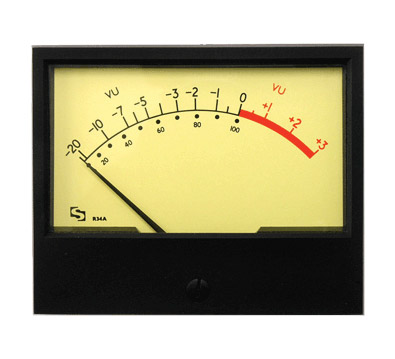
The unpowered endstop position should be the 0% mark which is just to the left of -20VU.
-
- Hugh Robjohns
Moderator -
Posts: 43684 Joined: Fri Jul 25, 2003 12:00 am
Location: Worcestershire, UK
Contact:
Technical Editor, Sound On Sound...
(But generally posting my own personal views and not necessarily those of SOS, the company or the magazine!)
In my world, things get less strange when I read the manual...
(But generally posting my own personal views and not necessarily those of SOS, the company or the magazine!)
In my world, things get less strange when I read the manual...
Re: Analog VU meter calibration (and that front screw)
cashhewn wrote: ↑Mon Oct 16, 2023 1:28 am I know that for the left and right VUs on the mix bus of my Soundcraft 600 analog console there is an adjustment on one of the master circuit boards to change what value dBu is being referenced by those meters at 0VU (or something like that), but you’re not actually changing anything in the VU meter itself (how’s that possible?!).
The adjustment simply alters the drive level of the signal going into the meter.
My mix bus VU meters are pretty much bang on 0VU when presented 1.228 dBu Vrms.
Then no adjustment needed. And it's 1.228 Vrms or +4dBu. 1.228dBu is something else entirely!

...my real question here is: what do the little screws on front of the VU meters actually do, and how would you use those to adjust anything?
They adjust the tension of the moving coil balance and they rarely need adjustment. They set the resting position of the needle when unpowered (which should be on the 0% mark of a VU meter). You can easily wreck a meter by misadjusting the balance, so leave it alone unless the resting point is way off!
-
- Hugh Robjohns
Moderator -
Posts: 43684 Joined: Fri Jul 25, 2003 12:00 am
Location: Worcestershire, UK
Contact:
Technical Editor, Sound On Sound...
(But generally posting my own personal views and not necessarily those of SOS, the company or the magazine!)
In my world, things get less strange when I read the manual...
(But generally posting my own personal views and not necessarily those of SOS, the company or the magazine!)
In my world, things get less strange when I read the manual...
Re: Analog VU meter calibration (and that front screw)
Thanks Hugh, James, Philbo and Wonks!
Oops, righto!
This is the bonus information I crave lol.
As an adult I very nearly did the same thing yesterday! Luckily I nervously righted the ship. My 0VU was about a dB off when sending a +4dBu sine wave from the DAW/DAC to a channel on my console then routing that to the mix bus (panned all the way left or right!), but I realized that this is actually more about the fiddly position of the analog channel strip's fader position than any necessary adjustment of the VU meter (since I have confirmed that 0VU is pretty much bang on with +4dBu at the console mix bus output).
All right, now back to music making, thanks again all!
Then no adjustment needed. And it's 1.228 Vrms or +4dBu. 1.228dBu is something else entirely!
Oops, righto!
and a modulation level (0 to 100%) below the arc.
This is the bonus information I crave lol.
as a kid I adjusted that screw on my first multimeter and ended up in a right mess.
As an adult I very nearly did the same thing yesterday! Luckily I nervously righted the ship. My 0VU was about a dB off when sending a +4dBu sine wave from the DAW/DAC to a channel on my console then routing that to the mix bus (panned all the way left or right!), but I realized that this is actually more about the fiddly position of the analog channel strip's fader position than any necessary adjustment of the VU meter (since I have confirmed that 0VU is pretty much bang on with +4dBu at the console mix bus output).
All right, now back to music making, thanks again all!